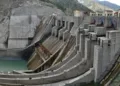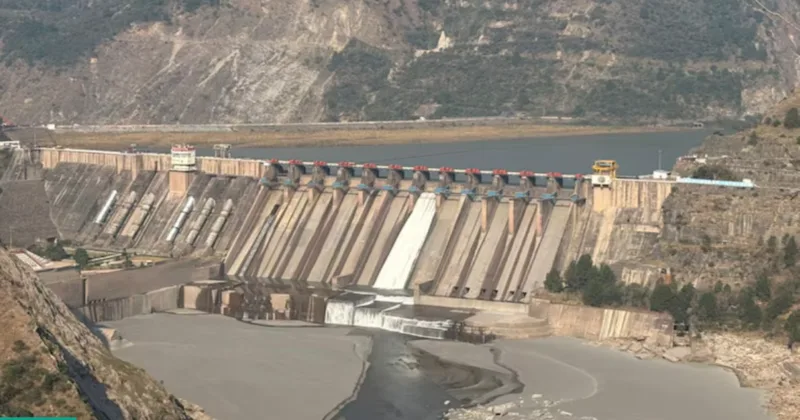
After the signing of the Indus Waters Treaty in September 1960, the first hydropower station that India built on the Chenab, one of the three Western Rivers, was the 690 MW Salal power station. It has six units of 115 MW each, but Pakistan’s objections to certain design elements forced us to compromise. The original design had six under sluice gates (gates located at the base of dam) and six silt excluder gates. The closure of under-sluice gates means that the appropriate sediment management facilities are not in place.
This amounted to a terrible setback, as over the next few decades the reservoir of the Salal dam choked with sediments carried by river currents. It is widely believed to have lost as much as 90 per cent of its holding capacity, thereby compromising its generation capacity during months of lean flow, usually from late October to mid-April. It is only around May 15 that the snow melts, increasing water levels and allowing power generation to reach peak levels.
Salal Sedimentation
With the IWT being put in abeyance on April 23 last year, the government has been taking proactive steps to revive the Salal reservoir through sediment removal, ensuring enhanced reservoir capacity during winters. This will, in turn, lead to improved power production in severe winters when the demand is at a peak and the Union Territory (UT) of Jammu & Kashmir is forced to import costly power from the Northern Grid.
For enhancing Salal’s operational efficiency, three key measures, dredging, flushing and revival of under sluicing gates, are being planned. The desilting of the dam reservoir has been given to Reach Dredging Limited of Kolkata, and the firm is expected to remove at least one lakh metric tonnes of silt. It started working on this project in the last week of November and has made some progress.
The company specialises in river engineering, land reclamation, and the operation of portable dredgers. It is the only dredger manufacturer in India and has completed over 500 projects, minor and major, since 2010, when it was set up. Simultaneously, Dharti Dredging and Infrastructure Limited, Mumbai, has also been drafted to take part in the Salal reservoir rejuvenation plans. The statutory clearances are in process, after which the work will commence in earnest.
Under Sluice Gates
Separately, a tender was floated on February 9 to make the permanently plugged under-sluices functional. “The last date for bid submission is March 23,” the official added. It is not yet clear how the deplugging of the under sluice gates will be effected.
Incidentally, the Salal reservoir’s original storage capacity of 284 million cubic meters (MCM) had drastically dropped to just 9.91 MCM. It has slightly improved and risen to 14 MCM by January 2026. However, efforts are now being made to reach the original storage capacity, and that means close to more than 30 times the 9.91 MCM capacity. This will severely impact the downstream Marala headworks located in Pakistan which are barely 50 km away from Salal.
In the coming months and years, the repercussions of India’s decision to put IWT in abeyance will unfold. Though Pakistan has time and again claimed that the stoppage of the downstream water of its share amounts to “an act of war’’, waging a war against India is not an easy option for it. As such, it looks like the cacophony of anti-India propaganda that Pakistan indulges in is going to rise sharply in the coming days.
The 22-kilometre-long reservoir created by the Salal dam on the Chenab River has faced high sediment inflows due to fragile geological formations, steep and unstable slopes, intense monsoon rains and frequent seismic activity in the region. This is mainly due to the fact that fast-flowing Himalayan rivers have high silt load, one of the highest in the entire world.
Taking this into consideration, Union Minister of Power and Housing and Urban Affairs Manohar Lal Khattar on January 4 directed the removal of sediment at the Salal project to ensure maximum utilisation of water resources, in the wake of the treaty between India and Pakistan being kept in abeyance. His visit and consultations with the officials have led to the hastening of several hydropower stations being planned and in different phases of execution.
Other Hydropower Projects
To hasten the construction of hydropower stations, concrete measures have been initiated for two of them in the last few days. One of them is the necessary clearances from the highest board of the NHPC for 240 MW Uri-II project in Kashmir and 260 MW Dul Hasti II projects, totalling 500 MW. The state-owned company’s board approved these projects, with construction targeted to commence in March 2026, within a week.
State-owned NHPC’s board gave the approval to investment proposals worth over Rs 5,700 crore for these projects, one located on the Chenab and the other on the Jhelum in the Union Territory of Jammu & Kashmir. In a regulatory filing, the company said its board had approved the implementation of the 240 MW Uri I, State II, at an estimated completion cost of Rs 2,708 crore. The necessary approvals were accorded on Friday (February 20).
The cost includes Rs 264.31 crore towards interest during construction (IDC) and a grant of Rs 26.20 crore for enabling infrastructure, considering a start date of March 1, 2026. The proposal is subject to the signing of an implementation agreement between NHPC and the Government of Jammu & Kashmir or JKSPDC, along with other requisite approvals, it said.
Hyperactive NHPC
The company’s board also approved the Dulhasti Stage-II HE Project (260 MW) at a completion cost of Rs 2,993.96 crore. This includes Rs 289.06 crore towards IDC and Rs 245 crore for enabling infrastructure, with construction to commence on March 1, 2026.
Of late, NHPC has been entering into bilateral agreements with the UT government to take it on board most of the projects. However, the UT government entities which participate in the process neither have the wherewithal in terms of capital or the necessary technical know-how and skills to execute these projects. This serves to shut up many local politicians who make unfounded allegations against the NHPC on a host of issues related to these projects.
It seems the Modi government is now going all out to execute various projects and is in no mood to offer any relief to Pakistan on IWT. It also indicates that during the 2029 Lok Sabha elections, putting IWT in abeyance will be one of the BJP’s main slogans.