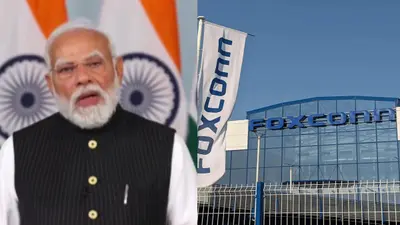
Greater Noida: Prime Minister Narendra Modi on Saturday (Feb 21) laid the foundation stone of a major semiconductor facility in Greater Noida, describing indigenous chip manufacturing as crucial for India’s technological self-reliance.
The project, set up through a joint venture between Indian and global technology firms, is expected to strengthen India’s semiconductor ecosystem and create thousands of jobs.
Addressing the event virtually, the Prime Minister said that self-reliance in semiconductor production is essential for building a technologically strong and economically resilient India.
Semiconductor unit to boost self-reliance
The semiconductor assembly and testing facility is being developed by a joint venture between HCL Group and Foxconn under the name India Chip Private Limited. The Outsourced Semiconductor Assembly and Test (OSAT) facility will be located within the Yamuna Expressway Industrial Development Authority region in Greater Noida and is expected to become operational by 2028.
Speaking at the launch, Modi highlighted the importance of domestic chip production in ensuring technological independence.
“Developed India will be built only when India is self-reliant. For this, Made in India chip is very important. Whatever India is doing in the field of technology in this decade will become the foundation of our capability in the 21st century,” he said.
The Prime Minister noted that the disruption of semiconductor supply chains during the Covid-19 pandemic demonstrated the risks of dependence on foreign manufacturing. He stressed that domestic production would protect India’s development from global disruptions.
Uttar Pradesh emerging as technology hub
Modi said the new facility would help transform Uttar Pradesh into an important centre in India’s semiconductor ecosystem and generate employment opportunities.
“We are proud that Uttar Pradesh is becoming a part of the semiconductor ecosystem in the country. This semiconductor unit will give new recognition to the state. Moreover, it will boost employment, as the establishment of a semiconductor facility attracts ancillary industries, which will ultimately generate more jobs,” he said.
The Prime Minister added that semiconductor manufacturing would play a vital role in the success of emerging technologies such as Digital India, electric vehicles, 5G networks and artificial intelligence.
Part of national semiconductor mission
The facility is among the projects approved under the India Semiconductor Mission, a national programme aimed at building a strong domestic semiconductor industry.
According to Modi, four semiconductor units out of ten approved projects under the mission are expected to begin production in the coming years.
He emphasised that domestic chip manufacturing would ensure uninterrupted progress across sectors by reducing dependence on imports.
“If India’s chips are made in India, we will not have to rely on others for the tech manufacturing needs. Digital India, semiconductor chips, EVs, 5G and AI are the soul of everyday needs. If we have chips of our own, our progress in every sector will remain unimpeded,” he said.
Investment and employment generation
The project will involve an investment of approximately ₹3,700 crore by the HCL Group over the next few years. The facility will manufacture display driver chips and is expected to generate more than 3,500 direct and indirect jobs.
Union Electronics and IT Minister Ashwini Vaishnaw said the plant would produce nearly 3.6 crore chips every month.
“In the last 11 years, the Prime Minister has established India as a powerhouse of electronics manufacturing. India is now ranked third among nations that export electronics. In a month, 3.6 crore chips will be produced from this plant. The brain of the digital screens that you see will now be made in Jewar,” he said.
The event was also attended by Uttar Pradesh Chief Minister Yogi Adityanath, HCL Chairperson Roshni Nadar Malhotra and Foxconn semiconductor business group president Bob Chen.
Roshni Nadar said the joint venture facility would cater to both domestic and global markets, while Bob Chen stated that Foxconn aims to establish a reliable semiconductor assembly and testing base in India and contribute to the country’s role in the global technology landscape.