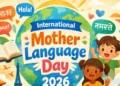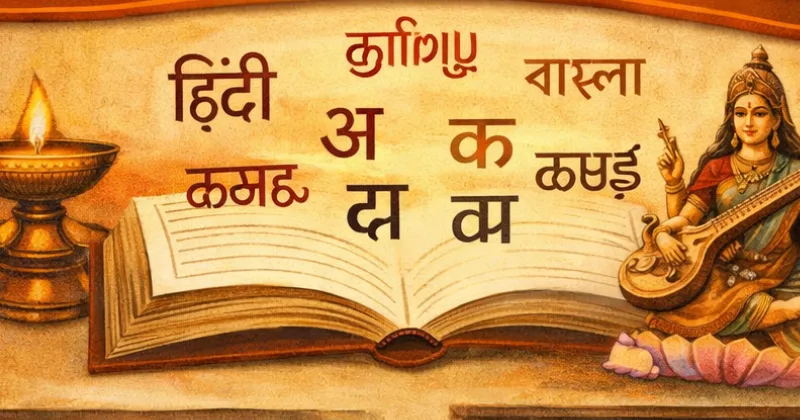
This year the International Mother Language Day is celebrating its 25th anniversary. In 1999, the UN declared February 21 as the International Mother Language Day. Since 2001, the world has been celebrating International Mother Language Day under the auspices of UNESCO, focusing on the challenges and solutions facing mother languages. Many national languages have become extinct as a result of the widespread invasions that have taken place around the world in the last millennium. The most recent example of this was the attempts by Pakistan, which was formed on the basis of religion from Bharat, to impose the official language of West Pakistan on East Pakistan, where Bengali is spoken. The United Nations called for February 21 to be observed as International Mother Language Day to commemorate the inspiring struggle and sacrifice made by students of Dhaka University in present-day Bangladesh for the freedom of their language. This encourages today’s society to strive to recognize language as the basis of a people’s existence, to develop an attitude of respect, and to devise plans to preserve and promote it.
Bharat, as the country with the most linguistic diversity, has a long history and tradition of co-existence and mutual respect. There are 22 official languages in our constitution and many more small and big languages in daily discourse. It is also true that many of them are facing a threat to their existence. Even though there are 22 official languages, they remain the languages of the society, sidelined by policy approaches that isolate them from education, governance, administration, judiciary, legislation, the economic sector, and the employment sector for a long time. In the last 10 years, we can see revolutionary changes in this field. It is noteworthy that the area of use of artificial intelligence(AI) and technology that was most showcased at the India AI Impact Summit being held in Delhi was language. The basic reason why entrepreneurs are coming forward to protect and activate languages using modern technology is the encouragement provided by the government and an example of the society recognizing the power of languages and the future demand of the market.
Adopting The National Education Policy 2020, the government and related institutions are giving great importance to the timely implementation of programs to ensure that Bharatiya languages are getting their due place even in higher education. The multilingual tool called Anuvadani, developed by AICTE itself, has started being widely used not only in the field of education but also in the field of judiciary. The fact that textbooks in the field of engineering education are being translated into our prominent languages and that educational institutions of national importance like NITs and IITs, which get admissions of the most talented students, have come forward to implement it, is giving confidence and new impetus to the community that receives school education in Bharatiya languages. This has gradually led to the elimination of the general sense of inferiority complex that existed in our society. Along with this, effective work is being done to integrate technology with Bharatiya languages and other languages in order to overcome language barriers and linguistic discrimination.
A massive project has been launched under the auspices of the Bharatiya Bhasha Samiti, which has been launched under the Education Ministry, to prepare three lakh books in Bharatiya languages that will be helpful for higher education in the next three years. This will not be just a translation of existing textbooks. Rather, it will be books that meet international standards, produced from a Bharatiya perspective by integrating Bharatiya knowledge traditions and practices. That too, in a way that suits our present realities and environment. This project approaches our languages as a storehouse of knowledge, beyond just a medium of communication. And also as the most dynamic force for realizing the development dreams of future Bharat- Vikasit Bharat. Perhaps this will be the first extensive and revolutionary work in the world since Israel’s efforts in the middle of the last century to protect, nurture and keep their language, Hibru, as the basis of the development process.
While celebrating linguistic diversity, Bharat has a stance that accepts the interdependence of languages and the uniqueness as well as Unifying thread of languages. Therefore, the new programs will strengthen the eternal and inherent unity among languages while maintaining the uniqueness of each language. The reason for many regionalist and divisive disturbances that have hindered our nation’s progress was the so-called language family theory imposed by the European imperialistic powers. Our new language policy, while recognizing and encouraging the study of all languages, big or small, also puts forward the goal of gaining pride and proficiency in one’s own language.
The central government has been following a policy and approach that recognizes the diversity of languages not only in the field of education but also in the field of administration and governess for the past few years. All states may get correspondence in their own official languages from the Union Home Ministry. The NCERT has prepared a new curriculum by converting the very rigid three-language formula that existed at the school level into a very flexible three-language scheme. According to this, only Mother language is compulsory for a child to study. The remaining two languages can be chosen according to the child’s wishes and circumstances. While choosing, there is only one condition that the other two languages should not be foreign in origin. It is also noteworthy that in the field of higher education, especially in universities in Uttar Bharat, courses have been formulated for studying other Bharatiya languages. It is also considering how to conduct the selection process with the help of artificial intelligence in competitive as well as entrance examinations. It is hoped that this will end all linguistic divisions and discrimination in such fields.
In this context, where comprehensive planning is being carried out with the aim of a vikasit Bharat, if the importance given to Mother languages is to give full results at the practical level, it is necessary to break the many misconceptions and superstitions related to language that exist today. For this, massive public awareness programmes should be there. Governments, educational institutions, and organizations working in the field of language will have to work together. We should recognize the umbilical connection that exists between development and languages. The fact that all education and administrative activities in the developed countries of the world are in their major languages. This should also be the basis of our language planning also. The efficient functioning of the states that have come into existence on the basis of language and the coordination of the Central Government can make this more effective.
It is surprising that the most setback of indigenous languages is taking place in states where there is political hostility towards other languages, especially Hindi. In Tamil Nadu, which rejects Hindi, the trend of students switching from Tamil medium to English medium in the last 10 years is alarming. This trend is also prevalent in Kerala and Karnataka.
The main message of this year’s International Mother Language Day is the voice of youth for multilingual education. There is no doubt that this message will empower Bharatiya youth to create new models in front of the world by integrating modern knowledge and technology, while strengthening their own language and culture, as a solution to the development crisis and existential crisis facing the whole world today.