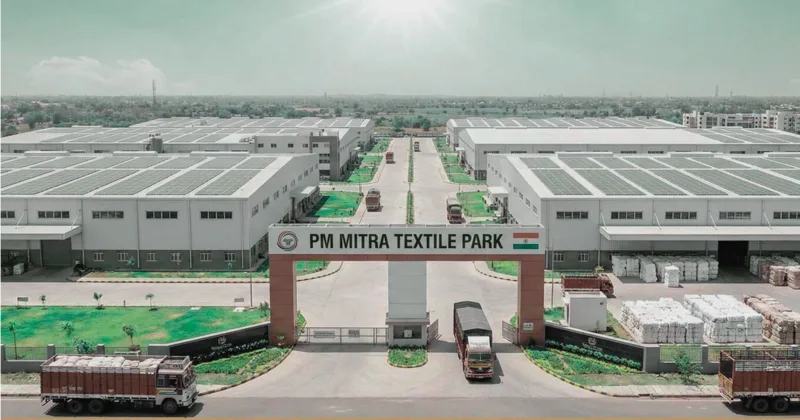
The Pradhan Mantri Mega Integrated Textile Region and Apparel(PM MITRA) Parks scheme represents a transformative shift in India’s textile sector, which is deeply embedded in its civilisational legacy and economic framework. The initiative stands as a advancement point in fortifying India’s industrial infrastructure, bolstering its international market stance and fostering expansive job creation. On the condition that it creates integrated textile parks in key states, this scheme sets the groundwork for a high-tech and efficient textile sector that is globally competitive and in line with India’s plan to become a manufacturing powerhouse.
National initiative with strategic scale
Seven PM MITRA Parks have been finalized by the Government of India in Tamil Nadu (Virudhunagar), Telangana (Warangal), Gujarat (Navsari), Karnataka (Kalaburagi), Madhya Pradesh (Dhar), Uttar Pradesh (Lucknow) and Maharashtra (Amravati). The development of these parks is allotted a total government budget of ₹4,445 crore over seven years up to 2027-28.
Something Big Just Happened in Indian Textiles
India’s first operational PM MITRA Park in Warangal, Telangana continues to advance at speed — with commercial production now underway. pic.twitter.com/6Hkwv1ViOn
— PM MITRA (@PMMITRAofficial) February 12, 2026
The scheme is a coordinated national level effort to boost textile manufacturing infrastructure with integrated industrial ecosystems. The geographic locations in different areas of the country are selected to ensure the industrial development is balanced among the various regions in the country and this will help the states with the most textile potential to develop as major hubs for manufacturing.
The parks have been set up to attract private investments, with each park attracting an investment of about ₹10,000 crores. It shows the confidence on India’s textile sector and the potential the sector enjoys to be a key player in the global manufacturing supply chains.
Integrated textile ecosystems: A structural transformation
The PM MITRA scheme represents a distinctive move in textile manufacturing that involves establishing integrated manufacturing ecosystems to allow co-locate different or similar industries within one industrial cluster. The PM MITRA scheme introduces a distinctly different textile manufacturing approach through the development of integrated ecosystems where various production stages are conducted within a single industrial cluster.
The process of textile manufacture involves many stages ranging from fibre manufacture, spinning, weaving, processing, garment manufacture to distribution. Different regions have hosted these stages, leading to more transportation costs, longer production times and fewer efficiencies.
By establishing integrated parks, PM MITRA Textile Parks integrate all aspects of textile manufacturing under a common infrastructure framework. This strengthens the entire value chain while ensuring the manufacturers operate in a coordinated environment. This integrated approach performs to enhance productivity, reduce operational costs and improve India’s competitiveness in textile markets globally.
Employment generation and economic impact
The most promising thing that comes out of the PM MITRA scheme is employment generation. Employment Generation is One of the greatest PM MITRA scheme Resultants. The scheme is expected to generate employment to approximately three lakh people per park, including one lakh direct jobs and two lakh indirect jobs.
These employment opportunities will materialize in different sectors, such as textile manufacturing, logistics, infrastructure services, maintenance and ancillary industries. This scheme will work well with the skilled workers as well as semi-skilled workers.
The employment generation potential of the scheme is crucial for rural and semi-urban areas, whereby industrial development can bring new economic opportunities and improved livelihoods. The employment generation potential of the scheme is important to rural/semiurban regions for industrial development.
PM MITRA parks will be developed to bring manufacturing ecosystems at scale and create large-scale employment. PM MITRA stands for Performance, Mission, Incentives, Technology, Revolution and Acceleration. Their central role in developing and manufacturing batteries and electronic vehicles offers the prospect to boost exports.
Infrastructure development and implementation progress
The implementation of PM MITRA parks is unfolding through a coordinated effort between the central government and its states. There has been infrastructure development in many park sites and the scheme implementation progress is steady.
Infrastructural works of 2160.17 crore worth have been initiated by state governments to provide the external infrastructural connectivity to the parks like roads, utilities and essential services. This includes ₹564.72 crore which has been spent already on the ground.
Detailed Project Reports (DPRs) worth ₹7,145 crore have been approved for PM MITRA parks in Madhya Pradesh, Tamil Nadu, Maharashtra and Telangana. They cover the infrastructure, industrial layout and operational modalities of the parks. The approval of the DPR is essential to the actualization of policy vision into industrial infrastructure.
State-level progress and investment activity
Considerable advances have been noted in several states in which PM MITRA parks are. Progress has been made in various states where PM MITRA parks are being developed, this includes Madhya Pradesh where 1150 acres of land have been allotted for the PM MITRA park in Dhar.
This park has already attracted proposed investments totalling ₹24,175 crores, indicating significant investor interest in the project. In Tamil Nadu, the applications have been received for 201 acres of land, with investments proposed to be worth ₹2,076 crore. These applications are from investors and textile manufacturers seeking to establish their operations within the integrated textile ecosystem.
In Telangana, investments worth ₹3,862 crore have been grounded already and 540 acres of land have been allotted for industrial development. Such investments show a high pace of physical development of manufacturing infrastructure inside the park.
Inviting applications for land allotment has started the process of industrial development and investors’ participation in Maharashtra. These developments further prove the magnitude of the momentum created by the scheme and states readiness to take part in creating integrated textile manufacturing ecosystems.
Government support and financial assistance
The Government of India is providing development capital support to ensure effective implementation of the PM MITRA parks. As per the support framework, the first installment of financial support has already been sanctioned to several states. Madhya Pradesh and Tamil Nadu have received ₹50 crore each and Maharashtra and Telangana have received ₹30 crore each as part of development capital support.
This financial support is used for infrastructure development and project planning and readiness of the parks. The development capital support ensures that infrastructure development takes place smoothly and that industrial ecosystems are developed efficiently.
Land acquisition and infrastructure readiness
Land acquisition and approvals are the prerequisites for industrial development. Substantial progress has been made in this regard for several PM MITRA parks. In the Virudhunagar PM MITRA Park in the state of Tamil Nadu, the acquisition of 100 percent land has been achieved. All necessary approvals, including environmental clearance, have been obtained and making the site ready for development.
A Detailed Project Report of ₹1,894 crore has been approved for this park and infrastructure development to the tune of ₹364 crore has already been allocated. Such advancements indicate significant progress in the creation of industrial infrastructure.
After the approval of the land allotment policy, applications for 201 acres of land with proposed investments of ₹2,076 crore have been received, which indicates significant interest from investors. Such advancements indicate that the PM MITRA parks are ready to facilitate industrial activity.
Stakeholder consultations and implementation
The development of PM MITRA parks has been facilitated through extensive stakeholder consultations to ensure smooth implementation. Over 200 stakeholder consultations have been held with different stakeholders, including state governments, investors and potential park developers at the international, national and local levels.
These consultations have aided in aligning the scheme with industry requirements and investor expectations. The joint mechanism will ensure that the PM MITRA parks are developed in a manner that caters to the requirements of textile manufacturers and promotes sustainable industrial development.
Enhancing regional industrial development
The PM MITRA parks are being established in various states, ensuring balanced industrial development in various regions of India. States such as Uttar Pradesh, Madhya Pradesh, Telangana, Tamil Nadu, Maharashtra, Gujarat and Karnataka will benefit from the development of these textile manufacturing hubs.
The development of these textile manufacturing hubs will enhance industrial infrastructure development, investment and employment opportunities in regions that possess robust textile manufacturing capabilities. This regional development of industrial infrastructure will promote balanced economic development and eliminate regional disparities.
Enhancing India’s textile manufacturing capacity
The PM MITRA initiative is a significant milestone in the development of the textile manufacturing sector in India. The initiative helps to create integrated industrial ecosystems that improve efficiency and lower costs of production.
The provision of world-class infrastructure, manufacturing and industrial ecosystems enables manufacturers to produce efficiently and increase production. This is a significant factor that helps India to compete in the global textile industry.
The PM MITRA parks are a transformational initiative that helps to develop the textile manufacturing sector in India by creating integrated industrial ecosystems. With the help of the government, development of infrastructure and significant participation from investors, the initiative is setting the stage for the development of textile manufacturing ecosystems.
The development of integrated textile parks in seven states is a move that is part of a larger strategy to develop the country’s manufacturing sector. As development of infrastructure continues and investment continues to flow into the initiative, PM MITRA parks will be at the forefront of the development of the textile sector in India and the country’s rise as a manufacturing leader.