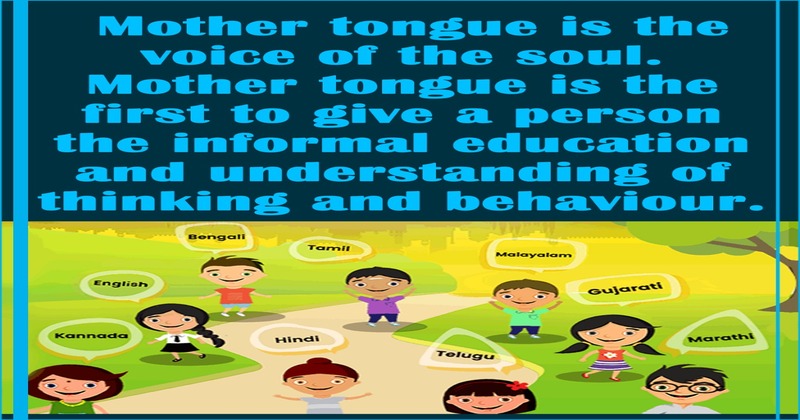
International Mother Language Day is celebrated on February 21 to promote awareness of the linguistic and cultural uniqueness of different people. First announced by UNESCO on November 17, 1999, it was formally recognised by the United Nations General Assembly with the adoption of UN resolution 56/262 in 2002. Mother Language Day is part of a broader initiative “to promote the preservation and protection of all languages used by peoples of the world” as adopted by the UN General Assembly on May 16, 2007 in UN resolution 61/266, which also established 2008 as the International Year of Languages.
The idea to celebrate International Mother Language Day was the initiative of Bangladesh a country which came in to existence with brave operation of Indian Army against Pakistan’s atrocities against Bangla speaking people of east Pakistan. This day is very significant for Bharat due to many reasons. When Pakistan was created in 1947, it had two geographically separate parts: East Pakistan (currently known as Bangladesh) and West Pakistan (currently known as Pakistan). The two parts were very different to each other in sense of culture, language, etc.
In 1948, the then Government of Pakistan declared Urdu to be the sole national language of Pakistan including for the people of east Pakistan who were native speakers of Bangla. The East Pakistan people protested, since Bangla was the mother tongue of majority of the population from East Pakistan. The residents there demanded Bangla to be at least one of the national languages, in addition to Urdu. The demand was raised first by Dhirendranath Datta from East Pakistan on February 23, 1948, in the constituent Assembly of Pakistan. But Pakistan government was stubborn about imposing Urdu.This turned in to continuous battle , general public, arranged massive rallies and meetings became a regular phenomenon. On 21 February 1952, police opened fire on rallies organised by the students of the University of Dhaka.In this open fire incident, many people died and got injured. This is a rare incident in history, where people sacrificed their lives for their mother tongue.
The resolution was suggested by two Bangladeshis Rafiqul Islam and Abdus Salam, living in Vancouver, Canada. They wrote a letter to Kofi Annan on January 9, 1998 asking him to take a step for saving the world’s languages from extinction by declaring an International Mother Language Day. They proposed the date as February 21 to commemorate the 1952 killings in Dhaka during the Language Movement.”21st February – The International Mother Language Day. On November 17, 1999 the 30th General Assembly of UNESCO unanimously resolved that “21st February be proclaimed International Mother Language Day throughout the world.
This day is a glorious chapter in history of Bharat and it’s army who assisted to the cause by fighting a decisive war against Pakistan and preserved the Bangla language identity from extinction by theocratic Islamic state of Pakistan.
Key Points
Students studying through Bharatiya languages do more scientific research than those who get engineering education in English medium
– Bharatiya scientist CV Srinath Shastri
The study of English activates only one part of the brain while the study of Hindi activates both parts of the brain
– Dr. Nandini Singh, National Brain Research Center, Bharat
If there is a complete script in the world, then it is Devanagari
– Sir Isaac Pitman
Hindi is taught in some form or the other in about 170 countries of the world nowadays. Sanskrit is being taught in universities in more than 32 countries of the world. It is compulsory to study Sanskrit for 6 years in St James’s School in England.
“I could become a good scientist because I studied Mathematics and Science in mother tongue (Dharampeth College Nagpur)”.
– Dr. APJ Abdul Kalam
I have been using English for 60 years, but English can never facilitate the level of spontaneity that we get speaking in Hindi.
– Pandit Madan Mohan Malviya
“If science is to be made publically accessible, then science should be taught through mother tongue.”
-World-famous poet and Nobel laureate Ravindra Nath Thakur
“The foreign medium of instruction has put an extra load on the nerves of the our children, made them rattles, they are not fit for creativity …. The foreign language has hindered the development of native languages. ”
– Mahatma Gandhi
Among the top 20 countries of the world GDP, all of them are doing all their work in their own language, in which four countries are English speaking, because their mother tongue is English. He further writes that among the 20 most backward countries in the GDP of the world, higher education is being given in foreign language or in its own and foreign language both and the work of governance and administration are done in the same way..
– Retired Senior Scientist from Microsoft, Sankrat Sanu
World renowned atomic scientist and Vice Chancellor of Hiroshima University, Japan, do not know English.
– Former director of NEPA, Pradeep Joshi
Most of India’s renowned scientists have received their education in their mother tongue. Among which mainly Jagdish Chandra Basu, Srinivasa Ramanujan, Dr. Abdul Kalam etc. are the prominent names
Detailed discussion
‘Language in the country in the present perspective’ has become a subject of widespread discussion – on the one hand the importance of mother tongue in the country seems to be decreasing. About 150 studies in the last 40 years in the world have concluded that education should be imparted in the mother tongue, because the child receives the mother tongue rites from the mother’s womb. According to the experience of Indian scientist CV Srinath Shastri, students studying through Bharatiya languages do more scientific research than those who get engineering education in English medium. According to research findings of Dr. Nandini Singh, National Brain Research Center, the study of English activates only one part of the brain while the study of Hindi activates both parts of the brain. Sir Isaac Pitman has said that if there is a complete script in the world, then it is Devanagari. Study, research, books etc. through foreign language is also against modernism, because modern knowledge can be reached to all sections of society in its own language.
Hindi is taught in some form or another in about 170 countries of the world nowadays. Sanskrit is being taught in universities in more than 32 countries of the world. It is compulsory to study Sanskrit for 6 years in St James’s School in England. Earlier, even in Bharat, wherever Hindi was opposed (due to political reasons) or where the use of Hindi was considered less as in Tamil Nadu, Mizoram, Nagaland etc, Hindi speaking classes have been started in large quantities to teach and speak Hindi in these states too.
Arunachal Pradesh’s official languages is Hindi and Nagaland has recognised Hindi as the second official language. A large number of people are participating in Hindi examinations conducted by Dakshin Hindi Prachar Sabha, Madras and Rashtrabhasha Prachar Samiti, Wardha etc.
It is easier to learn, understand and acquire knowledge in Mother tongue. On the basis of his own experience, former President Dr. Abdul Kalam has said “I became a good scientist because I studied mathematics and science in mother tongue (Dharampeth College Nagpur)”.
Similarly, the world-famous poet RabindraNath Thakur has said: “If science is to be made public accessible, then science should be taught through mother tongue.”
Mahatma Gandhi stated: “The foreign medium of instruction has put an extra load on the nerves of our children, made them rattles, they are not fit for creativity …. The foreign language has hindered the development of native languages. ”
Sixteen Israeli scholars have received the Nobel Prize. All have worked in their mother tongue Hebrew.
Most of Bharat’s renowned scientists have received their education in their mother tongue. Some of them are Jagdish Chandra Basu, Srinivasa Ramanujan, Dr. Abdul Kalam etc. Mahatma Gandhi has rightly said: “Mother tongue is as important for the mental development of children as mother’s milk for physical development”.
It seems fair to say that English has become a language of exploitation. Due to the excessive use of English everywhere at the level of medical, engineering justice and governance, about 95 percent of the people of India do not understand the real content of it.
Language is the carrier of character, culture, and civilisations. The French had a place in Britain till 1362 in the same way as English is having presently in India. Merely, 100 years ago, the Swedish language used to be in dominant language in Finland, the French language dominated the Tsar era in Russia. Now all the work is being done in their own languages, due to the strong will power of the people and rulers of all these countries. There is a need to awaken this kind of will among the people of our country. It has to be started by ourselves. For this, sign in your language at all the places. Write or speak in any language, but use the word ‘Bharat’, not India. Use your language only in work and practice. Educate your children in the mother tongue medium school. Write name plates and plaques in home, office, shop in your language. Write or print your personal letter, application form, invitation letter etc. in mother tongue language.
Wherever the language laws are being violated or the Bharatiya languages are being insulted at the government level, efforts will have to be made to stop them and legal battles will also have to be fought. In the Parliament of the country, there should be a comprehensive discussion on the question of language, for this, efforts will have to be made by bringing political parties or MPs on one platform who are loyal to Bharatiya languages. Along with making Hindi and Bharatiya languages a medium of education, it will also have to be linked with employment. Work of the Supreme Court and High Court should be done in Hindi, the official language of the state and the official language of the Union, in order to ensure this objective, a forum for language-loving lawyers should be made.
It is welcome step by the present govt of Bharat which has come up with new education policy 2020, which duly recognises the importance of education in mother tongue and sketch the future road map to execute it in forthcoming years.