At the AI Summit in India, the spotlight shifted from global technological discourse to a powerful idea rooted in India’s civilizational legacy: large language models (LLMs) were built from India’s own ancient manuscripts. During a thought-provoking conversation between Dhairya Maheshwari of Sputnik India and R. Ramakrishnan, founder of BharatiyaGPT, a unique vision for India’s technological future emerged. In today’s world, most large language models are trained mainly on Western data. Indian innovators asked a powerful question: what if the future of AI could also learn from India’s centuries-old knowledge in fields like science, medicine, mathematics, philosophy, and life sciences?
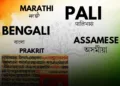
This philosophy gave rise to a pioneering initiative i.e., an India-centric LLM ecosystem, built from the ground up on the treasures of Indian wisdom preserved in over one crore (10 million+) ancient manuscripts that are written across forty-plus distinct scripts and spanning multiple domains. The journey is not just technological, but cultural, scientific, and historical.
🚨This is what everyone should talk about AI India Summit not one off incident of Galgotia
Bharat has successfully made LLMs scanning Lacs of Ancient Manuscripts ❗️
•Ancient Medicine & Surgery
•Ancient Mathematics
•Ancient Sciences
•Ancient Ayurveda pic.twitter.com/JUnrOXuAal— RapperPandit (@RapperPandit) February 18, 2026
While developing “Immverse AI,” the team realised that merely adapting western datasets would never capture India’s intellectual heritage. The solution? Create Bharatiya LLMs i.e., language models trained explicitly on Indian manuscript literature across disciplines. This initiative will make knowledge easily available to everyone. Knowledge that was earlier limited to libraries, archives, or a few scholars.
Introducing the Bharatiya GPT Family
At the summit, the launch of Bharatiya GPT marked a new chapter in AI innovation. Unlike generic AI models, this variant is deeply rooted in indigenous sources. It is paired with a bouquet of smaller, domain-focused Large Language Models (SLMs) each tailored for a specific field of ancient Indian expertise. A few of the highlights:
Ayurveda, one of the world’s oldest medical systems, finds new expression through Lok Swasti GPT. Built from six principal Sanskrit manuscripts: Ashtanga Hridayam, Sushrut Samhita, Charaka Samhita and others, this model offers detailed insights into ancient medicine and surgery, health maintenance, and wellness systems that have endured for millennia.
Built on foundational text such as Aryabhatiya, Lilavati, and Bija Ganitam, Ganit GPT revives classical Indian mathematics. Concepts from algebra, trigonometry, number theory, and computational insights from ancient scholars like Aryabhata and Bhaskara are now accessible with modern clarity.
Leveraging Kautilya’s Arthashastra, one of the most advanced treatises on economics, statecraft, governance, and strategic management, this model brings ancient political and economic theory into conversation with present-day challenges.
A philosophical guidebook that influences spirituality and life management, Bhagavad Gita GPT allows users to explore the text’s verses, context, and layered meanings interactively. It combines spiritual depth with analytical clarity.
Other Important Tools
Other remarkable models include exploration tools based on Gandha Shastra, i.e., ancient Indian perfumery and aromatic science, dating back to the Rigveda, and specialised insights drawn from the Ramayana and the Mahabharata. These models not only return accurate verses (shlokas) in response to queries but also help interpret them with contextual explanations grounded in the original manuscripts.
What makes these models transformative is not merely text retrieval. Ask a question, and you don’t just get a paraphrased answer; you receive the original shlok, its underlying meaning, explanation, and conceptual linkage within the scripture. This is AI that respects context, respects tradition, and respects knowledge as science rather than mythology.
Importantly, this initiative highlights that India’s ancient texts were not merely religious or devotional writings, but scientific documents that are highly systematic, empirical, and closely linked to real-world sciences. Using AI, these texts are being decoded for learners, researchers, educators, and curious minds across the world, not just within India.
At the AI Summit, the message was clear: this is not just innovation for India, it is innovation for the world. By infusing AI with Indian scholarly heritage, these models are democratising knowledge that might otherwise remain locked in libraries, understood only by specialists, or lost in translation over centuries. Young generations who grew up learning about Ayurveda, mathematics, governance, and philosophy in fragments will now be able to interact with a living repository of ancestral intelligence with AI as the bridge.