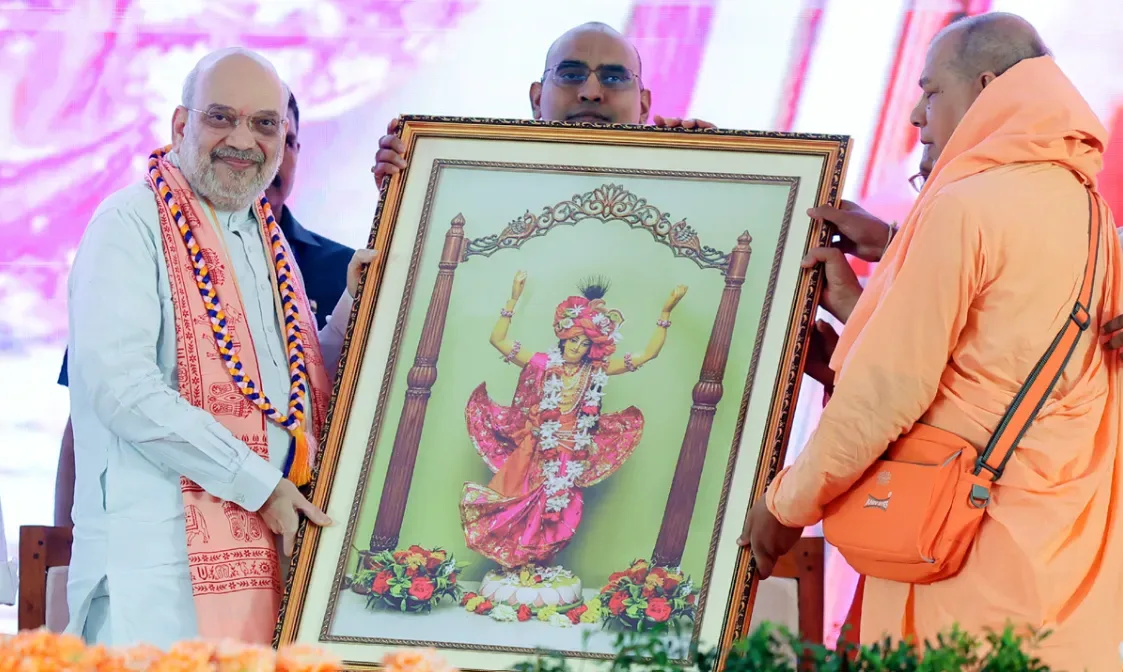
Nadia (West Bengal): Union Home Minister Amit Shah on Feb 18, visited the headquarters of the International Society for Krishna Consciousness (ISKCON) in Mayapur, Nadia district, praising the organisation’s global role in spreading the message of Sanatana Dharma.
Addressing devotees and community members, Shah credited the spiritual legacy of ISKCON’s founders for transforming the movement into a worldwide force rooted in the teachings of the Bhagavad Gita.
“ISKCON Spreading Sanatana Dharma Across the World”
During his address, Shah said the worldwide expansion of ISKCON was the result of the karma and vision of A.C. Bhaktivedanta Swami Prabhupada and his spiritual inspiration, Bhaktisiddhanta Sarasvati Thakura.
“Today, as we witness the grand ISKCON movement spreading across the world, it is the karma of the lives of Bhaktivedanta Prabhupada and his inspiration, Bhaktisiddhanta Prabhupada, that ISKCON is spreading the message of Sanatana Dharma throughout the world,” Shah said.
He emphasised that ISKCON has played a significant role in inspiring people globally to follow the path of the Gita, describing the movement as a spiritual bridge connecting India’s ancient philosophy with contemporary society.
Gita Diplomacy Highlighted
Shah also lauded the Matua community for its consistent commitment to social welfare and grassroots reform.
Highlighting what he termed “Gita diplomacy,” Shah noted that Prime Minister Narendra Modi often presents a copy of the Bhagavad Gita to visiting heads of state and foreign ministers.
“ISKCON has inspired everyone to follow the path of the Gita and has sustained the Gita movement. Therefore, our Prime Minister Narendra Modi also gifts a Geeta to Heads of States or Ministers of another country, when they visit India,” he said.
From Mayapur to Gandhinagar
A day prior to his West Bengal visit, Shah unveiled a 21-foot equestrian statue of Chhatrapati Shivaji Maharaj in Gandhinagar, Gujarat, constructed by Maharashtra Samaj Gandhinagar.
Calling it a moment of pride, Shah said the statue would inspire youth with Shivaji Maharaj’s courage and leadership in establishing Hindu Swaraj during a period of political subjugation.
“When the darkness of slavery loomed large… 16-year-old Shivaji showed a new path,” Shah said, recalling the Maratha ruler’s defiance against dominant imperial powers of his time.
He further stated that Shivaji Maharaj’s commitment to protecting temples and cultural identity continues to resonate in contemporary India.
Historical Vows to Contemporary Developments
Shah drew parallels between Shivaji Maharaj’s vow to rebuild temples destroyed by invaders and recent developments such as the consecration of the Ram Temple in Ayodhya, the redevelopment of the Kashi Vishwanath Corridor, and restoration efforts at the Somnath Temple.
“At that time, he gave the message that if destructive forces destroy temples, we will build new ones,” Shah said, adding that such historical resolve remains a source of inspiration.
He also highlighted Shivaji Maharaj’s establishment of a naval force and his guiding motto, describing him as a visionary who combined spiritual commitment with strategic statecraft.