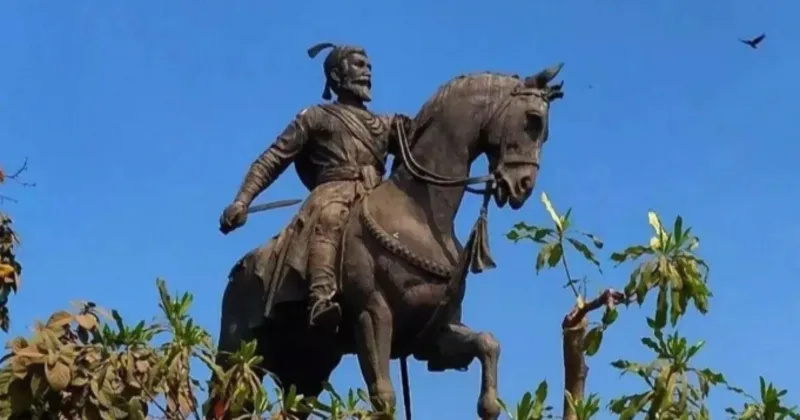
History is not merely a compendium of chronological events; it is the resonant echo of the footsteps of those titans who, through the sheer force of their will, diverted the very currents of time. On the horizon of Indian history, Chhatrapati Shivaji Maharaj shines as a perennial sun whose brilliance remains undimmed by the passing centuries. He was not merely the architect of an empire, but a ‘Nation-Sculptor’ who breathed life into a moribund society. His persona is an inspiration, his legacy a marvel, and his leadership an exhaustive academy of wisdom.
The Persona – Gold Tempered in the Forge of Virtues
“Chhatrapati Shivaji Maharaj was born on February 19, 1630, at the hill fortress of Shivneri near Pune. His father, Shahaji Bhonsle, was a formidable Maratha general, and his mother, Jijabai, was a courageous and pious lady from the Jadhav lineage.”
The persona of Shivaji Maharaj was not an accidental occurrence but the profound result of meticulously cultivated values. In an era where subjugation was accepted as destiny, a child opened his eyes upon the heights of Shivneri. Queen-Mother Jijabai did not merely rock his cradle with lullabies, but infused his soul with the spirited epics of the Ramayana and the Mahabharata.
Dimensions of His Persona
Fortitude and Equanimity: Maharaj’s character stood as resolute as the Himalayas amidst the most tempestuous adversities. Whether in the incarceration at Agra or the mortal peril of the Afzal Khan encounter, he never surrendered his composure.
Ethical Purity
In an age where the women of the vanquished were treated as spoils of war, Maharaj accorded the daughter-in-law of the Governor of Kalyan the reverence due to a mother. He established an ethical benchmark that remains a distant dream for modern global leadership.
Spiritual Pluralism
Though a devout Hindu, his persona was devoid of bigotry. His Royal Seal (Rajmudra) was dedicated to the welfare of the populace, not the suppression of any particular faith.
The Legacy – A Herculean Odyssey from Nought to Zenith
“At the tender age of 16, Shivaji Maharaj commenced his campaign to conquer fortresses. In 1646, by capturing the Torna Fort (Prachandgad), he sounded the clarion call of ‘Swarajya’ (Self-Rule). This was followed by victories at Rajgad, Kondhana, Purandar, and Jawali.”
The legacy of Shivaji Maharaj is the sublime art of transmuting the ‘impossible’ into the ‘attainable’. Deprived of a paternal throne, he raised an empire solely through the allegiance of the Mavals (local mountain folk).
Pillars of His Legacy
Ganimi Kava (Guerrilla Warfare)
This was not merely a military tactic but a martial philosophy. He transformed the treacherous Sahyadri ranges into his strategic allies. He demonstrated that war is won not by numerical superiority alone, but by the astute synthesis of intellect and topography.
Creation of the Indian Navy
Maharaj was a visionary. He perceived that foreign powers arriving by sea (British, Portuguese) would act as a malignancy on Indian sovereignty. He raised a navy from nothing and fortified the Indian coastline with impregnable maritime bastions like Sindhudurg.
Ashtapradhan and Sublime Governance
He did not just conquer stones; he conquered systems. Through the Ashtapradhan (Council of Eight Ministers), he decentralised executive power. To eradicate corruption, he abolished the Jagirdari system and ensured revenue flowed directly to the state treasury.
Leadership – The Mastery of Transmuting Crisis into Opportunity
“Under the Treaty of Purandar (1665), he was compelled to cede 23 forts to the Mughals and accept a journey to Agra. From Aurangzeb’s confinement, he escaped through sheer cunning and courage, concealed within baskets of fruit.”
The true crucible of leadership is the hour of darkness. The escape from Agra remains the pinnacle of ‘Crisis Management’. When the adversary believed the ‘Mountain Rat’ was caged, Maharaj’s diplomacy left the Mughal hegemony bewildered.
Attributes of His Leadership
Leadership by Example: He scaled the walls of fortresses himself. He did not lead as a distant commander but as a fellow warrior.
Farsightedness: The conquest of the Gingee Fort was a testament to his prescience. He knew that should a catastrophe befall Maharashtra, this southern bastion would serve as the sanctuary for Swarajya.
Infusing Self-Confidence: He convinced an oppressed society that they were worthy of being sovereigns.
Contemporary Relevance – Paradigms for the Modern Age
In an era where global leadership grapples with ethical bankruptcy, the policies of Shivaji Maharaj serve as a lighthouse.
Defence Policy: His ‘Indigenous Defense System’ is the foundational mantra for modern ‘Self-Reliant India’ (Atmanirbhar Bharat). The inclusion of his Royal Seal in the new Indian Naval ensign is a formal acknowledgement of his timeless relevance.
Management: Business academies worldwide study his ‘Logistics’ and ‘Resource Management’. Achieving maximum productivity with limited resources is his enduring contribution.
Ecological and Water Conservation: Today’s water crisis reminds us of his mandates, including his mandate that water harvesting on forts be mandatory. He regarded trees as his own progeny and strictly prohibited their felling.
The True Meaning of Secularism: Maharaj demonstrated how to take pride in one’s own culture while simultaneously respecting others’ worship.
Epilogue
The Immortal Resonances of Swarajya: “On April 3, 1680, at Raigad Fort, this great soul departed. Even after his passing, the lamp of Swarajya lit by him continued to inspire Indians for centuries.”
The life of Chhatrapati Shivaji Maharaj is a poem that never concludes. He is an ‘Idea’ that pulsates in every heart where there is rebellion against injustice and profound love for the motherland. The words of his Royal Seal—”Vishwabandita” (Adored by the World)—have attained fruition, for today, not just India, but the entire world bows to his principles of leadership.
As long as humanity survives, as long as valour is venerated, the name of ‘Chhatrapati Shivaji Maharaj’ shall remain inscribed not just in the annals of history, but in the consciousness of mankind in letters of shimmering gold.
”Victory to Goddess Bhavani! Victory to Shivaji!”