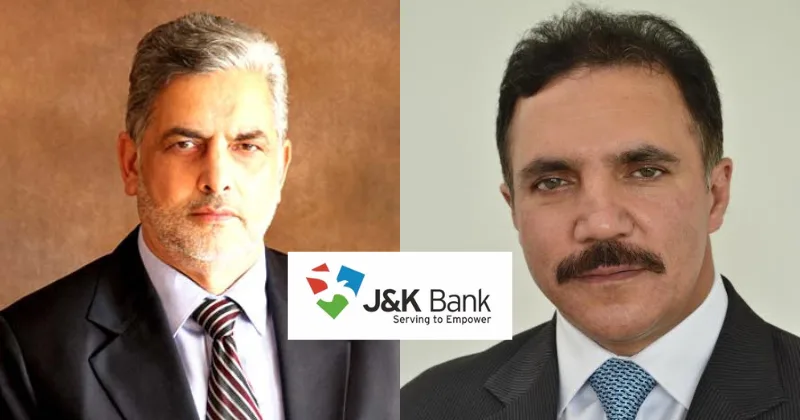
The Court of the Special Judge Anti-Corruption in Srinagar has ordered framing of charges against two former Chairmen and several senior officials of Jammu and Kashmir Bank Ltd. The framing of charges has been ordered in connection with alleged illegal appointments of bank attendants and assistant bank associates several years ago.
Special Judge of Anti-Corruption Court Tasleem Arief held that sufficient prima facie material exists to proceed against the accused for offences punishable under Section 5(1)(d) read with Section 5(2) of the JK Prevention of Corruption Act and Section 120-B (criminal conspiracy) of the Ranbir Penal Code (RPC).
The case arises out of FIR No. 10/2019 registered by the Anti-Corruption Bureau (ACB) based on a complaint alleging “backdoor” appointments in different branches of the bank.
According to the prosecution, former Chairmen Mushtaq Ahmed Sheikh and Parvez Ahmed Nengroo, along with senior officials, had conspired to bestow illegal favours on hundreds of blue-eyed people due to extraneous considerations. This they did by appointing certain beneficiaries without properly identifying vacancies, issuing advertisements or following prescribed norms under the Officers Service Manual, 2000.
The charge sheet names several other accused officials and beneficiaries, including Abdul Rouf Bhat, Mohd Maqbool Lone, Mohd Yahya Rafiqui, Syed Irfan Lateef, Mohd Iqbal Wani, Arshid Hussain Dar, Shakoor Ahmed Bhat, Waseem Mehraj, Vagish Chander Sharma, Mohd Ayoub Wanchoo, Fayaz Ahmed Bhat, Asif Iqbal Raja, Showkat Ahmed Bhat, Parvaiz Ahmed Baba, Anjum Ara, Faizan Ayaz, Mushtaq Ahmed Mir, Abdul Rashid Shigan, Mohd Aslam Ganie, Imran Matoo and Hameem Nusrat.
The ACB alleged that dozens of appointments were initially made temporarily for 89 days and later regularised despite the absence of sanctioned vacancies.
It further alleged that the two chairmen adopted an identical modus operandi in accommodating their respective favourites, including relatives. They conspired with other officials to create what it described as an unprecedented and illegal practice of clandestinely absorbing undeserving candidates.
Besides, grant of loans against insufficient collaterals was another modus operandi that was rampant at one time.
These malpractises were rooted in political interference as successive democratically elected governments wielded tremendous powers on the bank management. They often appointed their favourites to the Board of Directors (BoDs) with disastrous consequences for the financial health of the bank.
These were curbed to a great extent after the scrapping of Article 35-A and the management passing on in professional hands with little political interference.
According to the investigating agency, the alleged actions deprived more competent aspirants of employment opportunities. This also resulted in great financial losses to the bank, with these undeserving appointees drawing salaries amounting to over Rs 41 lakh till August 2019, thereby gaining undue pecuniary advantage.
The defence counsel sought discharge of the accused, arguing that the FIR was based on a false complaint later disowned by the alleged complainant. It was also contended that the J&K Bank is a private entity and its officers do not fall within the definition of “public servants” under the Prevention of Corruption Act (PCA).
This can be considered a very novel defence argument as the bank was controlled in entirety by the government with Finance Minister and Finance Secretary of J&K being ex officio members. Further, till date, the salaries of all employees of J&K are rooted into their accounts by this bank.
The defence further submitted that temporary appointments were made under Rule 310 of the Officers Service Manual due to administrative exigencies and were subsequently ratified by the Board of Directors through resolutions. It is in the government service that the rule to make temporary appointments (of less than 90 days) exists. That actually means that when it suited them, those making illegal appointments used a rule from government books. Repudiating that the bank employees could be treated as government employees when it did not suit their cause.
The court, however, observed that at the stage of framing of charges, it is only required to assess whether sufficient material existed to presume the commission of offences and not to conduct a detailed evaluation of evidence. The prosecution will have to prove the charges in the process of the trial only.
Relying on settled principles laid down by the Supreme Court, the court noted that conspiracy is often proved through circumstantial evidence and that the material on record indicated “a thread of concerted common course of action and commonality of design” sufficient at this stage to proceed.
The court also upheld the validity of the prosecution sanction granted by the Chairman/CEO of JK Bank under Section 6 of the JK Prevention of Corruption Act, observing that he was the competent authority to remove the in-service officials and was duly empowered to sanction their prosecution.
Holding that the prosecution had placed sufficient preliminary material on record indicating criminal misconduct and conspiracy, the court declined to discharge any of the accused.
“Consistent with the settled legal position and the foregoing discussion, this Court finds from a perusal of the material on record and the preliminary evidence that the prosecution has produced sufficient material furnishing grounds to proceed against the accused,” the court observed.
The matter has been listed for formal framing of charges on March 10, 2026.
Former J&K Bank chairman Parvez Ahmad Nengroo, facing graft charges, had joined the People’s Conference (PC) led by Sajad Gani Lone. Nengroo was removed from the post of chairman of the bank in 2019 by the government.
While welcoming Nengroo into the party fold, Lone had said that he will play a key role in scripting his party’s “economic agenda’’ for change. “I whole-heartedly welcome Parvez sahib into the Caravan of Change. He has had an illustrious banking career and is a hands-on leader who has risen from the ranks,” Sajad Gani Lone had said in September 2021 while welcoming Nengroo.
In June 2019, Nengroo was removed from his top position in the bank and the ACB started a probe into his “meteoric rise from a chartered accountant” to the bank’s top position in just 15 years. Nengroo was appointed as Chairman & Managing Director (CMD) of the Bank by then Chief Minister Mehbooba Mufti in October 2016.
During Nengroo’s tenure as CEO of the bank, several loan accounts turned defunct, Non Performing Assets (NPAs), and one time settlement (OTS) was allegedly one preferred method for siphoning off funds from different branches. These OTS cases were also scrutinised by the sleuths and many of them showed a similar pattern.
The Anti-Corruption Bureau (ACB) has alleged that the bank suffered a loss of over Rs 250 crores due to salaries paid to these illegal appointees over several years. Investigations into FIR No. 10/2019 revealed that approximately 3,000 illegal appointments were made since 2014, including more than 150 political workers appointed in 2017 alone. Some news reports had said at one time that around 600 appointments were made from various south Kashmir districts.
Separately, Nengroo was also arrested in 2021 regarding a tendering fraud involving a housekeeping contract that allegedly cost the bank Rs 7 crores.