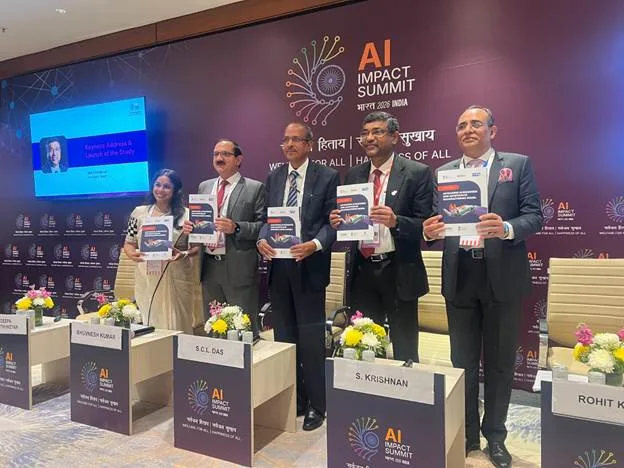
New Delhi: A high-level thematic session titled “Advancing AI Readiness and Adoption in Manufacturing MSMEs” was convened on the second day of the India AI Impact Summit 2026, focusing on embedding Artificial Intelligence into the core of India’s manufacturing ecosystem.
Bringing together senior government officials, policymakers, industry leaders and academic experts, the session underscored AI’s transformative potential in strengthening Micro, Small and Medium Enterprises (MSMEs), a sector central to India’s economic ambitions.
The session saw participation from key ministries of the Government of India, including the Ministry of Electronics and Information Technology (MeitY), the Ministry of Micro, Small and Medium Enterprises (MSME), the Ministry of Textiles, and the Department of Pharmaceuticals under the Ministry of Chemicals and Fertilisers. The deliberations centred on creating an actionable framework to drive AI adoption across manufacturing MSMEs, particularly in textiles, pharmaceuticals, including medical devices, and electronics.
During the event, a comprehensive study jointly undertaken by the National Institute of Smart Governance and Athena Infonomics was formally launched under the aegis of MeitY and the India AI Mission. The study aims to develop a practical and operational roadmap to accelerate AI integration across more than 350 manufacturing MSME units nationwide. By collecting granular insights from shop-floor workers to senior management, the research seeks to identify AI interventions capable of improving productivity, optimising unit economics, expanding product-service offerings and enhancing global market access.
Shri S. Krishnan, Secretary, MeitY, highlighted the importance of translating AI potential into tangible economic gains. He stated that the India AI Mission is committed to ensuring that AI has a meaningful impact on real sectors of the economy, particularly in strengthening manufacturing MSMEs by enhancing productivity, efficiency and technological capabilities.
Shri S. C. L. Das, Secretary, MSME, described AI as a “great force multiplier” for industry and emphasised that the private sector would drive the AI-powered transformation necessary for achieving Atmanirbhar Bharat. He stressed that AI adoption at the shop-floor level is crucial for MSMEs to enhance competitiveness and integrate more effectively into global supply chains.
The discussions were framed against the backdrop of the Economic Survey 2025–26, which notes that the MSME sector contributes approximately 31.1 per cent of India’s GDP, accounts for 35.4 per cent of total manufacturing output and represents 48.6 per cent of the country’s exports. With manufacturing central to India’s aspiration of becoming a $35 trillion economy by 2047, speakers underlined that accelerating technology adoption, improving financial access and strengthening market linkages would be critical to future-proofing MSMEs.
Shri Bhuvnesh Kumar, CEO of the National Institute of Smart Governance, expressed confidence that the study would deliver an implementable roadmap for large-scale AI deployment in manufacturing MSMEs. He noted that AI will play a pivotal role in India’s journey toward becoming the world’s third-largest economy, enabling smarter production systems and stronger export competitiveness.
Shri Rohit Kansal, Additional Secretary in the Ministry of Textiles, observed that India’s AI dividend would ultimately be realised on factory floors. He emphasised that long-term economic transformation depends on whether AI can modernise legacy sectors such as textiles and food processing, thereby driving sustainable growth.
Shri Aman Sharma, Joint Secretary in the Department of Pharmaceuticals, pointed out that MSMEs constitute more than 80 per cent of manufacturing units in the pharmaceutical sector. He stated that AI adoption can significantly reduce production costs, improve quality standards and enhance operational efficiency in the sector.
The session formed a key component of the India AI Impact Summit 2026, reinforcing the government’s intent to move beyond conceptual discussions and toward structured implementation. By fostering coordinated action among ministries, industry bodies and research institutions, the initiative aims to ensure that AI becomes a catalyst for industrial competitiveness, economic resilience and inclusive growth in India’s manufacturing landscape.