
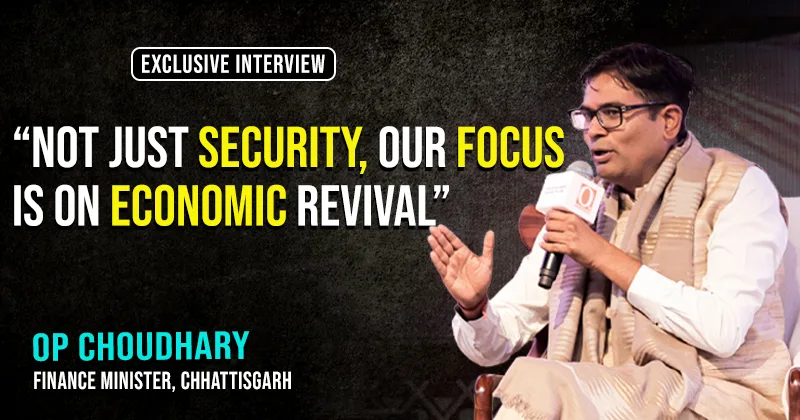
For decades, Bastar was seen as a conflict-ridden region that created fear in the mindset of everyone. Thankfully, the story is fast-changing. In this interaction with Organiser’s Senior Assistant Editor Nishant Kumar Azad, Chhattisgarh’s Finance Minister OP Choudhary explains how the State plans to align Bastar’s future with India’s larger development vision for 2047. Excerpts:
Under Vision 2047, Chhattisgarh aims to increase its GSDP from Rs 5 lakh crore to Rs 75 lakh crore. Having served as a bureaucrat and now as a political leader, you understand both the administrative and systemic challenges. How do you plan to overcome these barriers and turn this vision into reality?
I view Chhattisgarh’s growth as part of India’s larger growth story. During the Amrit Kaal, Prime Minister Narendra Modi has turned the dream of a developed India into a mass movement. India’s biggest strength is its young population, with an average age of 29, giving us a powerful demographic advantage.
Earlier, Chhattisgarh lagged due to misgovernance, corruption, and policy paralysis. But once our Government took charge, we aligned the State’s progress with India’s development momentum. Our aim is to transform developing Chhattisgarh into a developed State.
With an average age of youth at 24, we have a stronger demographic dividend. At the same time, under Union Home Minister Amit Shah’s leadership, armed Naxalism is being eliminated. This is a historic turning point.
Earlier, the State was seen through fear. Today, that perception is shifting – from fear to hope.
We have seen a large number of Maoists surrender under the Government’s rehabilitation policy. However, when surrendered cadres are offered Government jobs and financial assistance, some people feel it is unfair. How do you respond to this concern?
Those who joined Naxalism were not outsiders; they were our own local tribal brothers. During my tenure, I worked closely in the remote areas of Dantewada. I saw first hand how many of these individuals were misled or brainwashed, and how circumstances pushed them in that direction. Today, instead of using the term “surrender,” the Government prefers the word “rehabilitation.” When misguided people choose to return to the mainstream, it becomes the system’s responsibility to support them with empathy and a large heart. Of course, there may be a few with negative intentions, but many genuinely want to rebuild their lives. In a democracy, we must move forward by taking everyone along.
Jagargunda was once known as a major tamarind hub and an important local economic centre, but for years, conflict disrupted both connectivity and trade. What concrete steps is the government taking to revive the tamarind economy and restore Jagargunda as a regional livelihood hub?
Earlier, traditional crops like kodo and kutki were dismissed as poor people’s food, but Prime Minister Narendra Modi recognised them as Shri Anna and highlighted their nutritional value. Similarly, we are now focusing on minor forest produce and creating local processing and value addition.
Jagargunda once remained completely cut off. During my time as Collector, reaching it required massive security convoys and road clearing. Today, that isolation has ended. Roads are open, connectivity has improved, and after more than 20 years, a bank branch has reopened.
Our focus is not just security but economic revival, so that places like Jagargunda once again become centres of local prosperity.
Regarding the State Capital Region (SCR), which areas will be included, and how will balanced development between industry, agriculture, and forest be ensured?
The idea behind the SCR is simple: every economy needs a strong growth engine. Just as cities like New York, Hyderabad, or Bengaluru drive their larger economies, Chhattisgarh also needs a similar hub .That is why we are integrating Nava Raipur, Raipur, Bhilai, Durg, Rajnandgaon and nearby areas through planned infrastructure, job hubs, better transport, and future metro and rapid rail systems.
The SCR Act has been passed, and implementation is underway. The growth generated here will fund development in remote regions like Bastar and Surguja. That is our economic model.