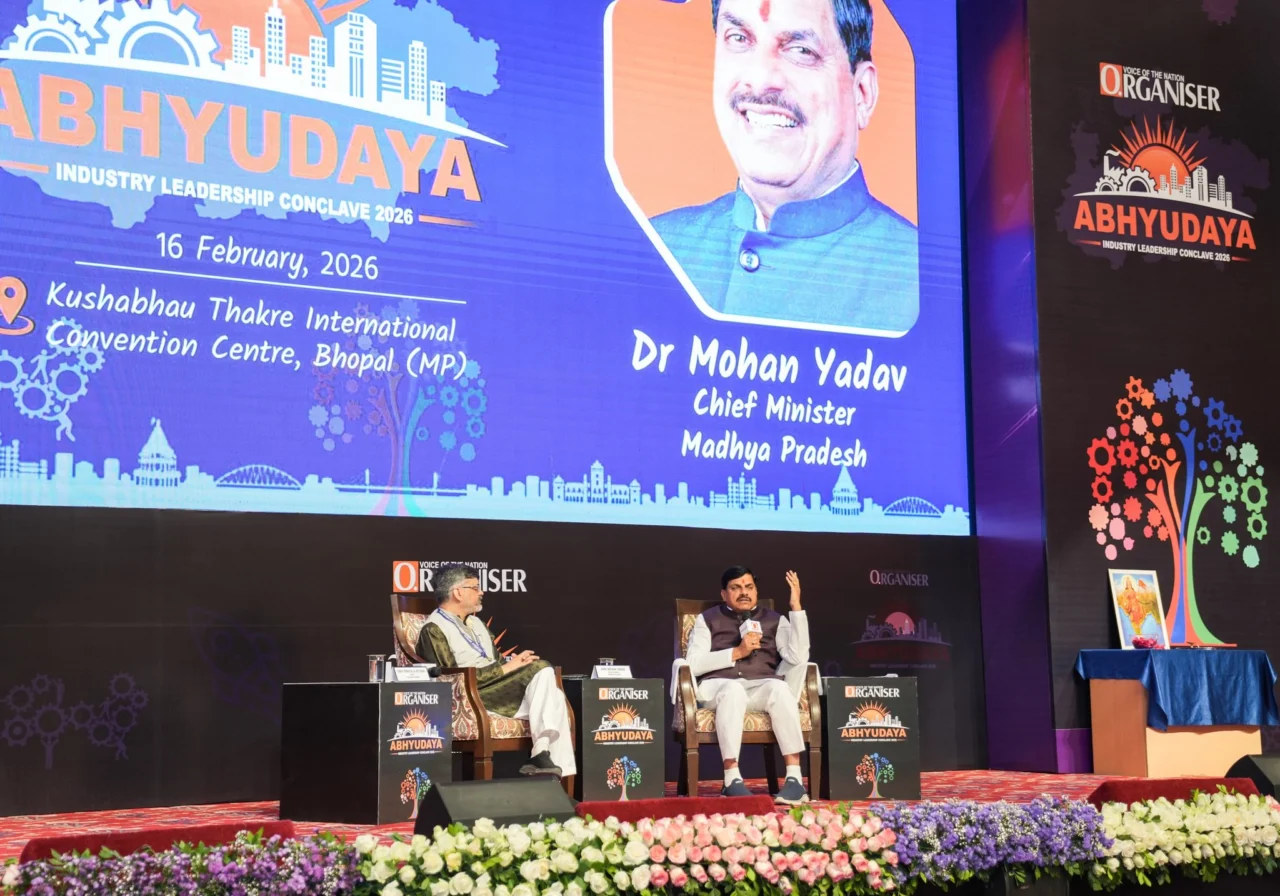
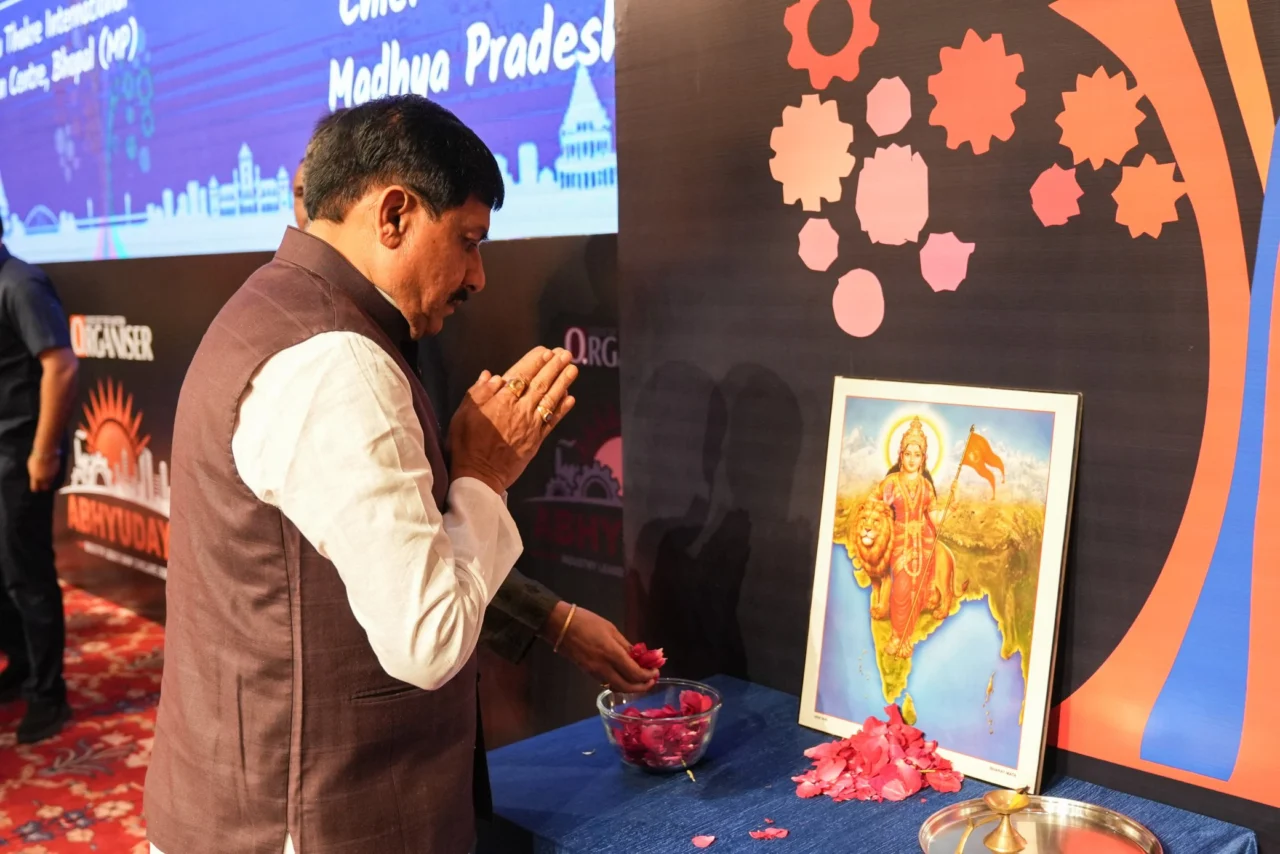
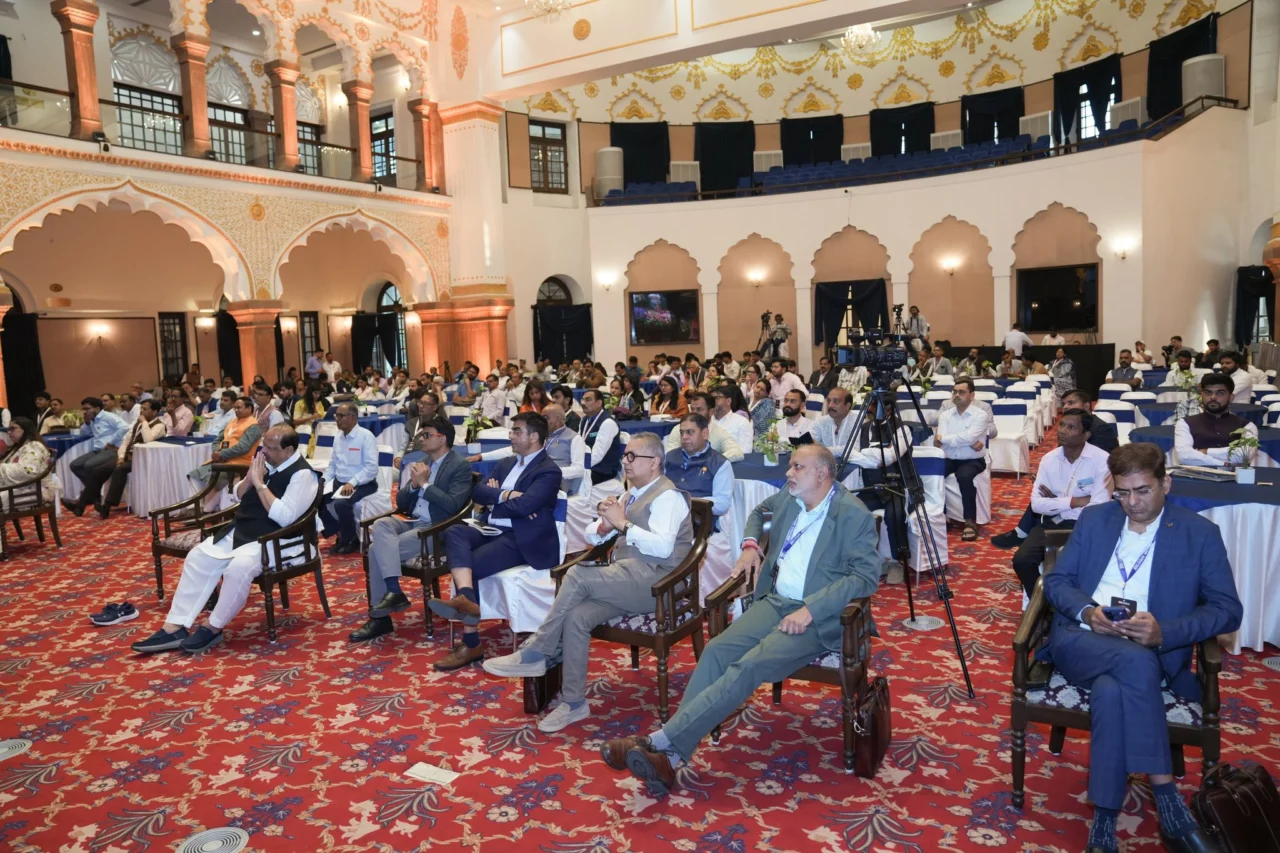
Bhopal: The final session of the ‘Abhyudaya Industry Leadership Conclave 2026’, organised by Organiser in Bhopal, featured an in-depth and wide-ranging dialogue between Madhya Pradesh Chief Minister Dr. Mohan Yadav and Organiser Editor Prafulla Ketkar.
Held at the Kushabhau Thakre Convention Centre, the session titled “Viksit Madhya Pradesh for Viksit Bharat” brought into focus the state’s industrial policy, employment-driven growth model, renewable energy expansion, agricultural transformation, cooperative federalism, and the roadmap towards Vision 2047.
From “BIMARU” to a growth-oriented state
Opening the discussion, Prafulla Ketkar referred to Union Home Minister Amit Shah’s statement in Raipur event held by Organiser, where he said, that the term “BIMARU” had been abolished from India’s map. Madhya Pradesh, once associated economic backwardness, is now repositioning itself as an industrial and innovation-driven state.
Ketkar asked what enabled such a rapid shift in vision, from the tag of “BIMARU” state to a focus on AI, manufacturing, and industrial policy.
Responding, Chief Minister Dr. Yadav said, “The Honourable Home Minister has stated it very well. What should have been done long before was delayed because of Congress government. When small and practical issues are addressed sincerely, the impact becomes visible immediately. We had everything – skills, resources but we needed a proper medium to channelise them. By nature, this land has “Parmatma ka aashirvad.”
He remarked that rivers like Narmada had always been flowing, yet regions such as Nimar had dried, and Malwa and Chambal were impacted due to lack of policy vision.
Recalling a past statement by Congress’s Digvijay Singh in the Vidhan Sabha, he said, “It was announced that bringing Narmada water to certain places was not possible. If people speak like this, then the state will become BIMARU. If leaders deliberately close their eyes, crisis is inevitable.”
He pointed out that Narmada water has now reached Indore and Yashwant Sagar, demonstrating that intent makes the difference.
“If technology becomes outdated, at least welfare should be considered. But earlier, that intention itself was missing. When you do not promote industrialisation, how will development take place?”
He added that after his government was formed, outreach programmes were conducted across small towns, both within India and abroad, inviting investors with a clear message, “Come, we will give everything. We have everything; we need industry. You need land; let us work together.”
Employment-based industrial planning
During the discussion, Ketkar raised the issue of supply chains and minimum guaranteed purchase mechanisms, particularly as Madhya Pradesh is evolving into both a spiritual tourism hub and a medical sector hub.
Dr. Yadav responded, “We are going even further. If you establish employment-based industries, we will provide Rs 5000 per labour. Employment-based, not unemployment-based planning, that bifurcation has helped a lot. We are focusing on employment-generating businesses. Only 1-1.5 percent unemployment is there in Madhya Pradesh. This is a matter of pride for us.”
He highlighted the new Industrial Promotion Policy and Investors’ Summit, where participation came from across the country and abroad.
“We have worked in two ways our youth should not become job seekers but job providers. Based on their work, they should build such systems.”
Madhya Pradesh, being the second-largest state geographically, holds potential in mining, tourism, religious tourism, textiles, and renewable energy. The government has implemented nearly 24 policies and is conducting conclaves in every district.
Citing Narmadapuram’s belt regarding renewable energy, he said, “When we focused on land procurement, 200 acres, 800 acres, even 1000 acres of land became available, and we had to establish a solar park. We linked that region to industry based on necessity. There is no transport difficulty, it is not far from Bhopal, water is sufficient, land is surplus.”
Similarly, from Shahdol to Singrauli, coal belts have been activated.
“At the Shahdol Industry Conclave, we received investment worth Rs 3000 crore and factories were established.”
Bridging education and industry
Ketkar raised the issue of education-industry interface, asking how policy would bridge academia and industry.
Dr. Yadav replied, “We are thinking in such a way that those who get employment should be trained here itself. I am satisfied that when the National Education Policy was announced, I was the Education Minister. Madhya Pradesh was the first to implement this policy.”
Under NEP 2020, reforms were initiated. He added, “For example, in medical colleges, our state will provide land for hospitals for 10 years at Rs 25 per acre, so that medical colleges can function like hospitals.”
He said that the Medical Education Ministry and Health Department, earlier separate, were merged for better coordination.
“In five years, the government budget will double. All types of registrations, power of attorney, loans, housing boards will be streamlined within the registration system.”
MSME reforms and simplification
Calling MSMEs the backbone of the state’s growth, the Chief Minister described a historic reform, “We ended the annual renewal of MSME licences and extended it to 10 years.”
However, he acknowledged that entrepreneurs still face multiple clearances.
“Simplification and industrialisation are both necessary. Wherever industrial areas are possible, we will develop them. Residential and commercial growth will continue. Results will be visible in the coming time.”
Integrated Vision: Agriculture and industry together
Emphasising an “Ekatma Drishti”, he stated, “Industry must grow, agriculture must grow, but the vision should be one. Our job is not merely to run the government through profit-making enterprises; our job is to generate employment.”
He cautioned against exporting raw cotton only for finished goods to be manufactured elsewhere, recalling historical mills like Vinod Mill and Vimal Mill.
“We are not looking only at profit; we are looking at employment generation.”
When Madhya Pradesh was formed in 1956, irrigation covered 7.5 lakh hectares.
“In just one and a half years, we have added irrigation to 7.5 lakh hectares.”
In dairy and animal husbandry, he said milk production has risen from 7 lakh hectares equivalent to 12 lakh, and farmers are being given Rs 5 per litre incentive.
“Milk contribution is 5 percent now; we aim to take it to 20 percent,”
River-linking projects like Ken-Betwa, Parvati-Kalisindh-Chambal, and development in Nimar and Tapti regions are underway, “Our relations with other states should be cordial and loving. We see states fighting over water, but we have adopted cooperative federalism.”
He cited the Gandhi Sagar Dam pump storage project and sharing arrangements with Rajasthan.
Renewable energy and self-reliance
On renewable energy, he said, “We are moving very fast. Under KUSUM, solar energy will be generated locally. In western MP, windmills existed but expansion was difficult. But we changed, even 2KW solar panels were installed near windmills to produce electricity, and we started buying it.”
An MoU has been signed with Uttar Pradesh near Morena for shared water usage.
Ending Naxalism
Addressing the Maoist challenge, he stated, “Madhya Pradesh has given the final salute to ‘Lal Salaam’. Under the leadership of the Hon’ble Prime Minister and Home Minister, the central and state governments together made the impossible possible.”
Referring to past violence, including a 1997 incident where a minister was brutally killed, he said such threats had to be eliminated.
“Our jawans risked their lives. We rehabilitated the areas. We recruited new police, shifted focus to agriculture and development. Electricity and infrastructure have been ensured. We will not allow such elements to re-emerge.”
AI, technology and MSME challenges
On AI and data monopolies affecting MSMEs, he added, “When computers came, the same fears were expressed. Today with AI, it is similar. Challenges come with opportunities. We must remain cautious.”
Indore has become an IT hub, and similar hubs are being developed in Ujjain and Bhopal, including in engineering colleges.
“Students should study there and work there. Human beings are beyond the limits of AI. Our people are capable; we are blessed.”
Vision 2047: 1 trillion-dollar economy
Concluding the dialogue, Dr. Yadav laid out the long-term roadmap, “We have prepared a 25-year plan. The target is a 1 trillion dollar economy.”
He noted that per capita income has reached Rs 1,55,000 and is projected to reach Rs 22,50,000 in 25 years.
“MSMEs are our backbone. We are not dependent only on heavy industries; we are dependent on MSMEs. This sector will grow at the fastest pace.”
The session concluded with Arun Kumar Goyal, Managing Director of Bharat Prakashan, extending a formal vote of thanks to the Chief Minister and participants.
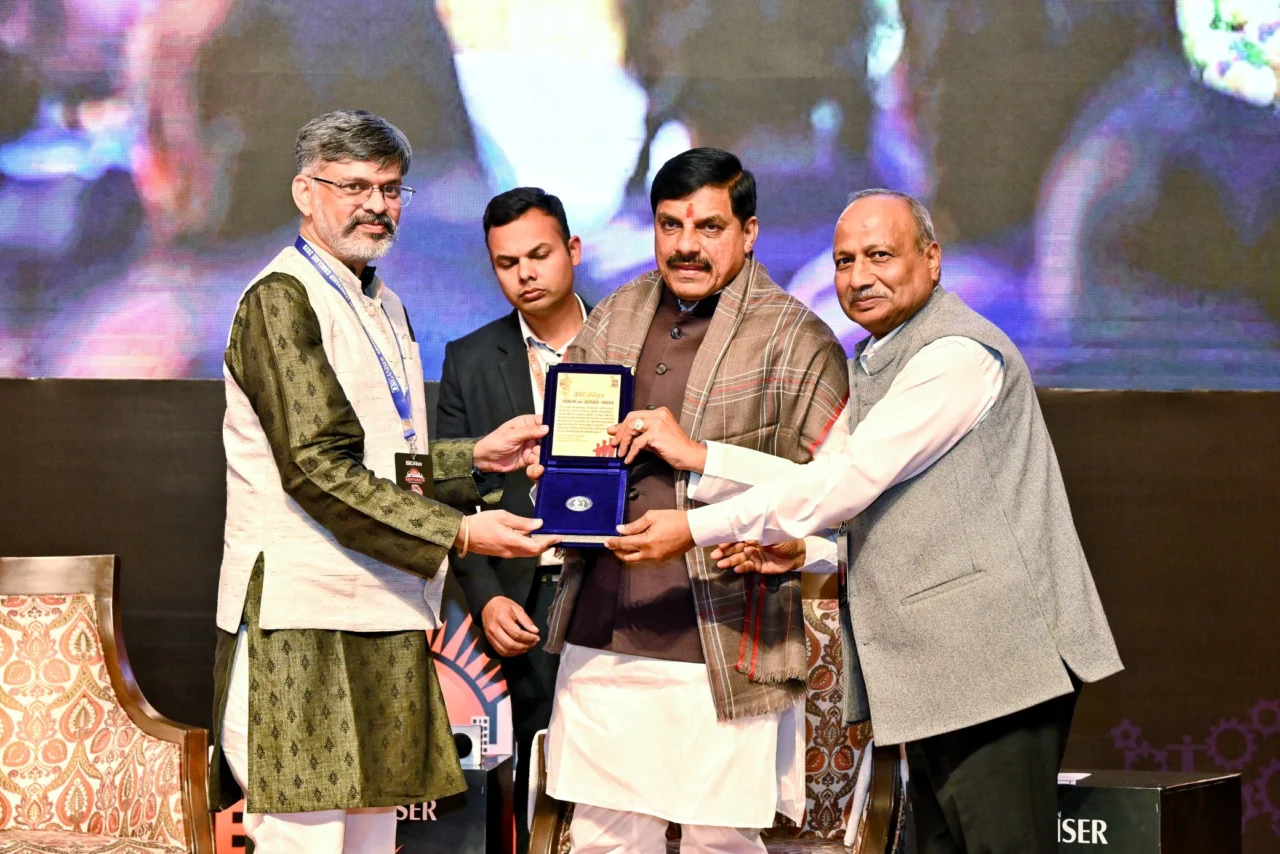
The session of ‘Abhyudaya’ thus articulated Madhya Pradesh’s structured and employment-centric development model, aligning industrial growth, agricultural strength, renewable energy, education reform, cooperative federalism, and internal security, towards the national goal of Viksit Bharat@2047.