
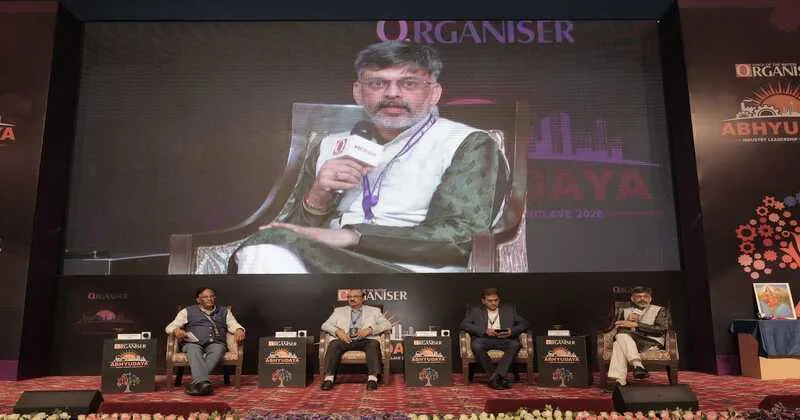
BHOPAL: Addressing the gathering at the Abhyudaya Leadership Conclave session titled “Atmanirbharta in Action” curated by Organiser Weekly, stakeholders from the MSME sector stated that to unlock their full potential, India must simplify compliance structures, reform regulatory frameworks, and foster a governance culture rooted in trust and facilitation rather than procedural rigidity.
On being asked about the problems and the opportunities in the MSME sector, Dr RS Goswami
CMD, Hind Pharma, spoke about the misleading narrative surrounding Micro, Small and Medium Enterprises (MSMEs). He added that one such claim suggests that MSMEs receive heavily subsidised loans and yet fail to deliver quality products. Clearing the air, Goswami stated that this portrayal oversimplifies a far more complex financial and structural reality.
Problems in the MSME Sector
Goswami ji also spoke about the MSMEs being given Rs 10,000 crore since the days of Manmohan Singh. Clarifying about the allocation of money, Goswamiji said, “During the tenure of former Prime Minister Dr Manmohan Singh, a financial package of approximately Rs 10,000 crore was announced for the MSME sector, this allocation was routed through the Small Industries Development Bank of India (SIDBI), rather than being handed directly to enterprises as unrestricted subsidies. The objective was to strengthen institutional lending support, not to encourage inefficiency. Access to affordable credit, is essential if Indian MSMEs are expected to compete in international markets where global players often benefit from low-cost capital and state-backed incentives.”
Speaking on the issue of the infrastructure of the existing industrial areas, Goswami Ji stated, “Beyond credit access, infrastructure in many industrial clusters remains inadequate. Poor logistics, inconsistent power supply, and outdated industrial estates hinder productivity and product quality. If India aims to build globally competitive MSMEs, addressing structural infrastructure gaps and ensuring genuinely accessible financing at competitive rates will be critical steps forward.”
Opportunities in the MSME Sector
As for opportunities, Goswamiji hailed PM Narendra Modi for playing a vital role in changing the international image of MSMEs. This happened first through Rohit Shetty, then through Mangalyaan, and then through vaccine diplomacy during COVID-19. Speaking about business growth, Goswamiji stated that countries that used to buy any product for as little as one dollar from such countries were now placing large business orders with us.
On being asked by editor of Organiser weekly, Praful Ketkar about the bottlenecks and if they were just related to the credit line, Harish Joshi, Director, Sumangalam Formulations Pvt Ltd, Independent Director, Balmer Lawrie Co. Ltd., Kolkata stated, “There are ample opportunities for the youth of the country and if one is willing to take the risk then the government is willing to stand with you.”
Joshiji highlighted that in the MSME sector, it is crucial to identify where opportunities lie. In India, there will not be a dearth of opportunities, as by 2050, there will be at least 28 crore youth, compared with China, where there will be a reduction of at least 14 crore. Joshji hailed the government for working towards the objective of strategic development and for creating opportunities for the youth in the coming years. He highlighted that the government has allocated Rs 1 lakh crore for research and development.
Joshji highlighted that it is important to make people aware of schemes that benefit MSMEs, as many are unaware of them. He also added that there is a need to give a fillip to MSMEs in manufacturing the supporting parts of mobile phones, which are presently imported.
Meanwhile, the panellists stated that though recent digital reforms have improved tax filing systems and introduced automation in GST processes, more needs to be done. Some of the suggestions included:
- A single-window compliance dashboard
- Rationalised GST slabs and return frequencies
- Simplified documentation for small exporters
- Reduced professional compliance costs
The broader demand is for predictability and clarity. Entrepreneurs want to know their obligations upfront, without facing sudden procedural complexities as they scale.
On being asked ditor of Organiser weekly, Praful Ketkar, about the role of the bodies that voice the concern of the MSMEs, Mitesh K. Lokwani, MD, HLBS TECH (P) LTD, Adhyaksh, Laghu Udyog Bharati, Bhopal, stated that the government should take steps to make the MSMEs aware about the latest developments that are taking place in various sectors. Lokwani ji reiterated that the government should ensure that MSMEs are made aware of the latest technology so they can use it in the products they manufacture and compete globally.
The point highlighted by Lokhwani ji implied that to compete internationally, Indian products must not only be cost-competitive but also quality-assured and brand-ready.
Key Takeaway
A key takeaway from the Abhyudaya Conclave was the urgent need to bridge the gap between policy formulation and implementation. Speakers stressed that while central policies can be visionary, their impact depends on on-ground execution. This requires capacity building among local administrative officers and digital transparency tools that ensure consistent policy application across regions.
Economic resilience, panellists agreed, is not built overnight. It requires long-term commitment to reform, simplification and support for the entrepreneurial ecosystem. Many at the event called for structured, multi-year roadmaps for compliance and incentives that provide businesses with predictability, enabling them to plan investments and expansions with confidence.