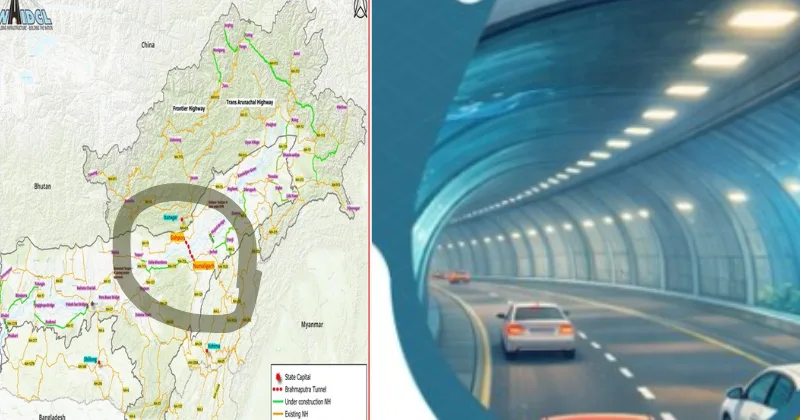
Guwahati: Major boost for infrastructure development in Assam by the PM Modi government. The Cabinet Committee on Economic Affairs, chaired by the Prime Minister Narendra Modi, on February 13 has approved the construction of 4-Lane Access-Controlled Greenfield connectivity from Gohpur on NH-15 to Numaligarh on NH-715 section, including 15.79 km of Road-cum-Rail Tunnel under river Brahmaputra, to be developed at a total capital cost of Rs. 18,662 crore in Assam on Engineering Procurement Construction (EPC).
With this, the long haul speculation on the proposed tunnel on the mighty Brahmaputra has come to an end. Opposition parties led by Congress in Assam were mocking it as a gimmick of the BJP government, which they commented as a day dream of the ruling party.
Currently, connectivity between Numaligarh on NH-715 and Gohpur on NH-15 is 240 km from the existing Kaliabhambhora road bridge near Silghat on NH-52, which takes 6 hours passing through Numaligarh, Kaziranga National Park and Biswanath Town. To address these challenges, the project is proposed to be developed as 4-Lane Access-Controlled Greenfield connectivity from Gohpur on NH-15 to Numaligarh with a Road-cum-Rail tunnel below the river Brahmaputra. This would be the first underwater Road-cum-Rail tunnel in India and 2nd in the world. The project will provide significant benefit to Assam, Arunachal Pradesh, Nagaland and other North-Eastern States. This will enhance the efficiency of freight movement, reducing logistics cost and driving socio-economic growth in the region.
The project alignment integrates with 02 major National Highways (NH-15 and NH-715) and 02 railway lines i.e. Rangia-Mukongselek Railway Section under Rangia Division of NFR on the Gohpur side and Furkating-Mariani loop line section under Tinsukia Division of NFR on the Numaligarh side.
The project would provide seamless connectivity to key economic, social and logistics nodes across Assam. Additionally, the project will enhance multi-modal integration by connecting with 11 Economic Nodes, 03 Social Nodes, 02 Tourist nodes and 08 Logistic Nodes, providing enhanced connectivity with 04 Major Railway Stations, 02 Airports and 2 inland waterways, thereby facilitating faster movement of goods and passengers across the region.
Upon completion, the project will play a pivotal role in strategic considerations, regional economic growth, strengthening connectivity between major economic centres and opening new avenues for trade and industrial development.
The project will also generate approximately 80 lakh person-days of direct and indirect employment, and will open new avenues of growth, development and prosperity in surrounding regions.