India’s rural transformation story in the past decade reflects a calibrated shift from fragmented welfare schemes to an integrated, decentralised and institution-driven development model. Anchored in the broader development philosophy of Sabka Saath, Sabka Vikas, Sabka Prayas and Sabka Vishwas, rural India has witnessed sustained fiscal commitment, infrastructure expansion, poverty reduction and growing community participation. The Union Budget 2026-27 underscores this trajectory with a rural development allocation of Rs 2.73 lakh crore, a sharp increase from Rs 87,765 crore in 2016–17, marking a rise of over 211 percent in a decade. This sustained public investment signals the government’s emphasis on strengthening rural livelihoods, infrastructure and grassroots governance as pillars of inclusive national growth.
The policy shift underpinning this transformation is as significant as the financial outlay. Rural development is no longer conceived as a top-down welfare exercise but as a decentralised partnership between the state and local institutions. The constitutional foundation for this transition lies in the 73rd Constitutional Amendment, which institutionalised Panchayati Raj Institutions as vehicles of grassroots democracy. Building upon this framework, flagship programmes have increasingly embedded participatory mechanisms, ensuring that panchayats, self-help groups and community cadres play a central role in planning, implementation and monitoring. The principle of Jan Bhagidari has moved rural governance from passive beneficiary participation to active community partnership.
Fiscal decentralisation has further strengthened local autonomy. Direct transfers to panchayats have expanded from around Rs 2.36 lakh crore under the 15th Finance Commission to nearly Rs 4.35 lakh crore under the 16th Finance Commission period, enhancing financial independence at the grassroots. Capacity building initiatives, digital planning tools and participatory budgeting processes have equipped local governments to tailor development interventions to region-specific needs.
The outcomes of this integrated strategy are visible in poverty indicators. India’s extreme poverty rate stood at 5.3 percent in 2022-23, below the global average, while multidimensional poverty declined to 11.28 percent. According to NITI Aayog’s Multidimensional Poverty Index estimates, the poverty headcount ratio fell from 55.3 percent in 2005-06 to 14.96 percent in 2019-21 and further to 11.28 percent in 2022-23. These figures indicate that sustained growth, combined with targeted welfare expansion and improved access to services, has produced measurable improvements in rural living standards.
Expansion of social protection coverage has been central to this progress. Access to improved drinking water, electrification and sanitation rose from 22 percent in 2016 to 64.3 percent in 2025. Social services expenditure recorded a compound annual growth rate of 12 percent between FY22 and FY26, with education and health allocations increasing steadily. These investments reflect a policy emphasis on expanding equal opportunity and reducing vulnerability.
The transformation in rural drinking water access under the Jal Jeevan Mission exemplifies this approach. When launched in 2019, only 3.23 crore rural households had tap water connections. By November 2025, coverage expanded to 15.74 crore households, raising rural tap water access close to universal levels. Independent assessments have documented time savings for women, improved health outcomes and enhanced participation in economic activities.
Sanitation outcomes under the Swachh Bharat Mission have also been significant. All districts were declared Open Defecation Free by 2019-20, and as of early 2026, over 96 percent of villages achieved ODF Plus status. More than 12.05 crore household toilets, 2.70 lakh community sanitary complexes and thousands of waste management units have been constructed, strengthening environmental health and community dignity.
Universal electrification under Pradhan Mantri Sahaj Bijli Har Ghar Yojana ensured that nearly 2.86 crore un-electrified households received connections by FY 2021-22. States reported 100 percent electrification of willing households, reducing energy poverty and enabling rural enterprises, digital access and improved quality of life.
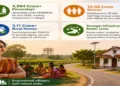
Housing security has expanded at scale through Pradhan Mantri Awaas Yojana-Gramin. Since April 2016, 3.70 crore rural houses have been constructed over 11 years. Budgetary allocation for PMAY-G rose from Rs 15,000 crore in 2016-17 to Rs 54,916.70 crore in 2026-27, an increase of 266.1 percent. Housing interventions not only provide shelter but also reinforce dignity, asset ownership and economic stability among low-income families.
Rural connectivity has reached near-universal levels under Pradhan Mantri Gram Sadak Yojana. More than 99.6 percent of eligible habitations have been connected through all-weather roads. Allocations increased from Rs 12,581 crore in 2016-17 to Rs 19,000 crore in 2026-27. Improved connectivity has reduced transaction costs, enhanced access to markets, healthcare and education, and facilitated labour mobility.
Targeted initiatives for tribal and vulnerable communities reflect a saturation-based approach. PM-JANMAN focuses on Particularly Vulnerable Tribal Groups across 28,700 habitations, while Dharti Abha-Janjatiya Gram Utkarsh Abhiyan aims to improve infrastructure and livelihoods in more than 63,000 tribal villages. Implementation of the Forest Rights Act has resulted in distribution of over 2.5 million forest titles, strengthening community control over land and resources.
Digitalisation has emerged as a transformative enabler of rural governance. The SVAMITVA scheme has surveyed 3.28 lakh villages and issued 2.76 crore property cards, formalising rural property rights and enhancing access to credit. The Digital India Land Records Modernisation Programme has digitised 99.8 percent of rural Records of Rights and computerised over 95 percent of Sub-Registration Offices, strengthening transparency in land transactions.
Women-led institutions have become the backbone of last-mile delivery under Deendayal Antyodaya Yojana–National Rural Livelihoods Mission. As of 2026, 10.05 crore women have been mobilised into 90.09 lakh Self-Help Groups, supported by more than 9 lakh community cadres. These collectives facilitate savings, credit access, livelihood diversification and social action. The programme’s allocation of Rs 19,200 crore in the current budget underscores its centrality to rural transformation.
Community Resource Persons such as Bank Sakhis, Krishi Sakhis and Pashu Sakhis have expanded grassroots service delivery. The Samaveshi Aajeevika Yojana adopts an ultra-poor graduation approach, integrating livelihood support with social protection and financial inclusion. Food, Nutrition, Health and WASH interventions implemented through SHGs have strengthened behavioural change and maternal-child health outcomes across thousands of blocks.
Skill development remains crucial in a rural labour market dominated by agriculture and self-employment. The Deen Dayal Upadhyaya Grameen Kaushalya Yojana has trained 17.92 lakh rural youth since inception, placing 11.64 lakh in wage employment. Complementing this, Rural Self Employment Training Institutes have trained nearly 59 lakh youth, facilitating enterprise creation and income diversification.
A major reform in rural employment policy is embodied in the Viksit Bharat Guarantee for Rozgar and Ajeevika Mission Act, which modernises the employment guarantee framework with a legal entitlement of 125 days of wage employment per rural household annually. With an allocation of Rs 95,692.31 crore in 2026-27, the Act prioritises water security, infrastructure, livelihoods and disaster preparedness while strengthening accountability provisions.
Collectively, these interventions reflect a structural transformation in rural governance. The combination of sustained fiscal commitment, decentralised institutions, women-led collectives, digital platforms and targeted livelihood programmes has repositioned rural India from a passive recipient of welfare to an active participant in development. The Union Budget 2026-27 consolidates this trajectory, affirming that inclusive growth is most sustainable when it is rooted in empowered communities, accountable institutions and participatory governance.