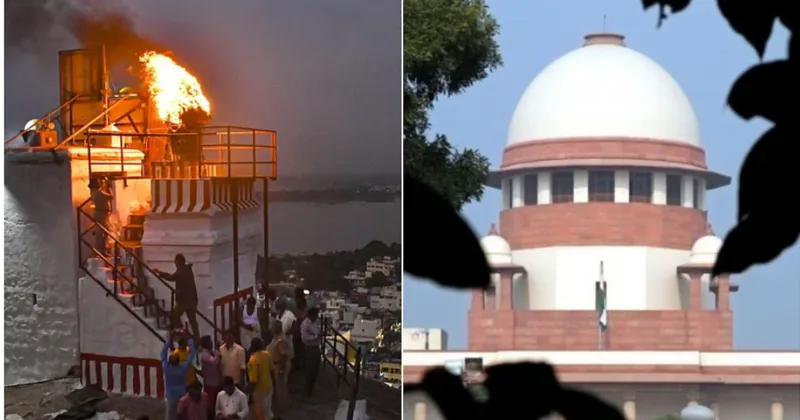
CHENNAI: The Supreme Court on February 9 upheld a Madras High Court ruling that limits the performance of namaz by Muslim devotees at the Thiruparankundram hill in Tamil Nadu to Ramzan and Bakri-Eid, declining to interfere with what it described as a “well-balanced” judicial order.
A bench comprising Justice Aravind Kumar and Justice P.B. Varale dismissed a petition filed by M. Imam Hussain, a worshipper at the Sikkandar Badhusha Avuliya Dargah located atop the Thiruparankundram hills. The petitioner challenged the Madras High Court’s October 2025 verdict, which restricted prayers at the Nellithoppu area—approximately 33 cents owned by the Dargah—to the two Islamic festivals, while prohibiting animal sacrifice and related activities until a competent civil court adjudicates the matter.
Refusing to intervene, the Supreme Court observed that the High Court’s order struck a careful balance between competing claims and sensitivities surrounding the hill, which is revered by multiple communities and is also a protected monument under the Archaeological Survey of India (ASI).
“It seems to be a very very balanced order,” the bench remarked, adding, “We do not propose to interfere with the order. Without expressing any opinion on the rights of the parties, the impugned order stands upheld.”
Petitioner’s Arguments
Appearing for the petitioner, senior advocate Prashant Bhushan contended that while law-and-order considerations could justify reasonable restrictions, the High Court erred in confining the right to offer namaz strictly to Ramzan and Bakri-Eid.
“There has never been a law-and-order problem,” Bhushan submitted, arguing that the use of the word “alone” in the High Court’s judgment was the primary grievance. He pointed out that the title of the 33-cent Nellithoppu area had been decreed in favour of Muslims by a trial court and affirmed by the Privy Council, a fact that the High Court itself had acknowledged.
“Despite holding that the land belongs to Mohammedans, the High Court has restricted prayers to Ramzan and Bakri-Eid,” Bhushan said, adding that other regulatory conditions could be imposed if required to maintain public order.
Response Of The Court
Justice Aravind Kumar, however, countered the argument by noting that the very existence of Peace Committee meetings indicated underlying law-and-order concerns. The bench indicated that the restrictions were not arbitrary but arose from the sensitive nature of the location and the potential for communal friction.
The issue relates to the Thiruparankundram hill in Madurai district, a site of immense religious significance. The hill houses the Subramaniaswamy temple, one of the six abodes (Arupadai Veedu) of Lord Murugan, and also the Sikkandar Badhusha Avuliya Dargah. Over the years, the performance of namaz and animal sacrifice at the hill has been a subject of recurring controversy.
Background of the Dispute
The matter has a long and complex legal history. In June 2025, a two-judge bench of the Madras High Court delivered a split verdict on petitions relating to prayers and animal sacrifice at the hill. Justice Nisha Banu declined to interfere with the existing practices, including animal sacrifice, while Justice S. Srimathy took a divergent view, holding that the Dargah should approach a civil court to establish its customary rights.
Justice Srimathy observed that the practice of offering namaz at the Nellithoppu area was of “recent origin” and that large congregations could obstruct pathways leading to the Kasi Viswanathar temple and encroach upon other parts of the Subramaniaswamy temple complex.
Following the split verdict, the matter was referred to a third judge. On October 10, 2025, Justice R. Vijayakumar delivered the deciding opinion, concurring with Justice Srimathy. He ruled that Muslim devotees could offer namaz only during Ramzan and Bakri-Eid, while prohibiting animal sacrifice, cooking, and the carrying and serving of non-vegetarian food on the hill until a civil court determines whether any such customary practice exists.
Justice Vijayakumar also held that the hill should continue to be referred to as “Thiruparankundram hill,” rejecting alternative names such as “Sikkandar Malai” or “Samanar Kundru.” The judge relied on a 1920 civil court decree and historical revenue records to support this conclusion.
ASI Protection and Legal Constraints
In its October 2025 judgment, the High Court further noted that approximately 172.2 acres of the hill have been declared a protected monument under the Ancient Monuments and Archaeological Sites and Remains Rules, 1959. The court held that activities such as animal sacrifice could not be permitted in such a protected area without statutory clearance.
The petitioner challenged both the restriction on prayers and the ban on animal sacrifice before the Supreme Court, arguing that they were arbitrary and violated Article 25 of the Constitution, which guarantees freedom of religion.
Contrasting Judicial Views
The controversy has also seen contrasting judicial approaches in recent years. In June 2023, the Madurai Bench of the Madras High Court had declined to ban prayers at the Sikkandar Badushah Dargah. A petition filed by one Ramalingam alleged that Ramzan prayers disturbed temple devotees. Dismissing the plea, Justices R. Subramanian and L. Victoria Gowri held that prayers lasting about half an hour would not disturb anyone and observed that “in a secular country, the court cannot ban the offering of prayer.”
That order, however, preceded the subsequent litigation and the High Court’s detailed examination of land ownership, customary practices, archaeological protection, and law-and-order concerns, culminating in the October 2025 verdict.
The dispute has remained sensitive, with periodic flashpoints. In December last year, the Madras High Court upheld a single-judge order permitting the lighting of a lamp at a deepathoon near the Dargah, even initiating contempt proceedings against the State after authorities cited law-and-order issues to delay its execution.
With the Supreme Court now declining to interfere, the High Court’s restrictions will continue to govern religious practices at the hill, at least until a competent civil court conclusively determines the issue of customary rights relating to animal sacrifice and broader prayer practices.