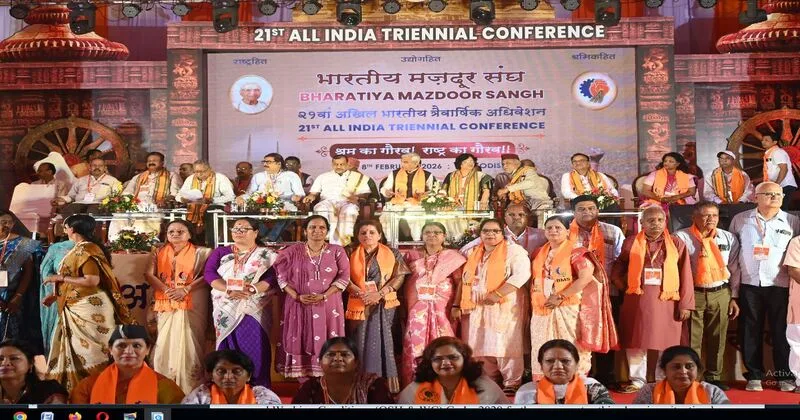
BHUBANESWAR: The Bharatiya Mazdoor Sangh (BMS), India’s largest trade union organisation, has called for the universal application of labour laws to all workers without any exclusion, asserting that such a move is essential to achieve Antyodaya, the upliftment of the last and most marginalised worker. The demand formed the core of four major resolutions adopted at the organisation’s three-day triennial national conference n held in Puri, Odisha, from February 6 to 8, 2026.
The resolutions, adopted after extensive deliberations by delegates from across the country, will be forwarded to the Central government for appropriate action. The conference reaffirmed Antyodaya as BMS’s guiding philosophy and resolved to align all organisational efforts toward building a strong, inclusive, and socially just India.
Demand for Universalisation of Labour Laws
In its primary resolution, BMS emphasised that labour laws must be universally applicable to all workers, irrespective of sector, employment type, or contractual status. The organisation maintained that exclusionary labour frameworks have deprived large sections of the workforce—particularly informal, unorganised, and contractual workers—of basic legal protections.
The resolution called upon both the Central and State governments to ensure that all labour laws are implemented without exception and to remove systemic exclusions that deny workers their rightful protections. BMS stressed that universal labour coverage is fundamental to social justice and sustainable economic growth.
The organisation further urged the government to announce a new labour policy that guarantees living wages and comprehensive social security for every worker. According to BMS, economic development must not be pursued at the cost of workers’ dignity, security, and well-being.
The resolution also sought suitable amendments to labour codes and other labour legislations to facilitate true universalisation of labour benefits. It called for immediate consultations with BMS on policy reforms related to labour welfare, asserting that constructive dialogue with worker representatives is essential for effective policymaking.
Employee Status and Social Security for Anganwadi Workers
Another significant resolution adopted at the conference pertained to Anganwadi workers, with BMS demanding that they be formally recognised as government employees and provided wages and social security benefits.
BMS stated that a clear employer–employee relationship exists between the government and Anganwadi workers, who perform statutory duties under various government schemes related to nutrition, child development, maternal health, and community welfare. The organisation rejected the notion that Anganwadi workers are volunteers, describing them instead as frontline service providers delivering essential public services.
The resolution noted that Anganwadi workers hold statutory positions and are therefore entitled to benefits under the Payment of Wages Act, 1936, and the Gratuity Act, 1972. BMS also referred to the recommendations made during the 45th session of the Indian Labour Conference, which called for the provision of minimum wages and social security for Anganwadi personnel.
Highlighting the prolonged economic insecurity and exploitation faced by Anganwadi workers—most of whom are women—the organisation urged the government to immediately grant them employee status and extend all applicable labour benefits, including minimum wages, provident fund, pension, health insurance, and gratuity.
BMS resolution stressed that meaningful social justice cannot be achieved while millions of grassroots women workers remain outside the formal labour framework despite their critical role in public service delivery.
Revival of the Tripartite Mechanism
The third resolution adopted by BMS called for the urgent revival and strengthening of the tripartite mechanism involving the government, employers, and trade unions. The organisation underscored that the tripartite system has historically played a crucial role in maintaining industrial harmony, resolving disputes, and shaping balanced labour policies.
However, BMS expressed concern that tripartite forums have become irregular, ineffective, and largely neglected in recent years, resulting in weakened industrial relations and reduced worker participation in decision-making.
The resolution demanded that tripartite dialogue be made regular, meaningful, practical, and outcome-oriented. According to BMS, sustained industrial peace cannot be achieved without structured consultation and cooperative engagement among all stakeholders.
The organisation cautioned that unilateral policymaking without adequate worker representation undermines democratic principles and increases the risk of industrial unrest. It warned that if the government fails to make sincere efforts to revitalise the tripartite system, BMS would be compelled to resort to agitation and movement-based actions to safeguard workers’ interests.
Calling for institutional accountability, BMS urged the government to restore the credibility of labour forums such as the Indian Labour Conference and ensure that workers’ voices are genuinely reflected in policy decisions.
Ending Exploitation of Contract Workers
The fourth resolution focused on the plight of contract workers, with BMS demanding comprehensive legal reforms to end their exploitation. The organisation described the prevailing contract labour system as discriminatory and unjust, noting that it is often misused to deny workers job security, fair wages, and social security.
BMS stated that contract labour is frequently employed even for work of a permanent and perennial nature, primarily as a cost-cutting measure, resulting in the systematic erosion of workers’ rights and dignity.
The resolution called for amendments to existing labour laws to ensure equal pay for equal work, social security coverage, and protection against arbitrary termination for contract workers. It asserted that workers engaged in core activities should not be treated as disposable manpower.
The organisation also demanded strict enforcement of laws to prevent misuse of the contract system and to hold principal employers accountable for violations. BMS warned that unchecked exploitation of contract workers has contributed to rising inequality, insecurity, and industrial instability across sectors.
Emphasising that sustainable economic growth is not possible without fairness and stability in employment, BMS urged the government to adopt a worker-centric approach while framing labour reforms and policies.
All four resolutions will be formally submitted to the appropriate authorities, with BMS reaffirming its resolve to continue advocating for universal labour rights, dignified employment, and equitable economic progress across the country.