Increasing life expectancy and a decreasing birth rate have combining effects that make changes in the demographic status of India. The proportion of the aging population in the country’s demographic has expanded significantly in recent years. By the year 2050, close to 20 percent of the population in India will be past the age of 60 years. This transformation comes with a moral and governance challenge that how does a developing nation ensure that those who spent their lives building the country do not spend their final years battling illness, debt and neglect? The answer is being articulated through Ayushman Vay Vandana yojna, the historic expansion of the Ayushman Bharat- Pradhan Mantri Jan Arogya Yojana.
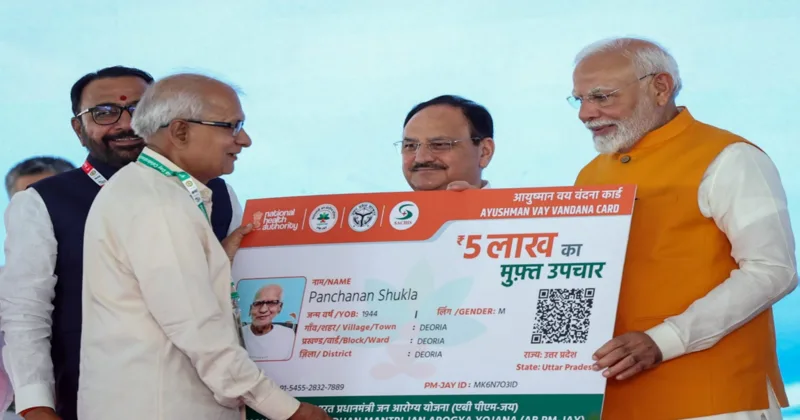
Ayushman Vay Vandana, which rolled out on 29th October 2024 by Prime Minister, indicates a policy shift in the most radical manner possible. For the first time, all Indian citizens aged 70+ are covered with an annual health insurance amount of 5 lakhs as a protection against secondary and tertiary care hospitalization, without any distinction based on income, caste or socio-economic status. In policy terms, this indicates a move from a targeted welfare approach to universal health security.
From selective welfare to universal assurance
When Ayushman Bharat-PMJAY was launched in 2018, it focused on covering the bottom 40 per cent of the population around 12 crore families who were most vulnerable to catastrophic health expenditure. Over the years, the scheme built a nationwide digital infrastructure, empanelled over 30,000 hospitals and standardised treatment costs across nearly 1,949 procedures spanning 27 medical specialties.
Ayushman Vay Vandana builds upon the foundation of serving elder. Recognising that age itself is a vulnerability, the Union Government approved the expansion in September 2024, extending coverage to nearly 6 crore senior citizens across 4.5 crore families. Prime Minister Narendra Modi formally launched the scheme to framing it as an ethical obligation of the State towards its elderly citizens.
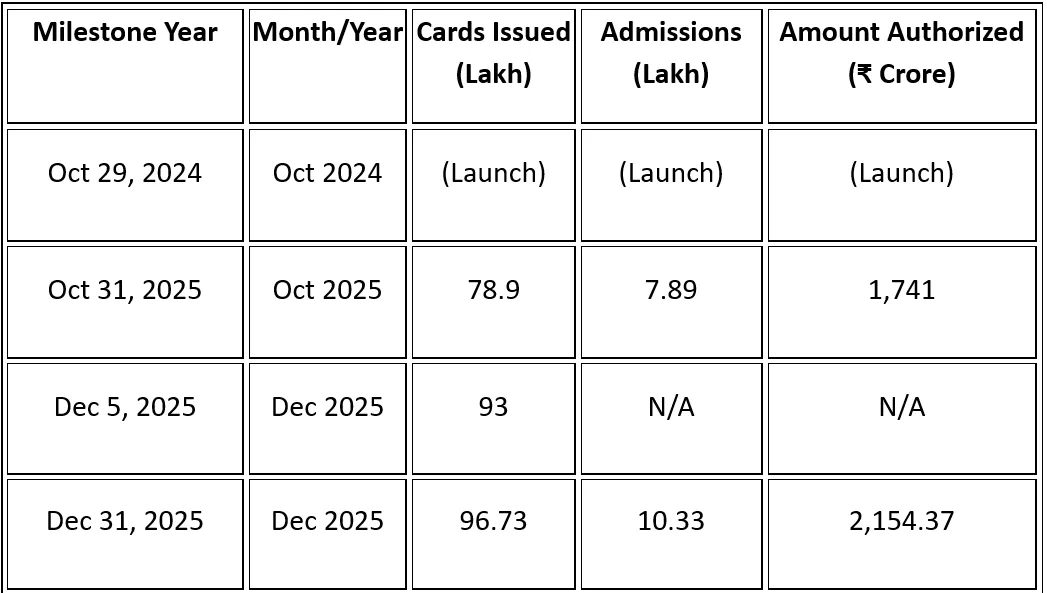 Phase-wise progress data of Ayushman Vay Vandana Yojna
What sets Ayushman Vay Vandana apart from many of the earlier welfare programmes and schemes is the pace and the scale of its rollout. As per official data placed before Parliament, 96.73 lakh Ayushman Vay Vandana cards had been issued in the country by December 31, 2025. This is a remarkable achievement considering it to came only fourteen months since the inception of the scheme. These cards translated to real health care access. During the same period, 10.33 lakh hospital admissions were authorised under the scheme, amounting to a total treatment value of ₹2,154.37 crore. These figures underline that the scheme is not merely about enrolment but about actual utilisation and impact.
A closer look at the data also reveals important gender dimensions. Of the total hospital admissions, 3.93 lakh were women beneficiaries, accounting for ₹820.42 crore worth of authorised treatment. Male beneficiaries accounted for 6.40 lakh admissions, with treatment costs amounting to ₹1,333.94 crore, It suggests that elderly women in healthcare are increasingly accessing institutional treatment through the scheme.
Financial protection against old-age medical distress
For decades healthcare expenses have been one of the primary reasons elderly Indians fall into poverty. Chronic ailments, surgeries and prolonged hospitalisation often forced families to exhaust savings, sell assets or depend on high-interest borrowing. Ayushman Vay Vandana directly confronts this reality.
By providing this yojana with cashless and paperless facilities, in empanelled hospitals throughout the country this scheme helps reduce out-of-pocket healthcare expenses, which is one of the largest shares of overall healthcare expenditure in the country. Treatment worth over ₹2,154 crore, which would have directly come out of the savings of the people is covered through this scheme alone by December 2025.
Integration and ease of access
Ease of health care access is because of well-integrated into the current existing infrastructures under the Ayushman Bharat scheme. Under PMJAY, already enrolled citizens receive the benefit of the scheme and the new scheme offers the elderly an additional card, which they can access through Common Service Centres, health camps or the PMJAY portal.
Biometric authentication, nationwide portability and real-time digital verification ensure beneficiaries can access treatment anywhere in the country. An elderly patient hailing from a rural district in Uttar Pradesh gets cashless treatment in Delhi or Mumbai tertiary hospitals with no bureaucratic hurdles. This portability is particularly significant in a country marked by internal migration and regional healthcare disparities.
Cooperative federalism in action
Strong Centre and State coordination is also reflected in the implementation of Ayushman Vay Vandana. Early leaders have emerged in the form of Uttar Pradesh, Maharashtra and Bihar, as a result of district-level enrolment and awareness drives. Other states, comprising some urban-heavy regions, have targeted outreach to scale up the implementation in a gradual manner.
The increase from 25 lakh cards issued by December 2024 to more than 96 lakh by December 2025 testifies to the fact that administrative momentum gathered with time, on the back of political commitment and bureaucratic capacity.
As with all such large-scale initiatives, there were some challenges with Ayushman Vay Vandana to begin with. The gaps in the level of awareness, the delays in hospital empanelling and the problem of digital literacy were also observed, particularly in the older age group living in rural areas or the remotest parts of the nation. Intensified efforts under the banner of Information, Education and Communication were the answer from the government side.
Instead of a static approach to implementation this approach has been dynamic, relying on real-time data to resolve bottlenecks, a key characteristic of the governance reforms introduced by Modi’s government.
Beyond Healthcare: A support towards civilisational values
Ayushman Vay Vandana is not just a health insurance plan, it’s a declaration about what India’s development agenda should be. In providing universal health care to its elderly citizens irrespective of their economic status, the State is making a powerful statement that the dignity of old age is non-negotiable.
It is the compatibility of this scheme with Visions of Viksit Bharat 2047, in which economic growth and social security go hand in hand at all stages of life. It has been the assurance offered to the elderly citizens of India, who have nourished the nation, that the country will reciprocate the same.
To a policy environment that was largely governed by abstractions, the numbers reveal a humane narrative with 96.73 lakh cards issued, 10.33 lakh hospitalisations and treatment worth over ₹2,154 crore now assured. It points towards a healthcare policy that supports the country ageing population.