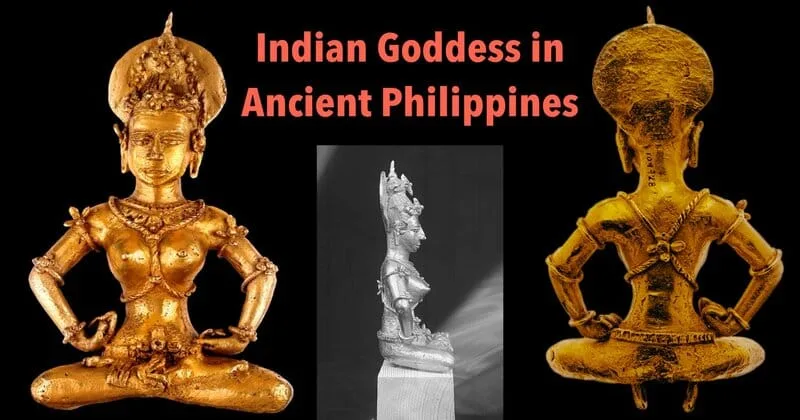
Philippines: Hidden for centuries along the banks of the Wawa River in Mindanao, the Agusan Gold Image is one of the Philippines’ most intriguing archaeological treasures. This small yet magnificent 1.8-kilogram gold statue reflects the deep cultural exchanges between Southeast Asia and the Indian subcontinent, and sparks a fascinating debate over its identity: Hindu, Buddhist, or a syncretic blend.
🇵🇭Philippines History – Indian Influence, Part 3
Agusan Gold Image – Parvati or Tara?Hidden for centuries, a 19th-century flood took her away. Another South Philippine flood deposited her on Wawa River bank. A 1.8 kg gold statue, she has Indian roots. Who is she? 🧵:… pic.twitter.com/1EXIhm1DPj
— Tapesh Yadav (@tapeshyadav_usa) February 8, 2026
Discovery and Journey
The story of the Agusan Gold Image begins with nature and chance. In 1917, following a devastating flood along the Wawa River in East Mindanao, a Manobo woman discovered a gold statue washed onto the riverbank. Monobo elders claimed that the figure had been in their possession for centuries, hidden to protect it from outsiders. Eventually, a local collector named Baklagon acquired the statue from the elders, but financial disputes led the Agusan Coconut Company to seize it.
Recognising its historical significance, the Field Museum in Chicago acquired the artefact in 1922, where it remains preserved today. Despite its removal, the Agusan Gold Image continues to speak volumes about the Philippine past, indigenous artistry, and international cultural connections.
The Artifact
Measuring 17.2 cm high, 9.3 cm long, and 4.5 cm deep, the Agusan Gold Image is small but commanding. Crafted from 21-karat gold, it depicts a seated female figure in a lotus-yoga posture. Her eyes are closed in serene meditation, her elongated earlobes and pronounced breasts reflect divine femininity, and a halo disc frames her head. The intricate crown recalls Balinese Hindu dance traditions, while the jewellery and posture hint at influences from Java and broader Southeast Asia.
Two loops at the back of her thighs indicate that she was once attached to a base or held in an ensemble with other figures. Notably, her hands rest near her waist without forming a specific mudra, with small gaps suggesting she may have held objects now lost to time. Dating estimates range from 900 to 1400 AD, placing her in a period of vibrant trade and cultural exchange across Southeast Asia.
The Agusan Gold Image’s identity remains debated among scholars:
Hindu Interpretation: Early researchers, including Robert Fox and Wilhelm Solheim, suggested she is Maa Parvati, consort of Shiva. The loops behind her thighs might indicate she was part of a divine grouping or positioned on Shiva’s lap, symbolising sacred union.
Buddhist Interpretation: Art historian H. Otley Beyer and later Bosch proposed she represents Tara, a Mahayana Buddhist goddess embodying compassion and enlightenment.
Syncretic or Royal Figure: Other scholars, including Juan Francisco, propose that she may reflect a fusion of Hindu and Buddhist traditions or even an Indo-Javanese queen. Tibetan expert Rob Linrothe links her partially to Vajralasya from the Vajradhatu mandala, though the logistics of a Tibetan figure reaching southern Mindanao remain mysterious.
Ultimately, the Agusan Gold Image may defy strict classification, representing a syncretic blend of religious, cultural, and royal symbolism that highlights the fluidity of Southeast Asian spiritual traditions.
The Agusan Gold Image is more than a beautiful artefact; it is a testament to the Philippines’ rich and complex precolonial history:
Indigenous Heritage: Its discovery affirms that vibrant indigenous cultures thrived in southern Mindanao long before the arrival of Islam and Christianity.
Hindu-Buddhist Influence: The statue provides tangible evidence of Hindu-Buddhist cultural presence in the Philippines, connected to broader Southeast Asian maritime networks, including Srivijaya and Majapahit.
Trade and Cultural Exchange: The figure’s Indian-influenced style reflects centuries of trade, cultural interaction, and artistic exchange between the Philippines, Indonesia, India, and possibly even Tibet.
The Agusan Gold Image remains a captivating symbol of the Philippines’ historical connectivity, artistic ingenuity, and spiritual diversity. Whether Maa Parvati, Tara, a syncretic deity, or royal figure, she continues to inspire awe and scholarship, a golden whisper from a forgotten era of Southeast Asian history.