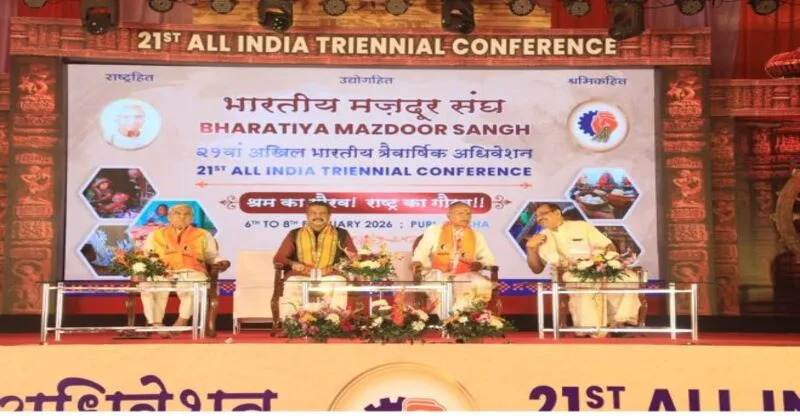
Union Education Minister Dharmendra Pradhan during the second day of the 21st All India Triennial Conference of the BMS in Puri
BHUBANESWAR: The Bharatiya Mazdoor Sangh (BMS) is not just a labour organisation; it is a powerful ideological movement that has provided direction to India’s economy at a time when the global labour movement has lost its way, said Union Education Minister Dharmendra Pradhan on February 7.
Addressing the second day of the 21st All India Triennial Conference of the Bharatiya Mazdoor Sangh in the sacred city of Puri, the Union Minister stated that while labour movements worldwide have been misled, BMS has chosen to act not only as an organisational platform but as a responsible ideological force committed to national development.
During the first session of the conference, held in the holy land of Bhagwan Jagannath, Pradhan expressed his gratitude to the organisation for providing guidance to both the nation and the labour community. “I sincerely appreciate the Bharatiya Mazdoor Sangh for guiding the country and the working class with clarity of thought and purpose,” he said.
Pradhan Lauds BMS for Standing UP For Rights Of Labours
Describing workers as the cornerstone of nation-building, the Union Minister emphasised that BMS has consistently upheld the constitutional ideal of the “dignity of labour.” Since its inception, the organisation has focused on labour welfare and the vision of an ‘Atmanirbhar Bharat’, working in the national interest. He noted that BMS has played a commendable role in reinforcing workers’ rights, dignity, and social justice.
Pradhan asserted that no country can progress by denying its workforce respect and rights. “If the labour force is provided with a life of dignity, the nation’s economy can grow at double the pace,” he stated. He highlighted steps taken by the Central government under Prime Minister Narendra Modi’s leadership, pointing out that minimum wages for workers had been increased after several years. The government, he added, has also been continuously working for the welfare of nearly 2.5 million mid-day meal workers, Anganwadi staff, and ASHA workers across the country.
Reflecting on his personal journey, Pradhan noted that he considers it a privilege to have begun his social life as a worker of the Bharatiya Mazdoor Sangh. He remarked that the organisation has evolved into a responsible social movement that views labour not merely as a means of livelihood but as the very foundation of nation-building. Through this approach, BMS has helped chart a path of balanced and inclusive development.
The Union Minister also praised the firm and courageous stance taken by BMS on labour codes. “On behalf of the government, I express my gratitude to the Bharatiya Mazdoor Sangh for the resolve and clarity with which it has supported labour reforms,” he said.
Providing a broader economic perspective, Pradhan noted that India has nearly 900 million people in the working-age group, of which only about 50 per cent are currently part of the active workforce. He stated that the Bharatiya Mazdoor Sangh (BMS) has served as a “touchstone” in offering ideological clarity to nearly 500 million working people in the country.
In light of the rapidly changing global landscape, particularly in the era of Artificial Intelligence (AI), Pradhan emphasised that India will not achieve its goal of becoming a developed nation unless workforce participation is increased from the current 50 per cent to at least 75 per cent. He stressed that greater labour force participation and preparedness are essential in the age of technological transformation.
The Union Minister observed that the world is changing at an unprecedented pace due to new technologies and increasing automation. In this context, he highlighted the urgent need to skill the country’s workforce. With future challenges in mind, he called for continuous skilling, re-skilling, and up-skilling of India’s workforce.
Highlighting reforms under the National Education Policy (NEP), Pradhan pointed out that the policy has introduced provisions allowing students to “learn while they earn,” a concept that was not feasible in the past. “Today, studying and earning simultaneously has become a reality, and the government is actively working in this direction. This is one of the key strengths of the National Education Policy,” he said.
He further noted that under the NEP, the integration of education and employment has opened new avenues for young people, enabling them to acquire skills while remaining economically productive.
Pradhan called upon the Bharatiya Mazdoor Sangh to think big and plan boldly, urging the organisation to take the lead in preparing India’s labour force for global challenges. He stated that BMS should focus on skilling, re-skilling, and up-skilling workers not only to meet domestic production needs but also to fulfil global demands through technology-driven innovation.
“India’s workforce should not only cater to the country’s requirements but should also be capable of meeting the needs of the entire world while remaining in India. Such innovation and vision are required,” he said, adding that the ongoing BMS conference should seriously deliberate on these issues.
Concluding his address, Pradhan stressed that it is imperative to prepare the workforce of the 21st century in accordance with global standards so that India can play a leading role in global welfare and economic growth.

