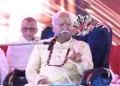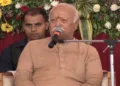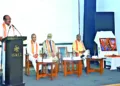

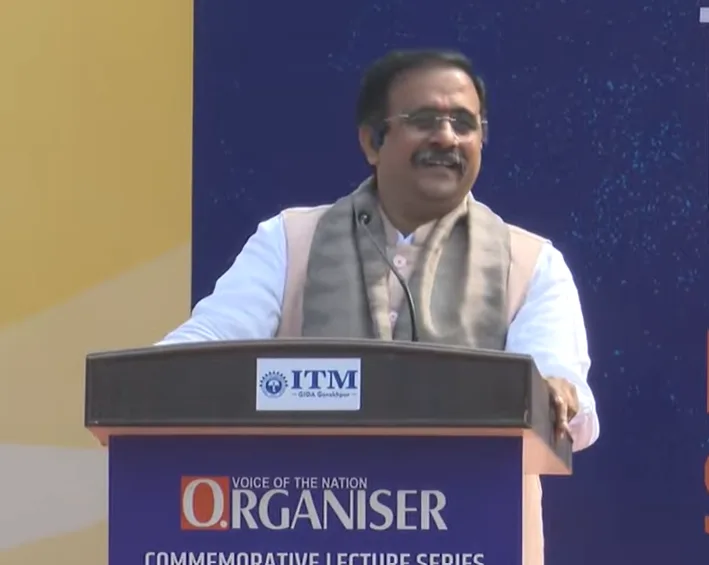
“When we talk about the Bhagavad Gita, many people think of it as a book to be read after retirement. The Bhagavad Gita is a conversation between Bhagwan Shri Krishna and Arjuna. The person who speaks, Shri Krishna, had lifted Govardhan Parvat on his finger at the age of 12. The person who was listening, Arjuna, was a warrior who could wield a 40-kg bow 24/7. This shows that the Gita can be easily understood by youth only. Hence, the youth must read the Bhagavad Gita; it should be read by all brave young people,” said Mukul Kanitkar, sadasya, Akhil Bharatiya Prachar Toli, Rashtriya Swayamsevak Sangh (RSS), at Organiser’s Commemorative Lecture Series ‘Resolve for Selfless Service’, Part-3, on the occasion of 100 years of RSS at ITM GIDA, Gorakhpur, on February 7.
He said Dr Hedgewar ji, the founder of RSS, worked with Bal Gangadhar Tilak, who had also written a book on the Bhagavad Gita. Thus, the Bhagavad Gita has been an inspiration for the Sangh. It also inspired many revolutionaries who fought for India’s independence. With the principle of “Rashtra nirman ke liye vyakti nirman” (nation-building through character-building), RSS has been working along the same lines, which closely align with the teachings of the Bhagavad Gita.
The Pandavas, though fewer in number, emerged victorious over the Kauravas because Bhagwan Shri Krishna kept them organised. Similarly, RSS has been working to organise society, said Mukul Kanitkar.
#LIVE | @eOrganiser Commemorative Lecture Series – 100 Years of RSS
Shri Mukul Kanitkar (@mukulkanitkar), Member, Akhil Bharatiya Prachar Toli, RSS (@RSSorg), is addressing the session on “Resolve for Selfless Service” at ITM GIDA, Gorakhpur, Uttar Pradesh.
📺 Tune in live 🔗:… pic.twitter.com/87WO1LcoYW
— Organiser Weekly (@eOrganiser) February 7, 2026
Citing the example of the 1971 Bangladesh Liberation War, he said that 93,000 Pakistani soldiers surrendered before 3,000 Bharatiya soldiers because Pakistan lacked the guiding philosophy of the Bhagavad Gita. The Bhagavad Gita kept Bharatiya soldiers organised, and owing to this, India defeated Pakistan.
“In a war, it is not necessary that everyone must take up weapons. Bhagwan Shri Krishna only guided Arjuna, and the Pandavas defeated the Kauravas. RSS also follows this path by awakening people to serve the motherland selflessly,” said Mukul Kanitkar.
Discipline is the core of the Sangh’s shakha, and the Bhagavad Gita also teaches the same. “Sangh is the Bhagavad Gita in action in the modern context. Mere individual character is not sufficient; national character is critical,” Kanitkar further added.
Wherever there is a calamity, RSS swayamsevaks quickly begin helping people without thinking about themselves. Kanitkar said, “The Bhagavad Gita teaches us to perform our karma without thinking about the results. The same principle applies to RSS. In the Sangh, one must work selflessly for the motherland. To understand the Sangh, one must think in terms of collective work.”
On this occasion, Ashutosh Singh, HoD, Electronics, IIIT Allahabad, said, “What is not in our destiny can be achieved by following the path shown by the Bhagavad Gita in our lives.” He also said that prominent scientists like Dr A P J Abdul Kalam and Vikram Sarabhai drew inspiration from the Bhagavad Gita.
While briefing about the journey of Organiser, Prafulla Ketkar, Editor, Organiser, said, “The journey of the Sangh began with organising society. The main motto of the Sangh was to awaken a society that was suffering exploitation under colonial forces and to remove internal differences. Over the last 100 years, the Sangh has taken many initiatives for society. As the Sangh completes 100 years, Organiser weekly also wanted to contribute to this milestone. Therefore, we have initiated a lecture series across the country.”
Notably, the book Resolve for Selfless Service, edited by Prafulla Ketkar, was also released. Prof N K Singh, Director, IMT, felicitated Mukul Kanitkar. Many eminent personalities, thinkers, and students attended the lecture.