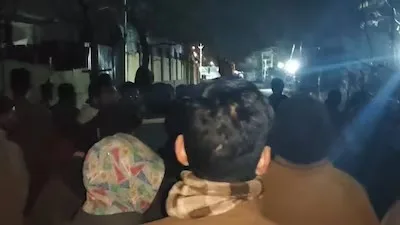
Anti-Pakistan slogans echoed through the Sumbal area of Jammu and Kashmir’s Bandipora district on Feb 6, as members of the Shia community staged protests hours after a deadly suicide bombing ripped through a Shia mosque in Islamabad, killing at least 31 people and injuring 169 others.
Protesters condemned Pakistan’s continued failure to protect its Shia minority and demanded an immediate end to sectarian killings, which have claimed hundreds of lives over the past decade. Chanting pro-India slogans, demonstrators accused Pakistan of allowing extremist groups to operate with impunity while religious minorities remain soft targets.
Visuals from the protest showed demonstrators holding placards and raising slogans against Pakistan, calling out what they described as institutional apathy toward repeated attacks on Shia places of worship.
Islamabad Blast: Shia Imambargah Turned into killing ground
The suicide attack took place at the Tarlai Imambargah, a prominent Shia mosque located in Islamabad’s Shehzad Town area, during Friday prayers. According to Pakistani authorities, the explosion occurred near the entrance of the mosque, causing maximum casualties among worshippers gathered inside.
Police and rescue teams rushed to the spot as scenes of chaos unfolded. Videos circulating on social media showed bodies lying near the mosque’s gate, blood-stained prayer mats, scattered shoes, and debris strewn across the red-carpeted prayer hall.
Pakistan’s Defence Minister Khawaja Asif stated that the attacker was intercepted by security personnel and detonated himself while standing among worshippers.
Pattern of Sectarian Targeting of Shias
The attack has once again drawn attention to Pakistan’s long-standing sectarian fault lines, with Shia Muslims frequently targeted by terror outfits such as the Tehreek-e-Taliban Pakistan (TTP) and the Islamic State (ISIS).
Conflict monitoring group ACLED described the bombing as the deadliest suicide attack in Islamabad in over a decade and said the modus operandi bore the hallmarks of Islamic State operations.
Pakistan’s Minister of State for Interior Tallal Chaudhry admitted that terrorists had “reached the extremes of cowardliness,” noting that they were deliberately attacking soft targets including mosques, imambargahs, schools, markets, and courts.
“This was not just an attack on worshippers, but on Pakistan’s internal security and social cohesion,” he said.
Political Condemnation Amid Public Anger
Pakistan Prime Minister Shehbaz Sharif and Deputy Prime Minister Ishaq Dar condemned the attack, but the statements failed to calm public anger, particularly among the Shia community, which has repeatedly accused successive governments of offering condolences without concrete action.
The Islamabad blast occurred less than three months after another suicide attack outside a district and sessions court in the capital killed 12 people in November 2025, underlining the deteriorating security situation even in Pakistan’s most heavily guarded city.
The Bandipora protest is being seen as a symbolic expression of solidarity with Shia victims in Pakistan and a sharp indictment of Islamabad’s inability to control sectarian terror within its borders.
Local Shia leaders in Kashmir said the Islamabad bombing was not an isolated incident but part of a sustained campaign of violence against Shias in Pakistan, including attacks on imambargahs, religious processions, and community leaders.
As sectarian violence continues to destabilise Pakistan internally, the anger witnessed on the streets of Bandipora highlights how such attacks reverberate beyond borders, exposing deep-rooted ideological and security failures within the Pakistani state.