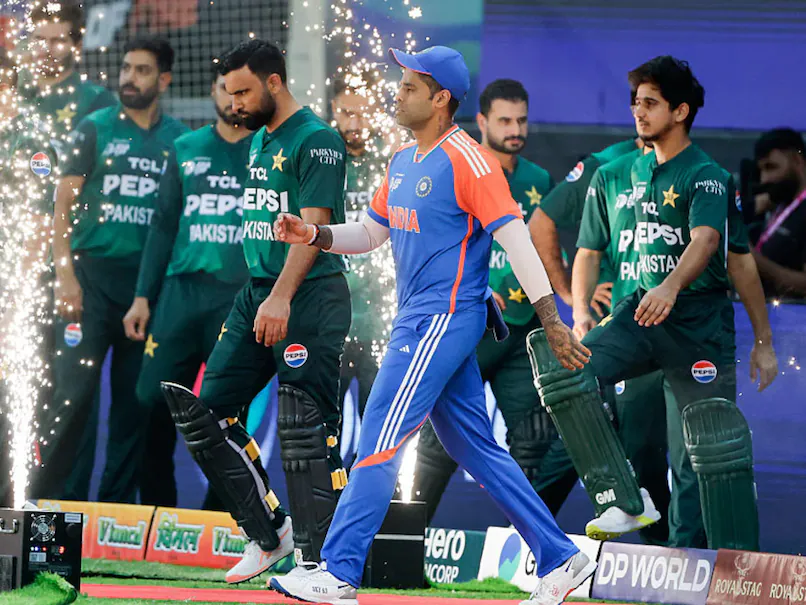
Amid growing uncertainty over the India-Pakistan clash in the T20 World Cup 2026, Indian T20 skipper Suryakumar Yadav has categorically stated that India has never declined to play its arch-rivals, exposing what many are calling Pakistan’s attempt to play the victim after opting out of the match. Speaking publicly for the first time on the controversy, Suryakumar made it clear that India remains fully prepared for the February 15 fixture, while the refusal came from Pakistan’s side.
Addressing the media during the captains’ day event ahead of the tournament, Suryakumar dismissed speculation that India was reluctant to face Pakistan. “Humne mana nahi kiya hai khelne. Unhone mana kiya hai. Hamara flights booked hai Colombo ke liye (We haven’t refused to play. They have. Our flights to Colombo are already booked),” the Indian captain said, underlining that the team has followed every protocol laid down by the ICC.
Detailing India’s travel plans, Suryakumar added, “Pehle hum yahan khelenge, phir Delhi jaayenge, phir wahaan se Colombo jaayenge (First we will play here, then go to Delhi, and from there travel to Colombo). Their decision is not in my control.” His remarks firmly put to rest claims that India was responsible for the uncertainty surrounding the marquee clash.
Pakistan’s denial and hypocrisy
The controversy erupted after Pakistan’s government reportedly denied permission for its national team to play the high-profile encounter in Colombo. While Islamabad has not officially stated the reason, the move is being projected as a political gesture, even as Pakistan continues to position itself as a victim on the global stage.
Many have pointed out the glaring hypocrisy in Pakistan’s stance, a country that has long been accused internationally of exporting terrorism, sponsoring cross-border attacks, and providing safe havens to terror groups targeting Indian civilians and security forces. Despite illegally occupying parts of Jammu and Kashmir and presiding over decades of cross-border terrorism that has claimed countless innocent lives in India, Pakistan has now chosen to opt out of a cricket match while citing political sensitivities.
Pakistan are scheduled to play all their T20 World Cup matches in Sri Lanka under a hybrid model agreed upon by the Pakistan Cricket Board (PCB), the Board of Control for Cricket in India (BCCI), and the International Cricket Council (ICC). The India-Pakistan clash in Colombo was part of this very arrangement, making Islamabad’s last-minute refusal all the more contentious.
ICC warns of sanctions
The ICC has already cautioned the PCB that any unilateral boycott of the India-Pakistan match could invite punitive sanctions. According to sources quoted in media, the global governing body has conveyed that such a move would not be in the broader interest of the game, especially given the unparalleled sporting, commercial and broadcast value of the fixture.
The India-Pakistan match remains the most-watched encounter in any ICC tournament, drawing peak global viewership, massive sponsorship interest and significant revenue for world cricket.
Bangladesh angle adds fuel
The diplomatic tension has been further complicated by developments involving Bangladesh cricket. Bangladesh were earlier knocked out of the tournament after refusing to play their matches in India, citing security concerns. This followed the controversial removal of Bangladesh pacer Mustafizur Rahman from the IPL on BCCI instructions, though no official reason was publicly cited.
Pakistan and its drama on field
The controversy first crystallised during the Asia Cup in September 2025, when Pakistan wicketkeeper-batter Mohammad Rizwan offered namaz on the field during a break, an act that immediately drew sharp reactions. Indian lawyer Vineet Jindal subsequently lodged a formal complaint with the International Cricket Council (ICC), arguing that Rizwan’s public religious display during an international fixture violated the principles of neutrality and sportsmanship expected under the ICC’s Code of Conduct.
Pakistan’s conduct during the tournament phase did not end there. The team continued to draw criticism for repeated gestures and on-field actions that injected religious symbolism into international cricket, even as it later sought to portray itself as aggrieved.
The strain was also reflected in the continued no-handshake policy between India and Pakistan. During the Under-19 World Cup 2026 Super Six clash at Queens Sports Club in Bulawayo on February 1, captains Ayush Mhatre and Farhan Yousaf once again avoided any customary exchange at the toss, carrying forward a stance shaped by earlier provocations rather than spontaneous hostility. Significantly, this policy originated after the Asia Cup 2025, which occurred soon afterthe Pahalgam terror attacks, and has since been consistently followed across senior, emerging and Under-19 tournaments.
Also, India’s five-wicket win over Pakistan in the Asia Cup final in September 2025 was followed by unprecedented scenes as the Indian team refused to accept the trophy at a presentation ceremony. The decision was taken because the trophy was to be presented by ACC president Mohsin Naqvi, who was also Pakistan’s Interior Minister and PCB chairman. “We decided not to take the trophy from a political leader of Pakistan,” BCCI secretary Devajit Saikia said, adding that it was “unfortunate” the trophy and medals were taken away and that a strong protest would be raised at the next ICC conference. The ceremony eventually ended without India collecting the silverware, prompting captain Suryakumar Yadav to say he had “never seen a champion team denied a hard-earned trophy,” a controversy that ultimately overshadowed the thrilling final itself.
Taken together, these episodes reveal a sustained pattern in which Pakistan’s own actions repeatedly triggered controversy, followed by attempts to reframe the fallout as victimhood.
India stays focused on the game
Despite the escalating rhetoric, the Indian camp has maintained that its focus remains squarely on cricket and tournament preparation. With the T20 World Cup set to begin on February 7, India is proceeding strictly according to schedule, leaving the final decision on the India-Pakistan clash to the ICC and the participating boards.
For now, Suryakumar Yadav’s message is unambiguous: India is ready, willing and prepared and it is Pakistan that has chosen to step away while attempting to claim the moral high ground.