A prime-time national television debate rarely collapses into theatre without consequence, but when it does, the aftershocks often reveal more than the original incident. That was precisely the case after a live Times Now debate on language politics and alleged “Hindi imposition” descended into chaos following the conduct of DMK spokesperson ‘Melting Point’ Saravanan. What followed was not merely a viral moment of embarrassment for a political party but a telling episode about how sections of the media selectively invoke journalistic ethics, depending on who is under scrutiny.
The on-air breakdown
The incident unfolded during a discussion on the politics of language, a subject long weaponised in Tamil Nadu’s Dravidian discourse. BJP spokesperson Shehzad Poonawalla posed pointed questions to Saravanan, pressing him on the ideological roots of the DMK’s cultural narrative, particularly the political context surrounding the film Parasakthi, the period of alleged Hindi imposition, and the apparent contradiction of the DMK’s present alliance with the Congress.
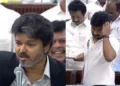
Rather than responding with facts, historical argument or political reasoning, Saravanan abruptly broke into loud, prolonged, almost ghostly laughter. The laughter was not fleeting, it continued for several seconds, drowning out the discussion and visibly unsettling other panellists. The anchor struggled to regain control as the studio descended into an awkward pause, transforming what was meant to be a political debate into a moment of televised absurdity.
Goel or Goebbels!
If there’s a competition between them, we will not be able to predict the winner.
Nepo Kid @PiyushGoyal who has ground our manufacturing is speaking about the competence of our DMK govt.
Skill India program is tangled in 10,000 crore scam but gives us… pic.twitter.com/6V9pu6qrNI
— Saravanan Annadurai (@saravofcl) February 1, 2026
Earlier in the same debate, Saravanan had complained about being invited to an English-language programme where Hindi was spoken, calling it a routine irritation. The laughter, however, erupted precisely when he was confronted with uncomfortable questions about DMK’s ideological consistency and alliance politics, questions he chose not to answer.
The clip spread rapidly across social media, with many viewers describing it not as debate but as a meltdown, an attempt to overwhelm scrutiny with noise rather than respond to substance.
Editing the narrative
Soon after, Saravanan shared a carefully edited three-minute clip of the debate on social media, conspicuously excluding the laughter episode that had gone viral. In his post, he shifted focus away from his own conduct, launching a political attack instead. Taking aim at Union Minister Piyush Goyal and the BJP, Saravanan accused the party of hypocrisy, invoked allegations of economic mismanagement, and framed himself as a victim of biased television journalism.
Nothing more satisfying than seeing @arivalayam spokesperson getting roasted and exposed on national media by @Shehzad_Ind ! Do watch pic.twitter.com/NBelyWtpds
— Vinoj P Selvam (@VinojBJP) February 1, 2026
By omitting the most controversial moment, the post attempted to recast the narrative, from an unanswered question and on-air breakdown to an ideological confrontation with the ruling party at the Centre.
Chitra Subramaniam enters the frame
It was at this point that senior journalist Chitra Subramaniam, co-founder of The News Minute, stepped in. Sharing Saravanan’s edited clip, she criticised the television channel rather than the DMK spokesperson’s conduct, writing that the episode exposed the “arrogance” and “mediocrity” of English-language news networks. Declaring that “journalism is a public good,” she framed the controversy as an indictment of television journalism rather than a failure of political accountability.
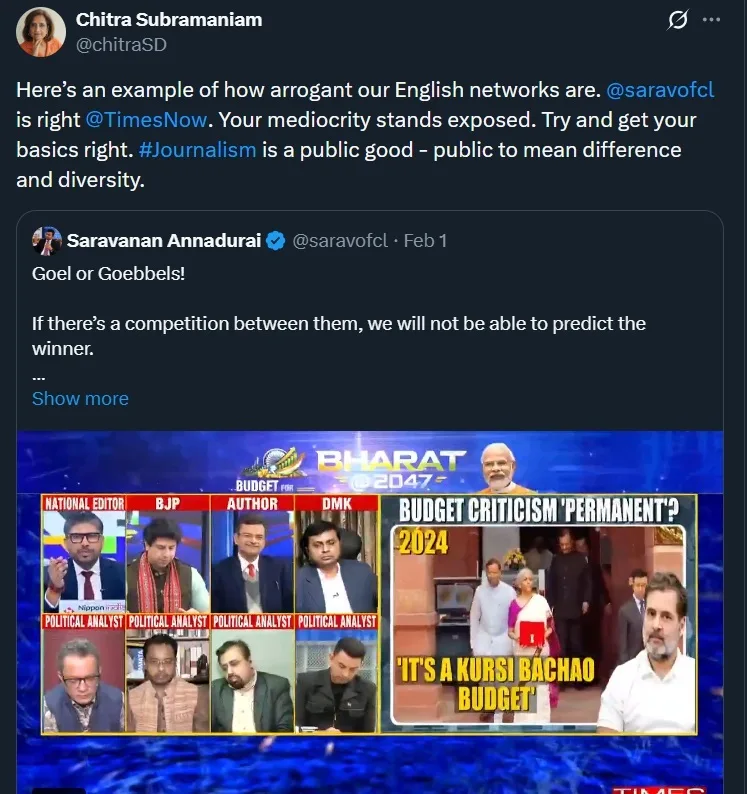
What stood out was not merely her defence of Saravanan but what her response excluded. There was no criticism of a political spokesperson evading questions, no concern over substituting debate with theatrics, and no acknowledgement that turning a national platform into a spectacle undermines democratic discourse.
For a journalist who frequently positions herself as a defender of free speech and ethical journalism, the silence on Saravanan’s behaviour was striking.
Selective ethics and familiar patterns
Media was quick to point out that Chitra Subramaniam’s invocation of journalistic ethics appears highly selective. Her public record, they argue, reflects outrage when the DMK or its spokespersons are challenged but conspicuous silence when alleged abuses occur closer to the party’s ecosystem.
There was little to no public condemnation from her when BJP Youth Wing Tamil Nadu State President SG Suryah was allegedly assaulted by DMK cadres posing as journalists. Similarly, allegations that journalists were kidnapped and assaulted by a DMK MLA and his associates for reporting on illegal quarrying failed to elicit comparable lectures on journalism as a “public good.”
In those instances, the media freedom Subramaniam now champions appeared absent from her commentary.
The contrast, reveals a troubling pattern: when a DMK spokesperson is embarrassed on national television, the blame is shifted to “arrogant English media”; when journalists themselves face alleged violence in Tamil Nadu, the moral urgency evaporates.
The News Minute and questions of credibility
The controversy has also revived scrutiny of The News Minute itself, a portal often accused by critics of functioning as a DMK-friendly echo chamber.
Over the years, the outlet has faced repeated allegations of publishing poorly substantiated stories and repackaging old material as fresh investigative reporting. Its controversial coverage of the Dharmasthala temple case, widely criticised for lacking verification, was never formally corrected or withdrawn. More recently, the portal drew backlash for presenting an old court case involving entrepreneur Sridhar Vembu as a new exposé, a move many described as clickbait journalism rather than evidence-driven reporting.
Against this backdrop, lectures on journalistic “basics” and accusations of mediocrity directed at others ring hollow to many observers.
Adding to the irony is Subramaniam’s own social media practice. While championing free speech and castigating journalists for linguistic or professional shortcomings, she routinely keeps replies disabled on her posts, shielding herself from dissent or critical engagement. For critics, the contradiction is hard to ignore.
From Bofors to blind spots
Chitra Subramaniam’s defenders often invoke her role in exposing the Bofors scandal, one of the most significant investigative stories in Indian journalism. That legacy, however, has increasingly come under strain as her present-day interventions appear driven less by principle and more by political alignment.
The Saravanan episode ultimately exposed more than an awkward television moment. It highlighted a broader crisis within Indian media discourse, where claims of neutrality and ethics are often deployed selectively. When political allies falter, the media becomes the villain; when opponents are questioned, standards and decorum suddenly matter.
For viewers, Saravanan’s laughter may have been embarrassing. But what followed, the reflexive defence from sections of the media establishment proved more revealing. It underscored how quickly principles are abandoned when they threaten preferred politics.
In an era where journalism increasingly competes with activism, the question is no longer whether bias exists, but whether those who claim the moral high ground are willing to apply their standards evenly. On that count, this episode has left uncomfortable questions hanging in the air, unanswered, much like the question Saravanan chose to laugh away.