Swadeshi at core: Everything Nirmala Sitharaman said about govt’s Swadeshi-first strategy in Budget 2026
September 13, 2026
  • Read Ecopy
  • Circulation
  • Advertise
  • Careers
  • About Us
  • Contact Us
Android AppiPhone AppArattai
Organiser
  • ‌
  • Bharat
    • Assam
    • Bihar
    • Chhattisgarh
    • Jharkhand
    • Maharashtra
    • View All States
  • World
    • Asia
    • Europe
    • North America
    • South America
    • Africa
    • Australia
  • Editorial
  • International
  • Opinion
  • RSS @ 100
  • More
    • World Hindu Congress 2026
    • Op Sindoor
    • Analysis
    • Sports
    • Defence
    • Politics
    • Business
    • Economy
    • Culture
    • Special Report
    • Sci & Tech
    • Entertainment
    • G20
    • Azadi Ka Amrit Mahotsav
    • Vocal4Local
    • Web Stories
    • Education
    • Employment
    • Books
    • Interviews
    • Travel
    • Law
    • Health
    • Obituary
  • Subscribe
    • Subscribe Print Edition
    • Subscribe Ecopy
    • Read Ecopy
  • ‌
  • Bharat
    • Assam
    • Bihar
    • Chhattisgarh
    • Jharkhand
    • Maharashtra
    • View All States
  • World
    • Asia
    • Europe
    • North America
    • South America
    • Africa
    • Australia
  • Editorial
  • International
  • Opinion
  • RSS @ 100
  • More
    • World Hindu Congress 2026
    • Op Sindoor
    • Analysis
    • Sports
    • Defence
    • Politics
    • Business
    • Economy
    • Culture
    • Special Report
    • Sci & Tech
    • Entertainment
    • G20
    • Azadi Ka Amrit Mahotsav
    • Vocal4Local
    • Web Stories
    • Education
    • Employment
    • Books
    • Interviews
    • Travel
    • Law
    • Health
    • Obituary
  • Subscribe
    • Subscribe Print Edition
    • Subscribe Ecopy
    • Read Ecopy
Organiser
  • Home
  • Bharat
  • World
  • Operation Sindoor
  • Editorial
  • Analysis
  • Opinion
  • Culture
  • Defence
  • International Edition
  • RSS @ 100
  • Magazine
  • Read Ecopy
Home Politics

Swadeshi at core: Everything Nirmala Sitharaman said about govt’s Swadeshi-first strategy in Budget 2026

Finance Minister Nirmala Sitharaman placed Swadeshi production at the heart of the Union Budget 2026-27, unveiling a six-point strategy to make domestic industry the primary engine of India’s long-term economic growth. From semiconductors and biopharma to textiles, MSMEs and green technologies, the Budget signalled a decisive shift from capacity creation to value-chain depth and Indian intellectual property

Shashank Kumar DwivediShashank Kumar Dwivedi
Feb 2, 2026, 12:00 pm IST
inPolitics, Bharat, Business, Economy
Follow on Google News
Union Budget 2026 | FM Nirmala Sitharaman

Union Budget 2026 | FM Nirmala Sitharaman

Facebook
Twitter
WhatsAppTelegramEmail

Finance Minister Nirmala Sitharaman on Saturday (Feb 1, 2026) laid out an expansive Swadeshi-first economic roadmap in the Union Budget 2026-27, positioning domestic production, technological self-reliance and value-chain integration as the central pillars of India’s growth strategy.

Presenting the Budget in Parliament, Sitharaman announced a six-point framework aimed at accelerating economic expansion with Swadeshi industry as its primary engine, marking a clear intent to move beyond mere assembly and import substitution towards deeper technological capability, export competitiveness and indigenous intellectual property.

The six-point Swadeshi framework

The six pillars outlined by the Finance Minister include:

1. Scaling up Swadeshi production in seven strategic and frontier sectors
2. Rejuvenating legacy industrial sectors to preserve jobs and regional economies
3. Creating champion MSMEs through targeted funds and institutional support
4. Delivering a major push for infrastructure
5. Ensuring long-term security and economic stability
6. Developing city economic regions as growth hubs

Swadeshi production features prominently in the first three pillars, underlining the government’s focus on technology depth, domestic supply chains and employment-intensive growth.

India Semiconductor Mission 2.0

A major announcement under the Swadeshi push was the launch of India Semiconductor Mission (ISM) 2.0 with an outlay of Rs 40,000 crore. Building on ISM 1.0, which expanded India’s semiconductor assembly and fabrication ecosystem, the new phase will focus on industry-led research and training centres.

The emphasis will be on developing semiconductor technologies, equipment and materials tailored to Indian needs, with a clear shift towards “producing equipment and materials designed for full-stack Indian IP.” This marks a strategic move away from assembly-driven participation to deeper involvement across the semiconductor value chain.

Biopharma SHAKTI

To establish India as a global biopharmaceutical hub, the Budget proposed Biopharma SHAKTI, with an allocation of Rs 10,000 crore over five years.

The initiative includes the creation of a biopharma network supported by three new National Institutes of Pharmaceutical Education and Research (NIPERs), upgrades to seven existing NIPERs, the establishment of 1,000 accredited clinical trial sites, and the upgradation of the Central Drugs Standard Control Organisation to align with global regulatory standards.

Electronics components manufacturing

To reduce import dependence in a sector critical to smartphones, automobiles and defence, the Budget proposed an Electronics Components Manufacturing Scheme aimed at deepening domestic supply chains and strengthening Swadeshi production capabilities.

Rare earth corridors

Recognising the strategic importance of critical minerals, the government announced dedicated rare earth corridors in Odisha, Kerala, Andhra Pradesh and Tamil Nadu. These corridors will promote mining, processing, research and manufacturing of rare earth permanent magnets, which are essential for electric vehicles, wind turbines and defence applications.

Chemical parks

Three dedicated chemical parks were announced to strengthen India’s position in speciality and bulk chemicals, a sector seen as vital for both domestic consumption and exports.

Container manufacturing

A new scheme for shipping container manufacturing was announced, with ₹10,000 crore allocated over five years. The objective is to build a globally competitive Swadeshi ecosystem and reduce India’s dependence on imported containers.

Textiles

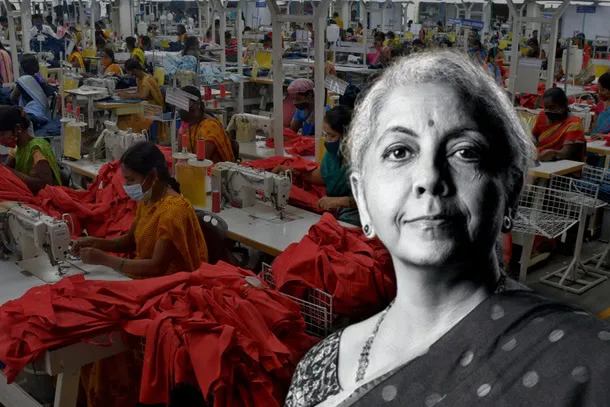
The Budget laid out an ambitious integrated programme for textiles aimed at growth, employment generation and global competitiveness.

Large textile parks will be developed through a “challenge mode”, a competitive process where private players bid to build and operate facilities. A special focus will be placed on technical textiles and value addition.

A five-part support package for the textile sector includes:

1. National Fibre Scheme to achieve self-reliance in natural, man-made and modern fibres
2. Textile Expansion and Employment Scheme to modernise existing clusters with better machinery, shared testing and certification facilities
3. National Handloom and Handicrafts Programme to consolidate support for artisans and weavers
4. TEX-ECO initiative to promote environmentally sustainable and globally competitive textile production
5. SAMARTH 2.0, an upgraded skilling programme in collaboration with industry and educational institutions

Additionally, Sitharaman announced the Mahatma Gandhi Gram Swaraj Initiative, aimed at strengthening khadi, handlooms and handicrafts by improving branding, market access, training and quality certification, including access to global markets.

Legacy industries and MSMEs

To address regional imbalances and employment concerns, the Budget announced a scheme to revive 200 legacy industrial clusters, traditional Swadeshi production centres that have declined but retain skilled labour and local economic importance.

For MSMEs, a Rs 10,000 crore fund was proposed to create “champion” enterprises, alongside the establishment of two high-tech tool rooms to boost capital goods manufacturing.

Capital goods and sports goods

The Finance Minister announced initiatives to promote high-value construction and infrastructure equipment manufacturing. India’s potential to emerge as a global hub for affordable, high-quality sports goods was also highlighted, with proposals for research and production support.

Green Swadeshi manufacturing

To align Swadeshi production with sustainability goals, the Budget allocated Rs 20,000 crore over five years for Carbon Capture, Utilisation and Storage (CCUS) technologies, aimed at scaling green manufacturing and improving readiness for end-use applications.

The Swadeshi push comes amid global trade disruptions, including higher US tariffs on Indian exports. The Economic Survey 2025-26 had earlier stressed the need to strengthen domestic production and reduce import dependence, particularly in electronics and critical minerals.

The Budget extends the Production-Linked Incentive framework to new sectors while deepening supply chains in existing ones. “Keeping atmanirbharta as a lodestar, we have built domestic manufacturing capacity, energy security and reduced critical import dependencies,” Sitharaman said in her speech.

The focus on full-stack Indian IP, clinical trial infrastructure, rare earth processing and legacy cluster revival reflects an attempt to move up the value chain while addressing employment realities.


Topics: Nirmala Sitharaman“Atmanirbharta”domestic manufacturingUnion Budget 2026Swadeshi Strategy
Share
Tweet
SendShareSend
✮ Subscribe Organiser YouTube Channel. ✮
✮ Join Organiser's WhatsApp channel for Nationalist views beyond the news. ✮
Previous News

Kerala: Metro Man E Sreedharan kicks off groundwork for semi-high-speed rail, opens project office in Malappuram

Next News

Budget 2026: Striking a balance between hope and hype

Related News

Union Finance Minister Nirmala Sitharaman refutes claims of upcoming UPI transaction fees.

Fact Check: Nirmala Sitharaman rebuts Jairam Ramesh’s UPI ‘MDR’ claim, says users will not be charged

Fact Check: PIB debunks AI deepfake falsely showing FM Nirmala Sitharaman endorsing Rs 70,000 a day investment scam

Representative image

Cockroach Syndrome: The new face of anti-India tech cynicism

Prime Minister Narendra Modi

PM Mudra Yojana Completes 11 Years: Over Rs 40 lakh crore disbursed, empowering crores of grassroots entrepreneurs

India emerges as a rising global arms supplier, crossing Rs 38,000 crore in defence exports amid strong policy push

India’s Defence Exports hit record Rs 38,424 crore in FY26, jump 62.66 per cent on rising global demand

(From L to R)Dr RS Goswami, CMD, Hind Pharma, Harish Joshi, Director, Sumangalam Formulations Pvt Ltd, Mitesh K Lokwani,MD, HLBS TECH (P) LTD, Adhyaksh, Laghu Udyog Bharati, Bhopal and Prafulla Ketkar, Organiser Editor

Abhyudaya – Industry Leadership Conclave 2026: Industrious wisdom for young entrepreneurs

Load More

Latest News

RSS Sarsanghchalak Dr Mohan Bhagwat, attended the 37th annual prize distribution ceremony ‘Swaraj’ at L.K. Singhania Education Centre

Education must go beyond livelihood and focus on holistic human development: Dr Mohan Bhagwat

(Left) Prime Minister Narendra Modi and Russian President Vladimir Putin (Right) Prime Minister Narendra Modi and Chinese President Xi Jinping in the backdrop of the Rameshwaram temple corridor in the backdrop of the BRICS 2026 summit

Bharat’s civilisational pride at BRICS 2026: Rameswaram temple corridor frames world leaders

The Bottle, the Broom & the Cockroach: How intoxication makes history and suffering disappear!

ABVP releases manifesto for upcoming DUSU elections

DUSU Elections 2026: ABVP releases student centric manifesto; ‘A- Awas, B- Bhagidari, V- Vishwas, P-Parinaam’

ED raid confirms PWD irregularities; Karnataka PWD Minister Satish Jarkiholi

PWD bribe allegations rock Karnataka as ED raids Satish Jarkiholi-Linked premises

BRICS Summit 2026: Iran-UAE talks amid West Asia conflict; Reflects India’s diplomatic clout for regional peace

Mamata Banerjee, former Chief Minister of Bengal

Will Mamata Banerjee fight Nandigram again? TMC rebels offer to stay out

FACT CHECK: ‘Poha For World Leaders’ Claim Blown Apart, Food Was For Journalists (Image generated using AI)

FACT CHECK: Were BRICS leaders served with ‘Poha’? viral claim is completely false

Chinese President Xi Jinping and Prime Minister Modi at BRICS Summit, 2026

BRICS Summit: China inks declaration on Pahalgam attack & counter-terrorism; India’s win amid Beijing-Islamabad ties

FACT CHECK: No Proof That Bangladesh’s Stolen Lemurs Were Found at Vantara

FACT CHECK: Bangladesh claims stolen Lemurs found at Vantara, but where’s the proof?

Load More
  • Privacy
  • Terms
  • Cookie Policy
  • Refund and Cancellation
  • Delivery and Shipping

© Bharat Prakashan (Delhi) Limited.
Tech-enabled by Ananthapuri Technologies

  • Home
  • Search Organiser
  • Bharat
    • Assam
    • Bihar
    • Chhattisgarh
    • Jharkhand
    • Maharashtra
    • View All States
  • World
    • Asia
    • Africa
    • North America
    • South America
    • Europe
    • Australia
  • Editorial
  • Operation Sindoor
  • Opinion
  • Analysis
  • Defence
  • Culture
  • Sports
  • Business
  • RSS @ 100
  • Entertainment
  • More ..
    • Sci & Tech
    • Vocal4Local
    • Special Report
    • Education
    • Employment
    • Books
    • Interviews
    • Travel
    • Health
    • Politics
    • Law
    • Economy
    • Obituary
  • Subscribe Magazine
  • Read Ecopy
  • Advertise
  • Circulation
  • Careers
  • About Us
  • Contact Us
  • Policies & Terms
    • Privacy Policy
    • Cookie Policy
    • Refund and Cancellation
    • Terms of Use

© Bharat Prakashan (Delhi) Limited.
Tech-enabled by Ananthapuri Technologies