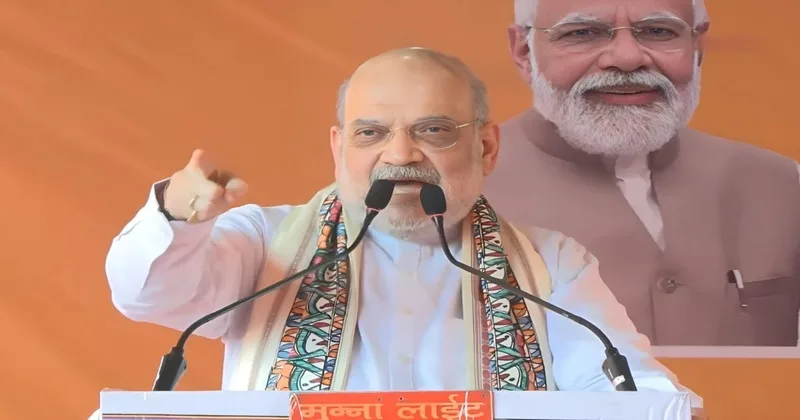
Union Home Minister Amit Shah on January 31, launched a blistering political and administrative critique of the West Bengal government in the aftermath of the deadly warehouse fire in Kolkata’s Anandapur area, alleging that the tragedy was not an accident but the result of entrenched corruption, regulatory collapse, and official apathy.
Addressing the BJP Karyakarta Sammelan in North 24 Parganas, Shah said the incident exposed the “true state of governance” in West Bengal and raised disturbing questions about how commercial establishments were allowed to operate in gross violation of safety norms while workers were left to die trapped inside.
Referring specifically to the fire that engulfed a decorator’s warehouse and spread to an adjoining godown reportedly used by popular food chain Wow! Momo, Shah said the blaze bore all the hallmarks of systemic failure rather than misfortune. “This was not an accident,” he asserted, adding that corruption had created conditions where human lives were treated as expendable.
Paying tribute to the workers who lost their lives, Shah questioned the financial and administrative background of the warehouse operations. “Whose money is parked in the momo factory? With whom did the owner travel abroad? Why has the owner not been arrested yet?” he asked, directly accusing the state government of shielding influential individuals instead of acting swiftly against those responsible.
The Union Home Minister alleged that despite the scale of the tragedy, the response of the state administration was shockingly delayed. According to Shah, a senior minister visited the site nearly 32 hours after the fire broke out. “Labourers were trapped inside, screaming for help, and the government remained silent,” he said, accusing the ruling Trinamool Congress (TMC) of criminal negligence.
Shah urged Chief Minister Mamata Banerjee to immediately order a full-fledged, time-bound investigation and ensure that accountability is fixed at every level — from warehouse owners and safety inspectors to local administrative officials. “Those responsible must go to jail,” he said, warning that cosmetic inquiries would not bring justice to the families of the victims.
The fire erupted late at night at a decorator’s warehouse in the Anandapur industrial area and quickly spread to adjacent structures, including a godown used for storing packaging materials, beverages and other supplies. Many of the workers were reportedly asleep when the blaze began, leaving them little time to escape as flames and smoke rapidly engulfed the premises.
Rescue operations continued for several days amid fears that more bodies could still be buried under the debris. The official death toll has risen to 25, though authorities have cautioned that the number may increase as clearing work progresses. The tragedy has left dozens of families in anguish, many of whom are still searching for missing relatives.
Police officials said more than 20 DNA samples have been collected from family members to identify victims whose bodies were charred beyond recognition. Several families have also lodged missing person complaints, expressing fear that their loved ones may still be trapped beneath the rubble. Scenes outside hospitals and temporary morgues have been marked by grief, anger and desperation.
Preliminary investigations have pointed to serious lapses in fire safety compliance. The warehouse, spread across approximately 12,000 square feet, allegedly lacked adequate fire exits, functional alarms and emergency response mechanisms. Early observations suggest that inflammable materials were stacked near entry and exit points, obstructing movement and effectively turning the building into a death trap once the fire broke out.
Officials are now examining whether mandatory fire safety clearances were obtained, whether periodic inspections were conducted, and how such a large number of workers were allowed to stay overnight in a facility that may not have been authorised for residential use. The role of local civic authorities and labour departments is also under scrutiny.
The tragedy has intensified political tensions in West Bengal, with the BJP accusing the Mamata Banerjee government of fostering a culture of impunity for businesses with political connections. Leader of the Opposition Suvendu Adhikari visited the site of the fire and staged a protest, holding the Chief Minister personally responsible for what he described as “institutionalised negligence.”
Adhikari demanded the resignation of senior state officials and called for a judicial inquiry, alleging that similar violations across the state were being ignored due to corruption and patronage. BJP leaders have argued that the Anandapur fire is not an isolated incident but part of a broader pattern of safety lapses in factories, warehouses and construction sites across Bengal.
The Trinamool Congress, however, has rejected allegations of deliberate inaction and corruption, maintaining that rescue and relief efforts were launched immediately and that investigations are underway. State officials have announced compensation for the families of the deceased, though opposition leaders have dismissed the move as inadequate and reactive.
Amit Shah, however, insisted that compensation alone cannot substitute for justice. He warned that unless strict action is taken, such tragedies would continue to recur. “When corruption decides who gets licenses, who gets inspections, and who gets protection, workers pay with their lives,” he said.
The Home Minister also linked the incident to what he called a broader breakdown of law, order and governance in the state, accusing the TMC government of prioritising political survival over public safety. He said the Anandapur fire should serve as a wake-up call for the people of West Bengal ahead of the upcoming elections.
Concluding his address, Shah appealed to BJP workers to carry the message of accountability to every household. “This is not about politics alone. This is about whether a government values the lives of its workers or protects the powerful,” he said, reiterating that only a change in governance could prevent such disasters in the future.
As investigations continue and political rhetoric intensifies, the families of the victims remain caught between grief and uncertainty, waiting not just for answers, but for justice in a tragedy that has shaken Kolkata and once again raised troubling questions about safety, accountability and governance in West Bengal.