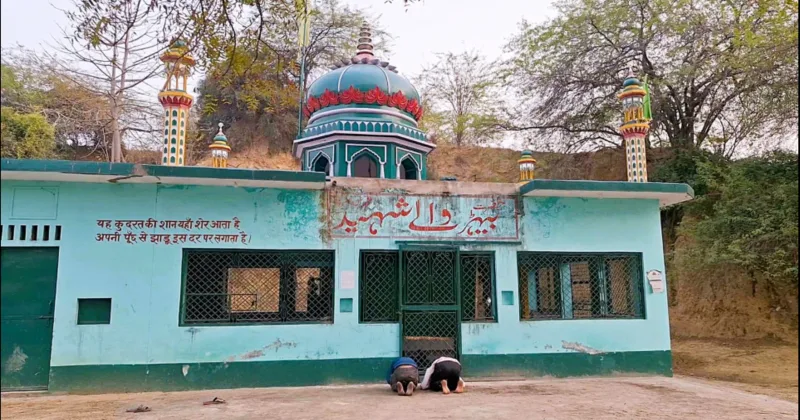
In the rugged, winding beehad of the Fisher Forest in Etawah, a centuries-old structure is finally facing a reckoning with history—and the bulldozer. The mazar of “Syed Baba,” long a site of local pilgrimage, has been identified by administrative and historical inquiries as the final resting place of Shamsuddin, a ruthless commander under the notorious Islamic invader Muhammad Ghori.
Following a complaint filed with Chief Minister Yogi Adityanath’s office, the Forest Department has labelled the structure an illegal encroachment on protected land. With no property documents produced to prove its legitimacy, the legal clock has run out, and the “Baba” of the beehad is about to be evicted by the rule of law.
The Sword Behind the Saintly Mask
To understand the significance of this demolition, one must look back at the late 12th century. Shamsuddin was not a “Sufi saint” of peace, as later lore often tries to paint such figures to make them palatable to the local populace. He was a high-ranking military general in the service of Muhammad Ghori, the man responsible for the fall of Prithviraj Chauhan’s kingdom and the subsequent waves of plunder across Northern India. Shamsuddin was instrumental in securing the regions around the Yamuna belt, including Etawah, for the Ghorid Empire through blood and iron. His presence in the beehad wasn’t for meditation; it was for subjugation. Historical records from the era of the Delhi Sultanate describe these commanders as the “Scourge of the Infidels,” tasked with dismantling local resistance and establishing an alien order on the ruins of indigenous culture.
The Irony of the Bow: A Masterclass in Idiocy
The move by the Yogi Adityanath government to clear this encroachment highlights a bizarre psychological phenomenon prevalent in the subcontinent. The beehad is often crowded with devotees—many of them descendants of the very people Shamsuddin’s armies once terrorised— who flock to offer chaddars and prayers. It is a peculiar brand of historical amnesia to see the children of a proud civilisation bowing before the grave of a man who likely burnt their ancestors’ homes.
This isn’t an isolated case of “Stockholm Syndrome” on a civilizational scale. Across India, there are numerous examples of invaders laughing from their graves at the sheer gullibility of the masses. Take the mazar of Ghazi Saiyyad Salar Masud (Bahraich), a nephew of Mahmud of Ghazni. Despite his mission being the total destruction of “idolaters,” he is worshipped today by the very people he sought to eliminate. Then there is Malik Itibar, a general under the brutal Khaljis, whose burial sites often become hubs for “miracle-seekers.”
The ultimate historical prank is played every time a local devotee asks for a “blessing” from a man whose only historical contribution was the humiliation of their lineage. These invaders didn’t just conquer land; they conquered the minds of future generations so thoroughly that the oppressed now guard the graves of their oppressors.
The Yogi Doctrine: Reclaiming the Land
The impending action in Etawah is part of a broader administrative drive to restore the sanctity of protected forest areas and rectify historical “land-grabs” disguised as religious sites. The
Forest Department’s notice was simple: show the papers. When the caretakers failed to produce a single scrap of evidence to prove ownership, it became clear that the mazar had been built on encroached state land over centuries of administrative apathy. By applying the law to the Fisher Forest, the administration is sending a clear message: the era of romanticising invaders is over.
The ghost of Shamsuddin is finally being told that his illegal stay on Indian soil has expired.