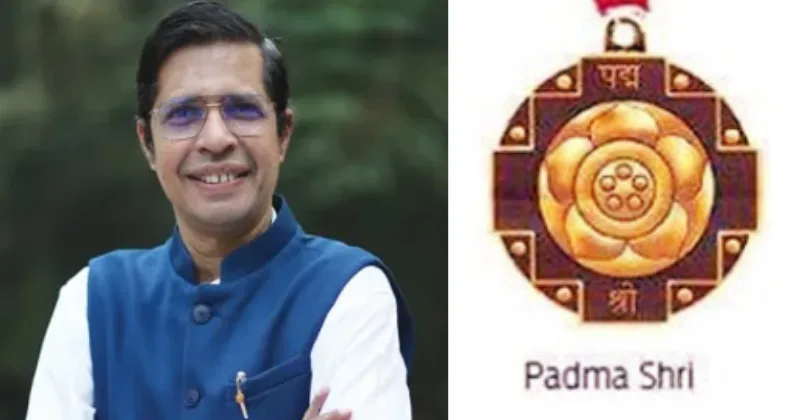
The conferment of the Padma Shri on Professor Kamakoti Veezhinathan in the 2026 honours list should have been a moment of national pride—an acknowledgement of an academician who has combined global-grade scientific excellence with deep Bharatiya civilisational rootedness. Instead, the recognition has triggered predictable hostility from sections of the Left-liberal academic and political ecosystem, revealing once again an entrenched discomfort with scholars who refuse to detach modern science from Indian values.
Professor Kamakoti is not merely a successful academician; he is one grounded unapologetically in Bharatiya thought and practice. That very grounding appears to be the reason he is being targeted. For decades, individuals like him—who challenge the colonial assumption that Indian knowledge systems are unscientific, insular, or unfit for the modern world—have remained inconvenient to ideologues who believe India must borrow legitimacy from the West to innovate.
The attacks follow a familiar pattern. Whenever an academic of national standing openly embraces Sanatana Dharma, Bharatiya culture, or indigenous knowledge systems, the same ecosystem rushes to question intent, merit, and credibility. Professor Kamakoti’s Padma Shri is being framed not as recognition of contribution, but as ideological provocation—an argument that itself betrays the narrowness of the critics.
A Life Rooted in Bharatiya Discipline and Academic Rigour
Professor Kamakoti currently serves as the Director of IIT Madras. His academic journey is entirely Indian: an MS and PhD in Computer Science from IIT Madras, a bachelor’s degree from Shri Venkateswara Engineering College, Chennai, and postdoctoral research at the Institute of Mathematical Sciences, Chennai. At a time when academic success is often measured by foreign validation, his career stands as a quiet rebuttal to the idea that excellence demands emigration.
A committed adherent of Sanatana Dharmam, Professor Kamakoti’s worldview has been shaped by the dharmic guidance of Kanchi Maha Periyava, Jagadguru Shri Chandrashekharendra Saraswati. This influence is not symbolic; it is visible in the personal discipline and professional integrity that define his life choices.
His father, Dr N. Veezhinathan, a renowned Vedanta and Sanskrit scholar from the University of Madras and a recipient of the President’s Award, trained him rigorously in Nyaya Shastram. Professor Kamakoti has often acknowledged how this grounding sharpened his pursuit of precision, abstraction, formalism, and intellectual discipline—qualities central not only to philosophy, but to computer science itself.
In an age of academic migration, Professor Kamakoti chose otherwise. He does not hold a passport. He has consistently declined lucrative overseas positions, adhering to Maha Periyava’s guidance to remain in Bharatham and serve society from within. This choice alone unsettles a worldview that equates success with departure.
Tradition and Technology: A False Divide Exposed
Beyond the laboratory and lecture hall, Professor Kamakoti is trained in Carnatic music and is an accomplished violin player. He is also deeply involved in sustainable and regenerative agriculture, practising innovative farming methods in his ancestral village of Vishnupuram near Kumbakonam. These pursuits are not hobbies; they are expressions of an integrated Bharatiya worldview where science, art, ecology, and ethics coexist.
It is precisely this integration that the anti-Bharatiya narrative struggles to digest. For decades, Indian academics were encouraged to mimic Western models while distancing themselves from indigenous traditions. Professor Kamakoti’s life contradicts that inherited prejudice.
Professional Excellence That Speaks for Itself
The professional record is unambiguous. Professor Kamakoti has received the Young Faculty Recognition Award and the ISA Mentor Award in 2007, followed by the DRDO Academic Excellence Award in 2014, presented by Prime Minister Narendra Modi. He has also been honoured with multiple lifetime and visionary awards from leading technology and semiconductor bodies.
Over a 25-year tenure at IIT Madras, he has guided 17 PhD scholars (with six ongoing) and 26 MS students (seven ongoing). His contributions to indigenous microcontroller architecture, fintech policy, and cybersecurity are widely acknowledged. Since 2019, he has served on the National Security Advisory Board, contributing to semiconductor policy, 5G and Trusted Telecom frameworks, AI governance, and national technology strategy.
Under his leadership, the IIT Madras Research Park incubates at least five high-impact technologies annually and supports over 100 startups. His “A Patent a Day” initiative led to 417 patents filed in 2025 alone. IIT Madras has also established a ₹100-crore Innovation and Entrepreneurship fund under his guidance.
The “Anaivarukkam” initiative reflects his belief in democratising science and technology education. IIT Madras now serves as the national coordinator for SWAYAM and SWAYAM Plus, offering free, high-quality courses to learners across the country, including large-scale online programmes in data science and electronic systems.
His latest initiative—the IIT-M Maestro Ilaiyaraaja Centre for Music Learning and Research, scheduled for the 2026–27 academic year—once again unsettles rigid academic compartments. The centre seeks to study Indian music as a science, integrating classical traditions with mathematics, acoustics, AI-driven audio tools, and instrument design. Its bamboo-based, natural-acoustics architecture itself symbolises harmony between tradition and technology.
Why the Discomfort Persists
Professor Kamakoti’s critics are not reacting to a single award; they are reacting to the collapse of an old assumption—that Bharatiya civilisation must remain a subject of nostalgia, not innovation. His career demonstrates that Indian knowledge systems are not obstacles to global science, but intellectual assets capable of shaping the future.
Among engineers, Carnatic musicians, cultural organisations, and social institutions, he is affectionately known as “Go-To Kama, Go-To Professor”. That reputation stems not from ideology, but from credibility earned across disciplines.
A Sanatana Dharma adherent with exceptional contributions to science, technology, and national security, Professor Kamakoti stands as a living refutation of the belief that India must choose between tradition and progress. The backlash against his Padma Shri only reinforces why such figures matter—because they remind the nation that Bharatiya confidence, not borrowed approval, is the foundation of true global leadership.