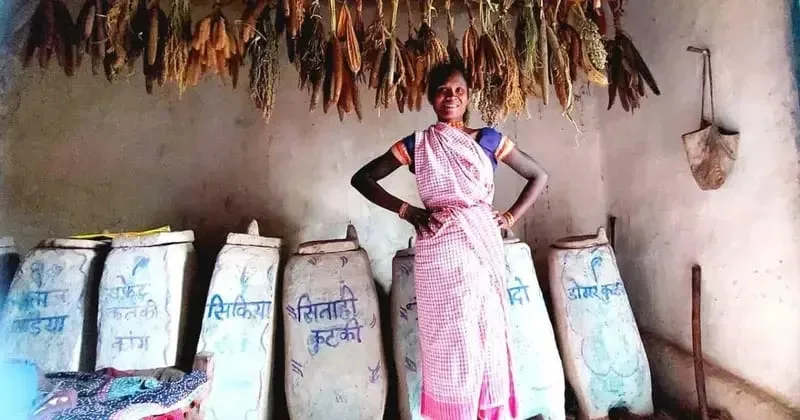
In the remote villages of Madhya Pradesh’s Dindori district, a quiet yet powerful revolution is taking root, led by a woman whose dedication to agriculture has earned her the title of the “Millets Queen.” Lahari Bai, a member of the Vanvasi community, has devoted her life to conserving traditional millet varieties, preserving a vital part of India’s agricultural heritage, and empowering local farmers with the seeds of sustainability.
Meet Lahari Bai – the Baiga farmer crowned 'Millets Queen' of Madhya Pradesh.
A member of tribal community, Lahari Bai has preserved over 150 varieties of traditional millet seeds.
Lahari Bai distributes millet seeds free of cost to farmers in her village and neighbouring… pic.twitter.com/gNBF444rDk
— News Arena India (@NewsArenaIndia) January 28, 2026
For decades, Lahari Bai has been on a mission to protect and promote millets, ancient grains known for their resilience and high nutritional value. She has meticulously collected and conserved over 150 varieties of traditional millet seeds, many of which were at risk of disappearing forever. In an era dominated by hybrid seeds and commercial agriculture, her work is a rare and invaluable effort to safeguard biodiversity and maintain the genetic wealth of India’s crops.
Millets are often referred to as “superfoods” due to their rich nutrient profile, including high fibre, protein, and essential minerals. They are also highly adaptable to adverse climates, requiring less water and chemical inputs than conventional crops like rice and wheat. Despite these benefits, the cultivation of traditional millets has been steadily declining, threatening not only the food security of rural communities but also the survival of these resilient grains. Lahari Bai’s efforts directly counter this trend, ensuring that both the seeds and the knowledge of cultivating them remain accessible to future generations.
What sets Lahari Bai apart is not just her dedication to conservation but also her selfless approach to sharing knowledge. She distributes millet seeds free of cost to farmers in her village and neighbouring regions, encouraging them to grow these traditional grains. This initiative not only revives old agricultural practices but also strengthens local food systems, promotes nutritional diversity, and reduces dependence on costly commercial seeds. Through her work, Lahari Bai is empowering small-scale farmers to become custodians of biodiversity while improving their livelihoods.
Her contributions have made a significant impact beyond the fields. In addition to conserving seeds, Lahari Bai serves as a living repository of indigenous knowledge. She teaches farmers about traditional cultivation methods, soil management, and the cultural significance of millets in Vanvasi communities. In doing so, she bridges the gap between modern agricultural challenges and ancient wisdom, demonstrating that sustainable farming is as much about knowledge as it is about seeds.
In a world increasingly dominated by monoculture and industrial farming, Lahari Bai’s work offers a vital lesson: conserving traditional crops is essential for ecological balance, nutritional security, and cultural preservation. Her dedication ensures that ancient millet varieties continue to flourish, providing food, income, and resilience to countless farmers while keeping alive the rich agricultural traditions of Madhya Pradesh’s Vanvasi communities.
Lahari Bai’s journey reminds us that meaningful change often begins at the local level. Through her tireless efforts, she has become more than a farmer; she is a guardian of biodiversity, a teacher, and an inspiration for sustainable agriculture. The “Millets Queen” of Madhya Pradesh is proof that preserving the past can sow the seeds for a healthier, more resilient future.