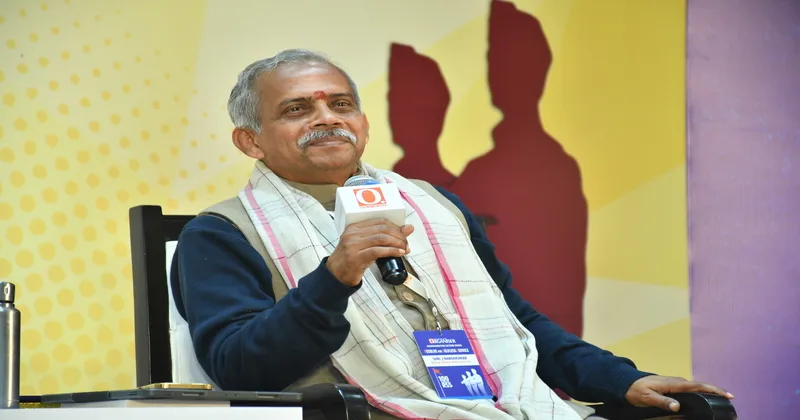
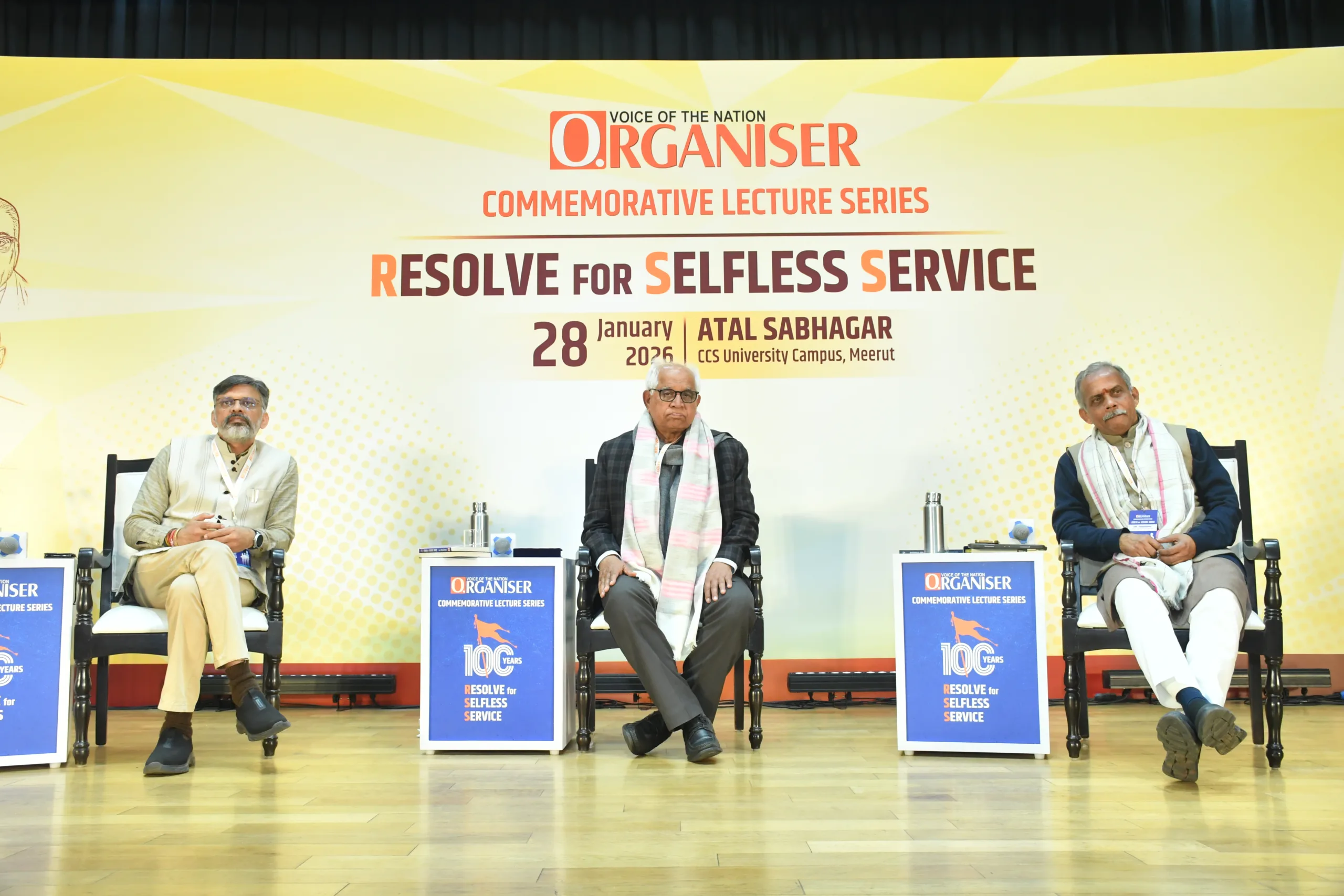
In the second of the four commemorative lecture series by Organiser on ‘100 years of RSS: Resolve for Selfless Service’ J Nandakumar, National Convener of Prajna Pravah at Atal Sabhagrah, Chaudhary Charan Singh University (CCSU), Meerut, Uttar Pradesh, on January 28, 2026 answered questions related to Sangh by the audience. Excerpts:
The Government of India has announced the goal of building Viksit Bharat by 2047. At the same time, there is a long-standing vision of Akhand Bharat. By when can these goals realistically be achieved, and what is the expected role of the youth in this national journey?
The ideas of Viksit Bharat, Akhand Bharat, and the role of youth must be understood as parts of one integrated vision. They cannot be seen in isolation.
The Rashtriya Swayamsevak Sangh was established with the objective of achieving the nation’s highest glory (Param Vaibhav). This vision is comprehensive. It does not refer only to economic prosperity or technological advancement, but also to cultural confidence, spiritual strength, social harmony, and national self-respect. In contemporary language, this integrated vision is what we now call Viksit Bharat. However, national development is not merely about infrastructure, GDP figures, or international rankings. One of the most fundamental requirements for becoming a truly developed nation is the complete elimination of the colonial mindset that still influences our thinking, behaviour, and self-perception.
The Hon’ble Prime Minister has repeatedly spoken about this during his articulation of the Panch Pran. One of these resolves is to remove every trace of servitude from our minds. Political freedom was achieved in 1947, but psychological freedom is still a work in progress. Even today, we unconsciously validate ourselves using Western standards. Our social practices, lifestyle choices, language preferences, and even celebrations often reflect this inherited mindset. For instance, many people follow Western customs in personal celebrations without questioning why our own rich traditions are sidelined. This is not a matter of rejecting the world, but of regaining confidence in our own civilisational values.
The youth are the primary agents of this transformation. Young Bharatiyas must cultivate both competence and character. Skill development should not be limited to securing individual employment. The ideal youth is one who acquires skills that enable him or her to generate employment for others. A nation becomes strong when its youth stop thinking only in terms of personal success and begin thinking in terms of national contribution. If the youth internalise this mindset, the vision of Viksit Bharat will not remain confined to government documents; it will become a living reality.
There are many who believe that Akhand Bharat is either an emotional slogan or an unrealistic ideological aspiration. How should this concept be understood in practical terms?
The idea of Akhand Bharat is often misunderstood, sometimes deliberately and sometimes due to lack of historical context. Akhand Bharat does not mean territorial expansion through military force or political domination. It is not about redrawing borders by coercion. Rather, it refers to the civilisational unity of the Indian subcontinent, which existed for thousands of years before colonial interventions artificially fragmented it.
Civilisations are not held together by weapons; they are bound by shared culture, values, memory, and lived experience. When Bharat becomes strong, stable, and prosperous, the civilisational pull of this land naturally becomes stronger. We are already witnessing signs of this. There is a visible emotional connection towards Bharat among common people in neighbouring regions. Cultural affinity, linguistic similarities, shared traditions, pilgrimage circuits, and historical memories cannot be erased by political borders.
What seems impossible today often becomes possible tomorrow. There was a time when the construction of the Ram Mandir in Ayodhya appeared unimaginable. There was also widespread skepticism about the abrogation of Article 370. Yet both became reality through constitutional and democratic processes. Similarly, as Bharat continues to rise economically, diplomatically, and morally on the global stage, the idea of Akhand Bharat will evolve organically. It will not be imposed; it will emerge naturally from shared civilisational consciousness.
Bharat’s global stature has changed significantly in recent years. How does this international transformation relate to internal national confidence?
There is a direct connection between how a nation sees itself and how the world sees that nation. For a long time, Bharat was viewed internationally as a country that lacked strategic clarity and self-confidence. That perception has now changed. Today, global leaders openly acknowledge that Bharat’s stability and progress are crucial for global peace and balance.
When the world listens attentively to Bharat’s voice on global platforms, it is not merely because of its economic size or population. It is because Bharat is increasingly seen as a civilisation that can offer solutions rooted in harmony, sustainability, and ethical governance. This external recognition reinforces internal confidence. When citizens see their country respected internationally, it strengthens national self-belief. That confidence is essential for societal transformation and long-term development.
There is often a perception that the Sangh functions through top-down decision-making. How does the organisation ensure internal democracy and alignment with grassroots workers?
This perception arises largely from misunderstanding the Sangh’s organisational culture. The Sangh operates on what can best be described as spiritual democracy. Authority does not flow only from the top; it evolves through collective deliberation. No major decision is taken without extensive consultation. Discussions begin at the shakha level and gradually move upward through districts, departments, provinces, and finally national forums. Feedback from grassroots karyakartas is not symbolic; it is essential.
A notable example is the change in the Sangh uniform. This was not a sudden directive. The discussion continued for nearly seven years. Opinions were collected from across the country, practical considerations were evaluated, and only after consensus emerged was the decision finalised. This consultative process ensures that decisions are owned collectively and implemented with conviction, not compulsion.
Many elite private schools and colleges are perceived as being disconnected from national and cultural values. How does the Sangh address this challenge?
This concern is real and must be acknowledged honestly. Today’s youth belong largely to Gen Z and the emerging Gen Alpha. Their worldview is shaped significantly by digital ecosystems rather than traditional social structures. Therefore, engagement strategies must evolve accordingly.
The Sangh recognises that ideological communication cannot rely solely on traditional formats. It must adopt modern tools, platforms, and language. Digital content, podcasts, social media outreach, online reading material, and interactive discussions are all necessary components. At the same time, engagement must be authentic rather than forced. Interestingly, we are seeing organic cultural revival among youth; initiatives like bhajan groups and cultural collectives are gaining popularity even among urban, English-speaking students. This demonstrates that when values are presented in relatable forms, youth respond positively.
Is the Sangh fully aligned with current government policies, particularly in education and economic matters?
The Sangh does not function as a political endorsement body. Its approach is principled, not partisan. Policies that serve national interest, social harmony, and long-term stability are supported. Where shortcomings exist, constructive suggestions are offered through appropriate channels. This feedback mechanism is decentralised. Student-related issues are addressed by student organisations, labour concerns by labour bodies, and educational reforms by institutions working specifically in that domain. This ensures accountability, specialisation, and clarity of purpose, rather than blanket approval or opposition.
What is the Sangh’s approach towards cow protection, social harmony, and issues related to religious conversions?
Cow protection has been part of Sangh’s work since well before Independence. It is not merely a symbolic issue but is linked to rural economy, agriculture, and sustainable living. Similarly, social harmony has always been central to Sangh ideology. Efforts at grassroots levels focus on reducing social divisions, promoting mutual respect, and strengthening national unity. Regarding religious conversions and misuse of constitutional provisions, the Sangh’s position is clear: existing laws must be implemented strictly and fairly. Vulnerable communities should be protected through legal means, awareness, and social empowerment. Recent judicial observations have reinforced the importance of this approach.
In an age dominated by social media influencers and digital narratives, does the Sangh have a virtual presence strong enough to counter misinformation?
Yes, the Sangh has significantly expanded its digital footprint. Official websites, verified social media handles, digital publications, and multimedia platforms now provide authentic information about Sangh ideology and activities. People are encouraged to rely on these primary sources rather than interpretations by external commentators. In the digital age, narrative clarity is essential. Direct communication reduces misunderstanding and builds trust.
In Essence
Bharat is undergoing a deep and multidimensional transformation. Economic growth, cultural resurgence, diplomatic confidence, and social churning are all part of this journey.
The responsibility of shaping the future lies primarily with the youth. With self-confidence rooted in civilisational values, disciplined effort, and a nation-first mindset, the visions of Viksit Bharat and Akhand Bharat are not distant ideals but achievable milestones.