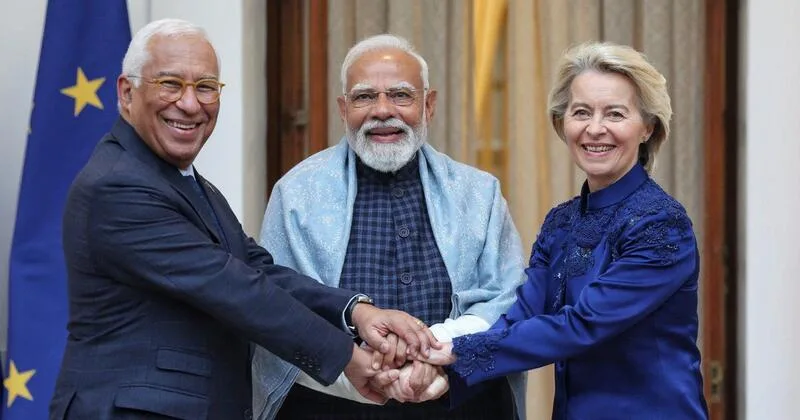
Dubbed the “Mother of All Deals,” the Free Trade Agreement (FTA) between India and the European Union has finally become a reality, marking a historic milestone in India’s trade diplomacy. The agreement is expected to benefit almost every Indian state. Not only will the tariff burden on exports to Europe be significantly reduced, but Indian exporters will also gain easier access to new markets, giving a major push to outward-oriented growth. Union Commerce and Industry Minister Piyush Goyal said in an interview that the India–EU Free Trade Agreement will generate a total export benefit of Rs 6.4 lakh crore for Indian states. At the announcement ceremony, European Commission President Ursula von der Leyen highlighted that Piyush Goyal was the key architect behind the successful conclusion of the negotiations. After years of delayed talks, the agreement is being described as the largest and most comprehensive trade deal in India’s history.
Under the new regime, exports of textiles and apparel, engineering goods, medicines and medical devices, electronic products, gems and jewellery, chemicals, marine products, leather and footwear, plastics and rubber, tea, spices, furniture, handicrafts, minerals, sports goods and a wide range of agricultural products from India to the European Union will become either duty-free or subject to only nominal duties. This sweeping reduction in tariffs is expected to sharply improve the competitiveness of Indian products in European markets.
Today is a day that will be remembered forever, marked indelibly in our shared history.
European Council President António Costa and European Commission President Ursula von der Leyen and I are delighted to announce the conclusion of the historic India-EU Free Trade Agreement.… pic.twitter.com/yaSlPm2b2L
— Narendra Modi (@narendramodi) January 27, 2026
Kerala is among the states set to gain significantly from the agreement. The state’s main exports to the European Union include marine products, pharmaceuticals and medical devices, tea and spices. Kochi (Ernakulam district) and Alappuzha district, which are major hubs for shrimp and tuna exports, are expected to see a rise in orders. Spices from Idukki and Wayanad districts will now flow in larger volumes to European countries. Pharmaceutical exports from Kerala are also projected to increase sharply, boosting employment and incomes in agriculture, fisheries and allied sectors. Families dependent on these sectors are expected to benefit directly from the export surge.
India’s engineering sector will be one of the biggest beneficiaries. The deal opens the door to a market worth $2 trillion, offering Indian manufacturers unprecedented access. The agreement is expected to provide a strong boost to India’s ambition of achieving $300 billion in engineering exports by 2030. Easier market entry and improved price competitiveness are likely to attract new orders and encourage capacity expansion.
Micro, small and medium enterprises (MSMEs) across states such as Maharashtra, Gujarat, Karnataka, Andhra Pradesh and Tamil Nadu are also set to gain. Chennai and Coimbatore, which are major hubs for electronics and engineering manufacturing, are expected to emerge as key centres for export growth. The agreement is expected to integrate Indian MSMEs more deeply into European supply chains. The gem and jewellery sector will receive 100 per cent duty-free access to the European Union under the deal, opening up a tax-free market worth $79 billion. Companies based in Gujarat, Rajasthan, Maharashtra and West Bengal are expected to benefit the most. With tariffs eliminated, Indian exporters are expected to become far more competitive against global rivals.
Leather and footwear products will see duties fall from 17 per cent to zero. Indian leather and footwear will now enter the $100 billion European market duty-free. This exemption is expected to increase demand for Indian products and generate higher orders and incomes for exporters. The Kolhapuri footwear segment is expected to gain the most, while Tamil Nadu’s Vellore–Ambur region, a major leather and footwear hub, is set to see fresh investments and job creation.
The textile and clothing sector is another major winner from the “Mother of All Deals.” The European Union currently represents a market of $263 billion for garments and textiles. With duties reduced from high levels to zero, India will gain a decisive edge over competitors such as China and Bangladesh. Textile hubs in Tamil Nadu, including Tiruppur, are expected to see a sharp rise in exports and employment.
Kerala-based Kitex, which had earlier announced plans to expand its European presence alongside the US market, is also set to benefit. Reflecting market optimism, Kitex’s share price rose by more than 5 per cent today following the announcement.
The European Union comprises 27 countries with a combined market size of $20 trillion, or approximately Rs 1,800 lakh crore. The agreement is the largest trade deal ever signed by India. India, now the world’s fourth-largest economic power, and the European Union, the second-largest, together represent a formidable economic bloc.
Indian exports worth $33 billion, or nearly Rs 3 lakh crore, which were previously subject to duties in Europe, will now enjoy preferential access. The India–EU deal covers nearly 25 per cent of global GDP. With one-third of world trade now falling under the ambit of India and the EU through this agreement, the deal is set to reshape global trade flows and firmly anchor India as a central player in the world economy.