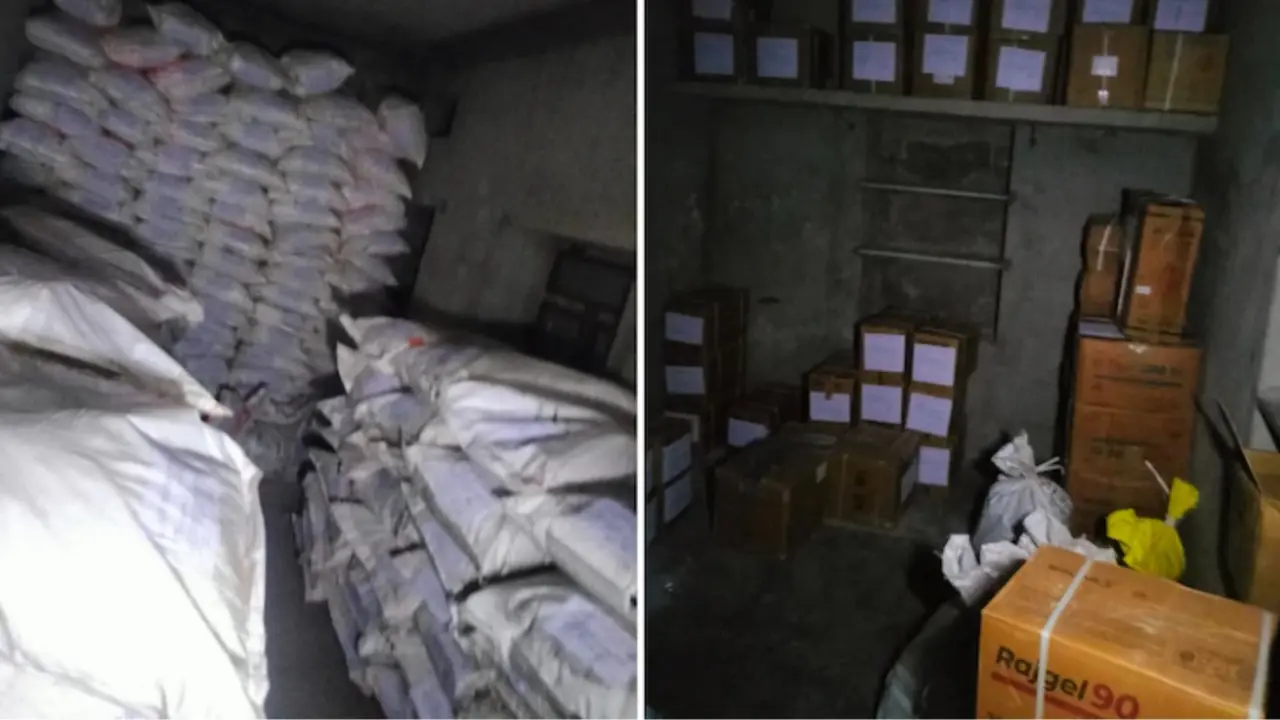
On the intervening night of January 24 and 25, 2026, Nagaur district police carried out a high-risk, intelligence-driven operation that led to the seizure of approximately 10,000 kilograms of ammonium nitrate along with a substantial cache of detonators, fuse wires and other explosive materials. The raid was conducted in Harsaur village under the jurisdiction of Thanwala police station, where the explosive substances were illegally stored inside a farmhouse constructed on agricultural land. Officials described the recovery as one of the largest ammonium nitrate seizures in recent years, particularly significant given its proximity to Republic Day celebrations.
The operation followed sustained intelligence inputs received over a period of time, suggesting that large quantities of explosive materials were being illegally bought, sold and stored in the Nagaur region. Given the sensitive timing and the scale of material involved, police treated the inputs with utmost seriousness and activated multiple teams to prevent any potential misuse.
Accused Suleman Khan Arrested at the Spot
During the raid, police arrested 58-year-old Suleman Khan, a resident of Harsaur village. According to officials present at the site, Suleman was found at the farmhouse when the police arrived. When questioned about the contents of the rooms inside the structure, he initially failed to give any clear explanation. After sustained questioning, he admitted that explosive material was stored inside the premises.
Police officials confirmed that Suleman could not produce any licence, permit or authorisation allowing him to store or possess explosive substances of such magnitude. His failure to provide legal documentation became a crucial factor in his immediate arrest at the spot.
How the Police Operation Unfolded
As detailed in the FIR (Number-16/2026) registered at Thanwala police station, Assistant Sub-Inspector Surendra Kumar departed from the police station at 4:51 PM on January 24 along with police staff after receiving credible information about illegal explosive storage. The team proceeded towards a kachcha road leading to Harsaur village, where they met Sub-Inspector Vijay Singh, the District Special Team in-charge, along with other DST personnel.
The DST team informed ASI Surendra Kumar that intelligence inputs specifically pointed towards a house built inside agricultural fields belonging to Suleman Khan, where explosive materials were suspected to be stored. Following this, additional police personnel were summoned to ensure adequate manpower and safety before entering the premises.
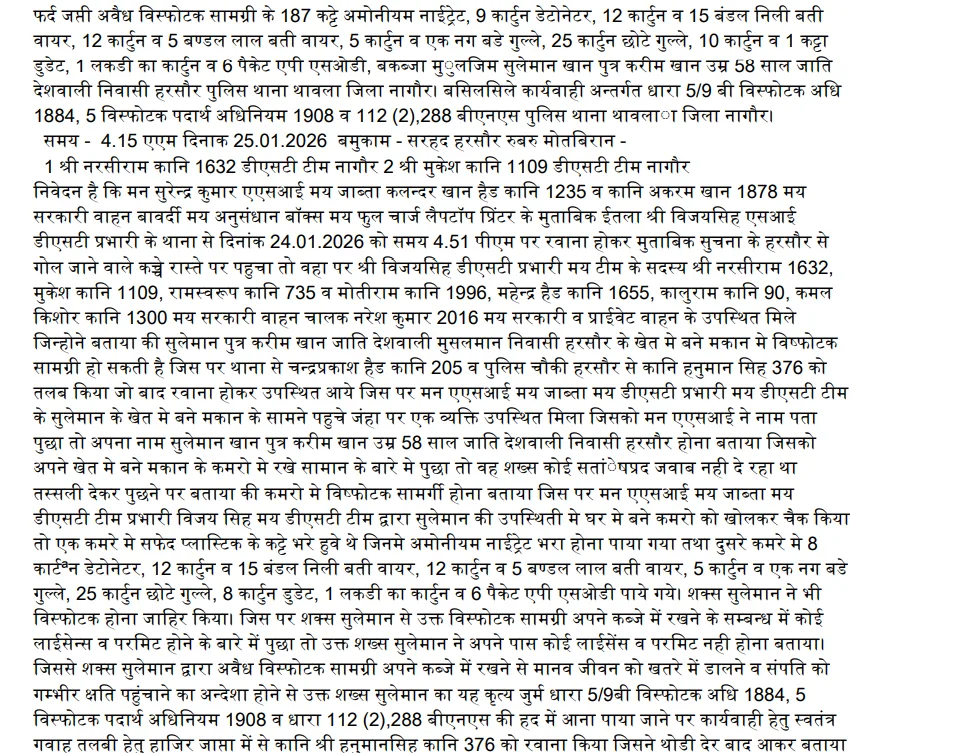
Upon reaching the farmhouse, the police team found Suleman Khan present. When asked about the materials stored inside the rooms, he initially provided evasive responses. However, after further questioning, he acknowledged that explosive substances were kept inside the rooms, prompting the police to conduct a detailed search.
Explosives Found Hidden Across Multiple Rooms
During the search, police discovered large white plastic sacks filled with ammonium nitrate in one room, while another room contained cartons and bundles of detonators, safety fuse wires and other blasting accessories. The FIR records that Suleman himself acknowledged that the material recovered was explosive in nature.
When asked to produce any licence or permission authorising possession of such material, Suleman failed to do so. Based on this, the complainant stated in the FIR that the accused’s actions had created a serious apprehension of danger to human life and the possibility of extensive damage to property.
Detailed Inventory of Recovered Explosive Material
The seizure conducted by the police included nearly 10,000 kilograms of ammonium nitrate packed in plastic sacks. In addition to this, detonators were recovered in significant numbers, including three large cartons containing 1,250 detonators each, five smaller cartons weighing 20 kilograms each, and one carton containing 388 detonators.
The recovery also included blue safety fuse wires stored in 12 cartons weighing 10.5 kilograms each, along with three plastic sacks containing a total of 15 bundles. Red safety fuse wire was seized in eight cartons measuring 1,500 metres each, four cartons marked “Tiger Card” containing 1,500 metres each, and two plastic sacks containing five bundles.
Gelatine sticks were also found, including five cartons of large gelatine sticks with nine units per carton and 25 cartons of smaller gelatine sticks weighing 25 kilograms each. In addition, dudet was recovered in four large cartons containing 500 units each, five smaller cartons containing 400 units each, one carton containing 200 units, and one plastic sack. Two wooden cartons of AP SOD were also seized, one containing 20 packets and another containing six packets.
Police officials noted that the combination of ammonium nitrate with detonators and ignition accessories significantly increased the lethality of the material and posed an immediate threat if mishandled or diverted for unlawful use.
Legal Provisions Invoked and FIR Details
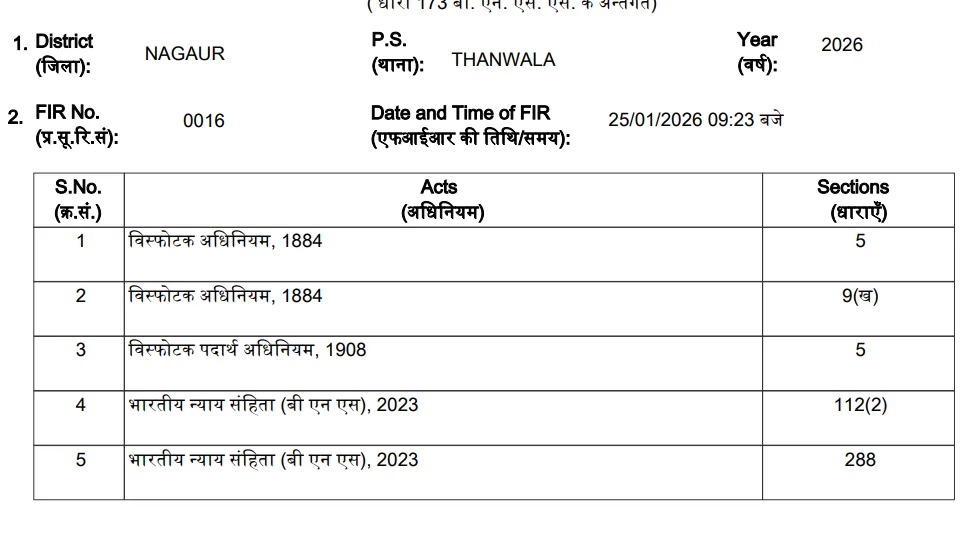
An FIR was registered on January 25, 2026, at Thanwala police station on the complaint of ASI Surendra Kumar. Suleman Khan has been booked under Sections 5 and 9(b) of the Explosives Act, Section 5 of the Explosive Substances Act, and Sections 112(2) and 288 of the Bharatiya Nyaya Sanhita.
The FIR clearly states that the illegal storage of such a large quantity of explosive material created a grave risk to human life and property. Though police attempted to secure independent witnesses from nearby areas, locals refused to participate, following which constables Mukesh and Narsiram were appointed as official witnesses.
The entire search and seizure operation was videographed, and both seizure and arrest memos were prepared at the spot, as required under law.
Accused’s Criminal History Raises Serious Concerns
Police officials revealed that Suleman Khan has a criminal history involving explosives-related offences. Three previous cases have been registered against him under explosives laws, two of which are currently pending before courts, while he was acquitted in one earlier case.
This history has prompted investigators to probe deeper into the source of the ammonium nitrate, the logistics involved in transporting such large quantities, and whether a larger supply network is operating across districts or state borders.
Senior Police Officials Call it a Landmark Seizure
Superintendent of Police Mridul Kachhawa described the operation as one of the biggest actions taken under the Explosives Act in the state so far. He stated that the district police had been receiving intelligence inputs for some time about illegal explosive material being traded and stored in the area. According to him, the seizure of nearly 10,000 kilograms of ammonium nitrate marks a major breakthrough and a crucial preventive action.
The seizure has taken on added significance due to its timing, coming just a day before Republic Day, when security arrangements are at their highest across the country. Officials pointed out that ammonium nitrate, though widely used for legitimate agricultural and industrial purposes, has repeatedly been misused in terror attacks and large-scale blasts.
The recovery in Nagaur has also brought renewed attention to the deadly misuse of ammonium nitrate in recent years. Notably, the same explosive material was used in the car blast near Delhi’s Red Fort on November 10, 2025, which claimed 15 lives.
That blast was later linked to a white-collar terror module associated with the Al Falah University network, underscoring how industrial-grade materials can be diverted for terror activities if not strictly regulated.
Investigation Widens, Central Agencies Alerted
Central agencies have been informed about the seizure and are expected to assist in the investigation. Police are examining whether the explosives were intended for illegal mining operations or if there were plans for more dangerous misuse. Officials have not ruled out the possibility that the seizure may have prevented a major disaster.
As investigations continue, the Nagaur operation stands out as a crucial preventive action carried out at a sensitive moment. By intercepting a massive stockpile of explosive material before it could be misused, Rajasthan Police have potentially averted a serious threat to public safety and national security.
The case now moves to the courts, where the seizure memos, arrest documentation and videographic evidence will form the basis of prosecution. Meanwhile, security agencies remain alert, treating the incident as a stark reminder of the constant vigilance required to counter both criminal and terror-related threats.