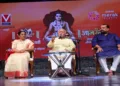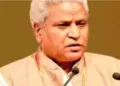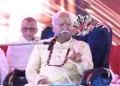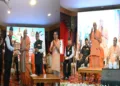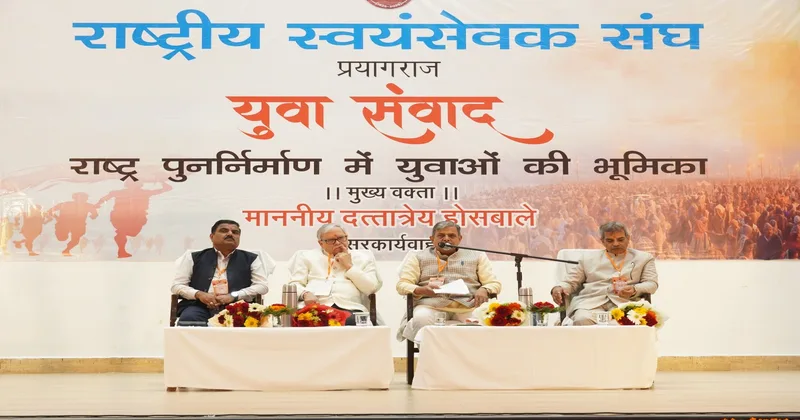
PRAYAGRAJ: The nation gives us everything; we too must learn to give something back should be the guiding mantra for all, said Rashtriya Swayamsevak Sangh (RSS) Sarkaryavah Dattatreya Hosabale while addressing the gathering at the MP Hall of Motilal Nehru National Institute of Technology (MNNIT) on January 25.
The theme of the programme was “The Role of Youth in Nation Reconstruction”, in which students from medical colleges, IIIT, MNNIT, and various colleges and universities participated in the programme.
He called upon the youth to embrace the “Panch Parivartan” (Five Transformations) for the reconstruction of the nation. He said that, the youth must step out of the confines of their homes and actively engage with society.
He emphasised the need to have the right perspective about Bharat and to reflect on how the country can be made truly great. He noted that all great personalities of the nation have spoken against discrimination based on high and low. Bhartiyata should be visible in industry, trade, and education, he said, stressing that Bharat’s cultural unity is of paramount importance and requires collective effort. Along with protecting the environment, shaping future generations into responsible citizens is a shared duty.
He further stated that Bharat’s knowledge tradition must be carried forward, and the youth should be firmly committed to their duties. Change, he said, is a law of nature, and many transformations have occurred from the past to the present. While good ideas for the nation and society may sound appealing, they are difficult to implement. The day this reality is accepted, the nation will begin achieving its goals.
Referring to the Ramayana, Hosabale said that Hanuman ji had conveyed that merely chanting the name is not enough—action is essential. Despite Lanka’s prosperity, Lord Rama handed over its rule to Vibhishana and returned to Ayodhya. Bharat continues to follow this tradition even today. He asserted that Bharat has never developed itself to dominate or oppress other nations, but has always sought to respect everyone while upholding simplicity, harmony, and balance within its culture. Bharatiya civilisation has never harboured ambitions of conquest. Many cultures have merged into the mainstream of Bharatiya culture and become an inseparable part of it—this, he said, is the greatness of Bharatiya culture.
He added that Bharat is known not for preserving its knowledge in museums and libraries, but for sharing its experiences and wisdom with the world. Referring to Dharampal ji’s book “The Pride of Bharat”, he highlighted its exposition on Bharat’s education system, Panchayat system, and cultural expression.
Hosabale recalled that leaders like Lal, Bal, and Pal dedicated themselves completely to the nation’s freedom struggle.
While discussing environmental issues, he cited Indore, which has ranked first in cleanliness for the past eight years. He asked whether Prayagraj could achieve the same distinction, stating that the day the youth of Prayagraj resolve to do so, the city too will earn that honour.
He warned that if society becomes trapped in greed and excessive consumption, it will be unable to properly channel purusharth (constructive effort). Every individual, he said, must use their potential to lead the nation towards progress, with the spirit of “Nation First”. Quoting Rajagopalachari, he said that instead of focusing on per capita income, the nation must look towards per capita character to build a strong national character. He also encouraged the youth to pursue innovation.
Expressing concern over the disintegration of joint families, Hosabale stressed the importance of spending time together as a family and moving forward collectively, which he said also contributes to nation-building.
He also addressed questions raised during the interaction and clarification session. MNNIT Director Professor Ramashankar Verma remarked that such youth dialogues help channel young minds towards national consciousness.
Sah-Prant Sanghchalak Professor Rana Krishna Pal and IIIT Director Mukul Yash Sutavade were also present on the dais. The programme began with the lighting of the ceremonial lamp before the portrait of Bharat Mata, followed by Vedic chants and Swasti Vachan by young Vedic students.