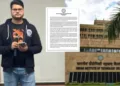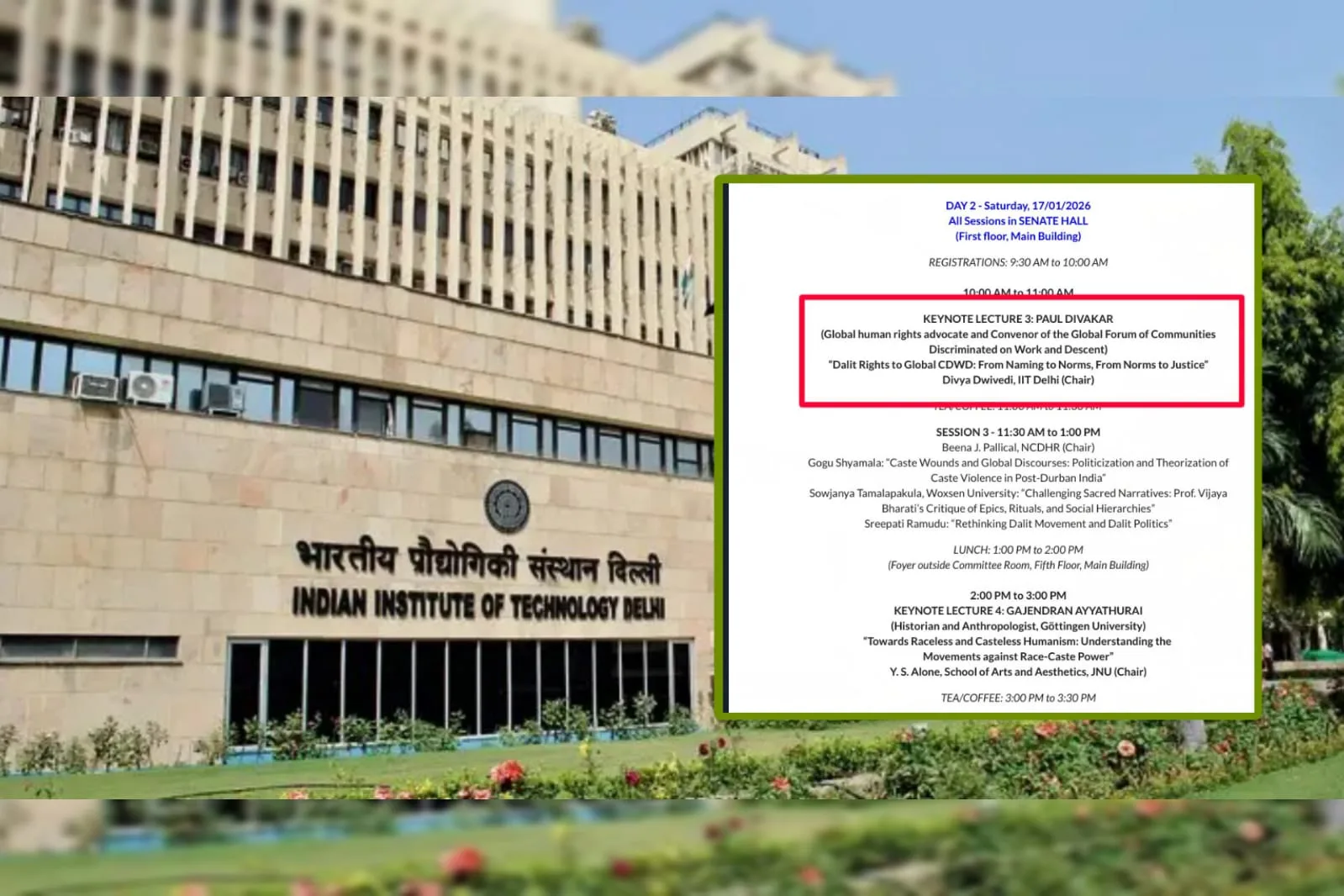
The Indian Institute of Technology (IIT) Delhi’s Department of Humanities and Social Sciences recently hosted the Critical Philosophy of Caste and Race (CPCR3) conference, a multi-day academic event held in the Senate Hall of the institute’s main building. The conference agenda, now circulating widely on social media, has drawn intense scrutiny for what many describe as an overtly ideological and activist-driven approach to caste discourse.
The conference, titled “Towards a Critical Philosophy of Caste and Race,” was chaired by Divya Dwivedi of IIT Delhi, who also delivered a keynote lecture framing caste and race within global theoretical and political paradigms.
Keynote sessions and themes
According to the official schedule visible in the circulated conference material, one of the key sessions featured Paul Divakar, described as a global human rights advocate and convenor of the Global Forum of Communities Discriminated on Work and Descent (CDWD). His keynote lecture was titled “Dalit Rights to Global CDWD: From Naming to Norms, From Norms to Justice,” further situating caste within international rights frameworks.
Another keynote lecture was delivered by Gajendran Ayyathurai, historian and anthropologist from Göttingen University, on “Towards Raceless and Casteless Humanism: Understanding the Movements against Race-Caste Power.”
Controversial comparisons and panel discussions
The conference sparked particular controversy due to sessions that explicitly linked India’s caste dynamics with global political conflicts. A session chaired by Gajendran Ayyathurai included a presentation by Aarushi Punia, an independent researcher, titled “What’s common between Dalits and Palestinians?”
This comparison has drawn strong criticism, with detractors arguing that such framing imports foreign geopolitical conflicts into India’s social discourse, oversimplifying complex realities and advancing ideological positions rather than scholarly analysis.
Another notable speaker, Thenmozhi Soundararajan of Equality Labs, delivered a talk titled “25 Years of Racial and Caste Equity Impact of Durban on Dalit Americans,” continuing the theme of internationalising caste discourse through the lens of race politics in the United States.
Sessions on ‘Sacred Narratives’ and social hierarchies
Several sessions also focused on reinterpreting Indian traditions and social structures through a critical lens. Papers included topics such as “Challenging Sacred Narratives: Critique of Epics, Rituals, and Social Hierarchies,” and “Caste Wounds and Global Discourses: Politicisation and Theorisation of Caste Violence.”
Speakers from institutions such as JNU, IGNOU, and international universities participated in these panels, discussing caste through frameworks of intersectionality, gender, race, and global power structures.
The conference also featured the launch of a book titled “Tamil Buddhism and Brahminism in Modern India: Deep Resistance against Caste (2025)” authored by Gajendran Ayyathurai. The book launch panel included academics from Indian and foreign universities, chaired once again by Divya Dwivedi of IIT Delhi.
Notably, the repeated presence of a narrow set of ideological perspectives across panels and keynotes indicates a lack of intellectual plurality.
Criticism of ‘Woke’ academic culture
The agenda has drawn criticism from scholars, students, and commentators who accuse the Humanities Department of IIT Delhi of promoting a “woke” ideological framework that allegedly prioritises activism over academic balance. Notably, the conference offered little room for alternative perspectives on caste, Indian civilisation, or social reform traditions rooted within the country.
The inclusion of comparisons between Dalits and Palestinians, and repeated references to global race politics, has been cited as evidence of an attempt to frame Indian social issues within a predetermined international activist narrative.
Debate over academic neutrality
The controversy has reignited a broader debate about the role of elite academic institutions and whether taxpayer-funded universities should host events perceived as advancing single-sided ideological positions. While organisers describe the conference as a critical academic engagement with caste and race, such platforms must also accommodate diverse viewpoints to uphold intellectual rigor.
As discussions continue both on and off campus, the CPCR3 conference has become a flashpoint in the ongoing debate over academic freedom, ideological bias, and the evolving direction of humanities education in India.
Similar cases from the past
Jawaharlal Nehru University (JNU), Delhi
Jawaharlal Nehru University has repeatedly remained at the centre of controversies linked to slogans, events, and academic narratives perceived as hostile to India’s sovereignty and constitutional order. The 2016 Afzal Guru–Maulana Azad event, organised under the banner of “judicial killing,” triggered nationwide outrage after slogans such as “Bharat tere tukde honge” were raised. The episode led to arrests, court proceedings, and parliamentary debate, with many accusing the university of providing intellectual cover to secessionist and extremist narratives. Subsequent years saw repeated clashes over events sympathetic to Kashmir separatism, the citizenship framework, and security forces, reinforcing perceptions that JNU had become an epicentre of ideological activism rather than balanced scholarship.
IIT Madras – Ambedkar-Periyar Study Circle Controversy (2015)
In 2015, IIT Madras found itself in controversy after the Ambedkar-Periyar Study Circle (APSC) was temporarily derecognised following complaints that its activities promoted hatred against the Prime Minister, Hindu traditions, and Indian nationalism under the garb of social justice discourse. Though recognition was later restored after political pressure, the episode highlighted how identity politics and ideological activism had entered premier technical institutions, raising concerns about misuse of campus spaces for partisan narratives disconnected from academic objectives.
University of Hyderabad – Rohith Vemula Case and Political Mobilisation
The suicide of research scholar Rohith Vemula (2016) became a flashpoint for nationwide protests. While the incident was deeply unfortunate, subsequent investigations and court proceedings complicated the narrative initially projected by activist groups. The tragedy was rapidly politicised, used to portray Indian institutions and Hindu society as structurally oppressive, while slogans questioning the legitimacy of the Indian state and its institutions surfaced during protests. The case became emblematic of how personal tragedies were transformed into ideological movements with overt political messaging.
Jadavpur University, West Bengal
Jadavpur University has long been cited for recurring campus unrest involving anti-police, anti-army, and anti-state slogans, particularly during protests related to Kashmir, CAA, and internal security operations. Several incidents involved clashes with law enforcement, damage to public property, and public calls questioning India’s territorial integrity. Alumni, parents, and even sections of faculty have repeatedly expressed concern that academic activity has been overshadowed by permanent agitation culture.
Tata Institute of Social Sciences (TISS), Mumbai
TISS has frequently drawn criticism for hosting seminars and academic material allegedly presenting one-sided portrayals of Indian society, Hindu traditions, and state institutions, while normalising extremist or Maoist-linked perspectives in social science discourse. The institute has faced scrutiny over student groups and publications accused of sympathising with urban Naxal narratives, prompting funding reviews and administrative interventions. Dissent at TISS often crosses into delegitimisation of constitutional institutions, including the judiciary and security forces.
IIT Bombay – Caste Discourse and Curriculum Disputes
IIT Bombay has seen repeated controversies over course content and student activism framing India’s social structure exclusively through global “race-caste oppression” theories. Certain reading lists and seminars were criticised for selectively importing Western activist frameworks while ignoring indigenous reform movements and constitutional mechanisms. These episodes reignited concerns that even elite STEM institutions were becoming spaces for ideological conditioning rather than intellectual plurality.
Jamia Millia Islamia – CAA Protests and Radicalisation Concerns
Jamia Millia Islamia became a focal point during the 2019–20 CAA protests, where peaceful demonstrations gradually gave way to violence, stone-pelting, and destruction of public property in surrounding areas. Investigations later revealed the presence of external radical elements exploiting student unrest. Many highlighted how misinformation regarding citizenship laws was amplified within campus spaces, contributing to nationwide instability.
Aligarh Muslim University (AMU) – National Symbols and Sovereignty Rows
AMU has periodically been embroiled in controversies involving refusal to sing the national anthem at events, resistance to celebrating national days, and protests framed against India’s constitutional identity. While the university administration has often attempted damage control, repeated incidents have reinforced perceptions of institutional ambivalence towards national symbols, drawing criticism from courts and policymakers alike.
Film and Television Institute of India (FTII), Pune
FTII students have repeatedly protested against administrative appointments and curriculum changes, framing these as ideological takeovers. These protests often portrayed Indian cultural nationalism as inherently authoritarian, while valorising Western ideological frameworks. The institute became symbolic of cultural gatekeeping, where dissenting viewpoints allegedly faced hostility.
Taken together, these recurring episodes across India’s premier universities and institutes reveal a troubling drift in parts of the higher education ecosystem. Campuses meant to nurture intellectual rigour, scientific temper, and national responsibility are increasingly being converted into arenas of permanent ideological agitation, where dissent often slips into disruption and academic freedom is invoked to shield narratives that undermine constitutional institutions, national unity, and social cohesion.
This is not a call to silence debate or stifle questioning, critical inquiry remains the lifeblood of any vibrant democracy. However, when selective histories, imported ideological frameworks, and romanticised extremist narratives dominate academic spaces while nationalist, civilisational, and constitutional perspectives are marginalised, the balance between freedom and responsibility is decisively lost. The repeated nature of these controversies suggests not isolated incidents, but a systemic challenge demanding serious introspection.
There is an urgent need for institutional accountability, curricular balance, and a reaffirmation of the foundational purpose of education in Bharat, to build enlightened citizens, not permanent agitators; to encourage dialogue, not disorder; and to strengthen the nation through knowledge, not fracture it through ideological dogma. Only through such course correction can India’s universities truly serve as temples of learning aligned with both academic excellence and national interest.