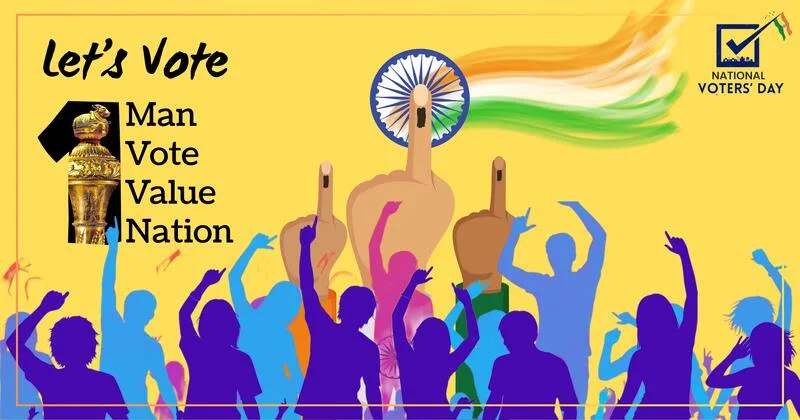
“On the 26th of January 1950, we are going to enter into a life of contradictions. In politics we will have equality and in social and economic life we will have inequality. In politics we will be recognizing the principle of one man one vote and one vote one value.”
— Dr BR Ambedkar, Constituent Assembly Speech, November 25, 1949.
As India observes National Voters’ Day on January 25, 2026, the nation celebrates its status as the world’s largest democracy. Yet, a persistent and paradoxical trend continues to challenge the foundational ideals of representative governance: the systemic under-participation of urban and metropolitan populations. Despite being the primary engines of economic growth, technology, and education, India’s major cities consistently record voter turnout figures that trail significantly behind the national average and their rural counterparts. Special Intensive Revision (SIR) has been a critical intervention to weed out “ghost voters”. However, a systemic analysis is necessary to examine the multi-dimensional factors that drive this complexity and the resulting impacts on the national integrity and democratic spirit.
The “Ghost Voter” Challenge
Many elections, at both national and state levels, are won by narrow margins, often between 2,000 and 5,000 votes. For instance in Lok Sabha elections, where 28 constituencies in 2009 and 14 in 2019 were decided by under 5,000 votes. State Assembly results reflect this pattern: 52 seats in Bihar (2020), 44 in Maharashtra (2024), 11 in Jharkhand (2024), and 8 in Haryana (2024) saw thin margins. Notably, 8 constituencies in Haryana (2024), with the thin margins of under 3,000 votes. In such tight contests, less voter turnout and the presence of “ghost voters”—entries for migrated, or duplicate citizens—can distort turnout percentages and compromise democratic legitimacy.
Urban Apathy Complexities
Higher literacy and better infrastructure do not automatically translate into higher voter engagement in the urban democratic systems. In urban and metropolitan India, this reveals a multifaceted challenge that jeopardizes the long-term vitality of the nation’s democratic institutions. Moreover, the urban environment introduces distinct complexities—such as high rates of migration, increased residential mobility, and a psychological detachment from state-provided services—that are progressively intensifying.
Though “apathy” is the usual term, analysts identify several non-behavioral factors depressing urban participation, with key barriers including:
Structural Migration: 37% of Indians are internal migrants, incurring high costs to vote in distant home villages.
Administrative Confusion: Frequent boundary changes (e.g., 25% of Mumbai wards) cause voter confusion and missing names on rolls.
Elite Disengagement: Wealthier urbanites rely on private services, reducing interest in local governance.
Low Perceived Impact: Urban residents feel public deliberations rarely influence city planning or budgets, fostering disillusionment.
Urban Turnout in Assembly Voting: 2023–2025
Recent state elections provide a nuanced view of the urban-rural divide. While overall turnout remains high in many states, urban centers consistently lag. The Bihar Assembly elections of November 2025 recorded a historic high overall turnout of 66.91%, the highest since 1951, largely by rural women (71.6%). In contrast, the February 2025 Delhi Assembly elections saw a turnout of 60.44%, continuing a downward trajectory from 62.55% in 2020 and 67.12% in 2015. This decline in the national capital is particularly significant given its highly educated electorate.
In the 2024 Andhra Pradesh election, with a recorded turnout of 81.86%, urban constituencies such as Visakhapatnam South (58.95%) and Kurnool (63.87%) exhibited significantly lower participation rates compared to the rural constituency of Etcherla (87.00%). Similarly, the 2023 Telangana election, which registered a 71.97% turnout overall, witnessed the fully urban Jubilee Hills constituency record a notably low 47.58%, thereby emphasizing metropolitan electoral disengagement.
Municipal Elections: Frontline of Disengagement
The urban “participation deficit,” especially in India’s metropolises, poses a major challenge. Municipal elections, despite their direct impact on essential services like water, sanitation, and roads, show voter turnout consistently below overall state averages. For instance, in the Maharashtra Municipal Elections conducted in January 2026, the aggregate turnout was estimated to be between 46% and 50%. Mumbai exhibited a marked disparity: the affluent Colaba locality registered a turnout of only 15.73%, in stark contrast to the suburban area of Bhandup, which recorded 53.34%.
Urban Voter in Parliamentary Polls
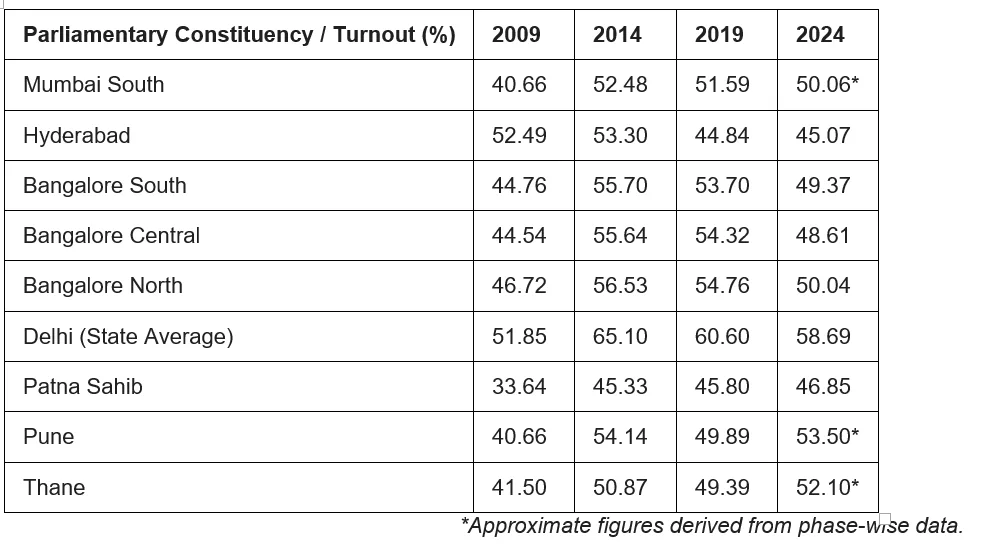
The divergence in voting patterns between urban and rural India is a structural feature that has solidified over the last decade and a half. In the 2019 Lok Sabha elections, while the national average turnout reached 67.4%, the Election Commission of India (ECI) identified that 17 of the 50 constituencies with the lowest voter turnout were located in major cities. This trend persisted into the 2024 General Elections; while the national average was 65.79%, major metros like Hyderabad and Mumbai frequently recorded turnouts languishing below the 55% mark. The peak of urban participation was observed in 2014, driven by a highly spirited national campaign that resonated with the urban middle class.
Impact on Policy and Urban Infrastructure
Low turnout has profound consequences. Because political parties are rational actors, they prioritize the needs of groups that vote in high numbers.
● Weakened Accountability: Low municipal voter turnout (below 50%) significantly reduces the democratic legitimacy of elected corporators. Low voter turnout leads to “distorted representation,” where elected officials, chosen by a minority, ignore the non-voting majority’s needs, hindering holistic urban development.
● Sustainability and “Wicked Problems”: Addressing urban sustainability challenges—such as climate change resilience and environmental degradation—requires empowered and collaborative participation. However, “weak democracy” in cities, characterized by individualism and low voting rates, makes it difficult for municipal governments to mobilize the public for the collective behavioral changes needed for sustainable urban living.
Path to a “New Normal”
Can 100% voter turnout become standard? While statistically challenging, several initiatives show it is possible to move closer to that ideal. To foster a stronger connection between the populace and their constitutional responsibilities, several initiatives have demonstrated the potential to turn around low turnout constituencies.
● Bihar SIR 2025: Prior to the 2025 Bihar assembly elections, the ECI conducted a Special Intensive Revision (SIR) by re-verifying nearly 60% of the electorate. This resulted in the deletion of around 68.6 lakh names from the electoral rolls and the addition of 21.5 lakh new voters. The zero-repoll status of the 2025 Bihar elections is credited to the integrity of this updated electoral roll.
● Targeted Urban SVEEP: ECI has shifted focus to booth-level micro-planning in cities. In 2024, the use of QR-coded voter slips and the ‘Chunavana’ app in Karnataka helped urban professionals navigate polling stations and view real-time queue data, reducing the “time cost” of voting.
● Community Mobilization: The engagement of “Jeevika Didis” (Self-Help Group volunteers) in Bihar’s 2025 election helped achieve record participation by turning voting into a community festival.
● “Let’s Vote”: The NGO-led “Let’s Vote” initiative in Hyderabad promotes voting as a “Civic Right and Responsibility” to urban youth and the working class. By framing “Voting” as civic pride, the campaigns aim to establish participation as a social norm.
The ECI’s Remote Voting Machine (RVM) prototype targets domestic migrants, the main barrier to urban voting. Future Mobile Voting (M-Voting) and AI could enable distance voting and deliver customized, local, language-specific messages. However, a systemic standard must evolve for achieving full voter participation among the urban and metropolitan dwellers, as the norm in Indian democracy requires a quadrant strategy: 1) Operationalizing SIR across the nation, 2) Dismantling structural barriers for migrants; 3) Reducing the “cost” of urban voting through administrative innovations; and 4) Rising the vote’s “value” among the citizenry.
National Voters’ Day 2026 is a reminder that democracy is as vibrant in its financial capitals as it is in its rural heartlands. Only by bridging this participation gap through administrative innovation and technological empowerment can India ensure its urban growth is governed by mandates that reflect the true will of all its people.