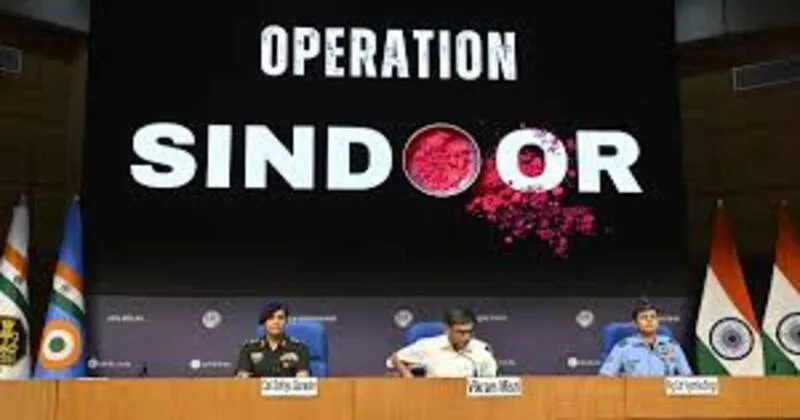
India’s 88-hour Operation Sindoor, conducted between May 7 and 10, 2025, decisively demonstrated the Indian Air Force’s supremacy over Pakistani airspace, compelling Pakistan to request a ceasefire and marking a rare case of operational dominance in South Asia without crossing nuclear thresholds. A detailed report authored by Adrien Fontanellaz and published by the Centre d’Histoire et de Prospective Militaires (CHPM) in Switzerland provides an exhaustive analysis of the operation’s strategic, tactical, and technological dimensions, documenting India’s effective management of escalation, protection of assets, and deep-strike capabilities.
The report, titled “Operation Sindoor: The India-Pakistan Air War (7-10 May 2025)”, was reviewed by a committee including Paris-based strategic analyst Joseph Henrotin, retired Swiss Air Force Major General Claude Meier, and nuclear doctrine specialist Arthur Lüsenti, ensuring rigorous professional oversight. The CHPM, founded in 1969, operates as a neutral forum for military research and lessons-learned analysis, unaffiliated with any government.
The report highlights that India’s response to the Pahalgam terrorist attack represented a deliberate departure from earlier crisis-management precedents. Under Prime Minister Narendra Modi’s leadership, the Indian armed forces were authorised to conduct targeted strikes against Jaish-e-Mohammed (JeM) and Lashkar-e-Taiba (LeT) infrastructure deep inside Pakistani territory. The operation granted the military considerable discretion to manage escalation, reflecting confidence in India’s air power and strategic deterrence.
India’s operational objectives were clear: degrade Pakistan’s air defence, protect critical assets, and demonstrate credible retaliatory capability without triggering nuclear escalation. This strategy allowed India to dictate the escalation dynamic, forcing Pakistan into a reactive posture and ultimately requesting a ceasefire.
The conflict’s first stage saw Pakistan launch attacks along the border on the night of May 7-8, 2025, prompting India to activate its pre-planned escalation strategy. On May 8, the IAF commenced air interdiction operations targeting Pakistani air-defence radars and surface-to-air missile batteries, continuing through May 9.
During this phase, eight Pakistani air-defence sites were neutralised on May 8, followed by four additional sites struck the next day. The early-warning radars at Chunian and Pasrur were visually confirmed as destroyed. An HQ-9 missile battery was reportedly neutralised, although Pakistan claimed to have shot down 25 Indian drones on the morning of May 9. An Indian S-400 battery engaged an Erieye electronic warfare aircraft near the border, reportedly destroying it at a distance of around 300 kilometres. These operations drastically reduced Pakistan’s radar coverage, forcing many radars to cease emissions to avoid Indian strikes, thereby enabling potential further escalation by Indian aviation.
Following Pakistani preparations for a counterattack on the evening of May 9, the IAF launched a series of deep-penetration missile strikes between 02:00 and 05:00 on May 10, employing BrahMos, SCALP-EG, and Rampage missiles fired from Su-30MKIs, Jaguars, and Rafales. Seven strategic installations up to 200 kilometres inside Pakistani territory were targeted.
Notable strikes included Nur Khan Air Base, destroying a command-and-control centre, and Murid Air Base, the hub of Pakistan’s MALE drone fleet, where hangars and a control centre were damaged. Rahim Yar Khan Air Base saw strikes on runways and a civilian airport terminal reportedly used for drone operations, while Sukkur Air Base sustained damage to drone hangars and radar systems. Additional unspecified targets were hit at Rafiqi Air Base.
Later, at 10:00 on May 10, a second wave of strikes targeted manned aircraft along with drones and supporting infrastructure. Sargodha Air Base, home to multiple combat squadrons, was rendered inoperative after missile impacts at its runways. In southern Pakistan, Jacobabad Air Base saw direct hits on an F-16 maintenance hangar, radar, and support facilities, while Bholari Air Base experienced damage to hangars housing Erieye aircraft.
Cumulatively, the IAF assessed destruction of 4–5 F-16s, one Erieye, one C-130 transport aircraft, several MALE drones, two radars, two command-and-control centres, and one surface-to-air missile battery, achieved at the cost of roughly 50 long-range munitions. Pakistan, however, claimed light damage to some assets and reported five personnel killed at Bholari. By noon on May 10, Pakistani military authorities requested a ceasefire, acknowledging India’s escalation dominance and operational success.
The report details the air engagement beginning May 7, with Indian aircraft targeting JeM headquarters at Bahawalpur and LeT headquarters at Muridke using precision-guided munitions. Strike formations penetrated Pakistani airspace at low altitude, executing pop-up manoeuvres to ensure accurate bomb delivery. Pakistani radar and Erieye early-warning systems detected the strikes, prompting 32 fighters to scramble on quick reaction alert. The initial force ratio saw 24 Pakistani fighters confronting 28 Indian aircraft. Social media and news outlets visually confirmed the loss of at least one Rafale, one Mirage 2000, and one MiG-29UPG or Su-30MKI. Indian authorities neither confirmed nor denied aircraft losses, though Chief of Defence Staff General Anil Chauhan acknowledged unspecified losses while emphasising that all mission objectives were successfully achieved.
The CHPM report identifies several factors contributing to Indian losses during the operation. Pakistan had prior awareness of Indian tactics, having conducted Zarb-e-Haideri air defence exercises on April 27, 2025. Indian pilots assumed Pakistani reluctance to fire beyond their airspace, resulting in surprise engagements. Pakistani fighters employed low-altitude concealment and turned off electromagnetic emissions to evade detection. Indian intelligence underestimated the threat from PL-15 missiles, assuming export variants with limited range.
Additionally, Pakistan leveraged Link 17 data links to integrate Western and Chinese systems for cooperative air-defence engagements. Despite these challenges, the IAF achieved its objectives, demonstrating meticulous planning, superior munitions, and coordination.
The report also highlights the strength and technological edge of the IAF, the fourth-largest air force globally. India relies on a mix of locally assembled and imported platforms, including Rafale, Su-30MKI, Mirage 2000, and trainer aircraft. The UAV fleet includes Searcher, Heron, and Heron TP drones, along with loitering munitions like Harop and Harpy. Missile capabilities include BrahMos supersonic missiles, Astra air-to-air missiles, and Akash SAM batteries, complemented by AEW&C systems such as Netra, derived from Embraer 145 aircraft, and an extensive satellite and radar reconnaissance infrastructure. This technological advantage allowed precision deep-strike operations that neutralised Pakistani air-defence assets while avoiding nuclear escalation.
In terms of outcomes, the report concludes that India achieved escalation dominance, demonstrating both the capability and willingness to impose higher costs while controlling further escalation. Political objectives, retaliatory strikes against JeM and LeT, alongside deterrence of Pakistan, were fully accomplished. The operation concluded without external mediation, reinforcing India’s strategic autonomy. Operation Sindoor serves as a case study in modern air warfare, showcasing the effectiveness of integrated air operations, long-range missile strikes, and electronic warfare in achieving defined objectives while maintaining strategic restraint.
According to the CHPM report, Operation Sindoor represents a landmark in South Asian military history. India’s air superiority, precision targeting, and operational planning enabled it to degrade Pakistan’s air defence and command infrastructure, protect critical assets, deter terrorist groups, and maintain control over escalation dynamics, ultimately compelling Pakistan to request a ceasefire.
The operation reflects India’s strategic maturity, its ability to conduct punitive strikes with minimal collateral escalation, and the IAF’s growing role as a modern, technologically advanced force capable of decisive outcomes in short-duration conflicts. Operation Sindoor not only achieved immediate military objectives but also reinforced India’s long-term deterrence posture, establishing a blueprint for high-intensity, limited-duration air campaigns in the region.