Civilisations elsewhere are remembered through broken stones, fading inscriptions, blood-soaked battlefields, and the rise and fall of political powers. Bharat however, remembers itself differently. It remembers through continuity, through things that never stopped flowing. And nothing carries that continuity more quietly, more faithfully, than its rivers. Among them, Maa Narmada does not merely pass through land; she passes through consciousness. She is not only geography, she is memory carried forward, morality learned without instruction, ecology lived as faith, and emotion that does not need language.
To call Narmada a river is technically correct but spiritually insufficient. She is called a mother not because a scripture once declared it so, but because generations have lived that truth. Along her banks, people say without hesitation, “Hum Rewa Maa ke balak hain, Maiya god khelawat hai..” a line that does not sound like poetry, but lived experience. She has listened without judgment, sustained without condition, and forgiven without being asked.
On Narmada Janmotsav, devotion does not suddenly awaken; it simply becomes visible. What the world witnesses on that day is what those living along her banks carry through every season of life. For them, faith is not marked on a calendar; it is woven into the rhythm of waking, working, waiting, and returning home.
Across tribal villages and settlements alike, a simple human belief endures that Maa Narmada asks for nothing elaborate. No grand ritual, no rehearsed performance. “Sirf darshan kaafi hai,” an elderly Baiga woman once told me at Ram Ghat. To see her with a clean heart, she said, is enough. In that single sentence lies an entire theology. This is what sets Narmada apart; with her faith is not demonstrated, it is felt.
This article is written not as an external observer but as a researcher who has lived in Narmada’s anchal, studied in her region academically, read her and returned to her repeatedly, not out of nostalgia, but out of an unbroken sense of belonging.
Journey to Amarkantak
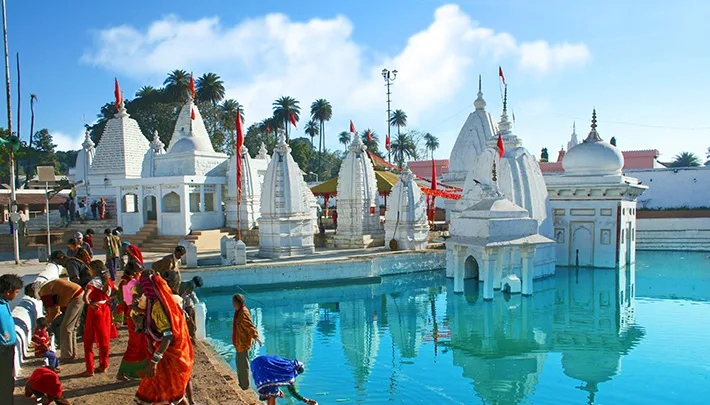
Maa Narmada emerges from Amarkantak, a small layered town located in the Maikal range of Madhya Pradesh. Geologically, it is a forested plateau rich in perennial water systems. Culturally, it is a womb. Spiritually, it is a tirtha where time slows down.
The Skanda Purana and Matsya Purana speak of Amarkantak not merely as a geographic location, but as a living, breathing realm, inhabited by siddhas, rishis, gandharvas, and yakshas. The Narmada Purana returns to this land again and again, describing it as a place where tapasya bears fruit swiftly because the earth itself is infused with spiritual energy. Here, belief holds that no sound is lost, not a chant, not a sigh, not even silence. Everything is heard.
I arrived in Amarkantak in 2014 as a journalism student, carrying notebooks, deadlines, and ambition. What unfolded over the years, however, went far beyond formal education. It was a civilisational immersion. Undergraduate classes, postgraduate research, and eventually a PhD ran parallel to an unspoken curriculum taught every day by Maa Narmada. The classrooms offered theory, but the river taught discipline, patience, attentiveness, and humility. She taught how to wait, how to listen, and how to remain grounded even when the current feels uncertain.
Physically, the air strengthened our bodies, the walks along the ghats disciplined our routines, and the stillness taught us to pause. Mentally, the impact was deeper. In the midst of university restrictions, deadlines, evaluations, and the unrelenting pressure to perform, the serene atmosphere became more than a backdrop. Maa Narmada was not just a river; she became a silent caregiver, holding us when anxiety crept in, calming us when our thoughts became too loud.
Friendships during those years were shaped quietly, almost invisibly, by the river’s presence. Conversations were fewer, silences longer, and yet understanding ran deep. Faith, doubt, exhaustion, hope, all coexisted on those ghats. Some of us arrived with an instinctive devotion, a bond so natural it needed no explanation. For others, the connection grew gradually, through evening walks that turned into rituals, through moments of surrender when the mind finally allowed itself to unclench.
For those who had grown up in the Narmada region, the relationship carried the weight of inheritance, memories of childhood, festivals, village rhythms, and ancestral faith. And yet, even then, certain moments stood apart.
Looking back, it is clear that Maa Narmada did more than surround us; she shaped us. She cared for us when systems were rigid and expectations unyielding. She guided us through confusion, teaching us resilience without aggression and strength without noise.
The antiquity of a river older than time
One of the most astonishing aspects of Maa Narmada is her claimed antiquity. According to Vande Maharaj, a respected traditional scholar and priest of Amarkantak, Narmada’s manifestation dates back over 25 billion years.
This calculation is rooted in Hindu cosmological time. The Puranas describe one Mahayuga as lasting 43 lakh 20 thousand years. One thousand such Mahayugas constitute a Kalpa, equivalent to one day of Brahma, roughly 4.32 billion years. Based on these calculations, the year 2026 corresponds to the 25,88,49,06,127th Narmada Janmotsav.
From a modern scientific lens, such numbers may appear symbolic. Yet in Indic philosophy, symbolism does not negate truth. It expands it. The message is clear: Narmada belongs to cosmic time, not historical time. She precedes civilisation and will likely outlast it.
Narmada Janmotsav 2026: Faith in motion
This year in 2026, Narmada Janmotsav falls on Sunday, January 25, observed on Shukla Paksha Saptami of the Magha month. In Amarkantak, the celebration extends over two days, January 24 and 25, transforming the town into a living spiritual hub.
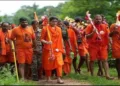
The festivities unfold organically. Processions carry the symbolic form of Maa Narmada through narrow lanes. Akhand kirtans echo through forests. The Nirjharini Mahotsav celebrates the countless streams feeding the river. Maha aartis at Narmada Kund and Ram Ghat gather pilgrims, students, ascetics, and locals alike.
On the evenings, devotional singers perform at Ram Ghat. Yet the most moving moments are unscheduled. An old man lighting a diya with trembling hands. A child releasing flowers into the current. Groups of friends sitting silently, watching reflections dissolve into water.
Tribal faith and living ecology
For the Gond, Baiga, Bharia, and Korku tribes, Narmada is not mythology but kinship. There is no separation between worship and ecology. Protecting forests, respecting animals, and conserving water are not ideological acts, they are familial duties.
Tribal elders explain that Maa Narmada is pleased by karuna, compassion towards all living beings. Anger, greed, and exploitation disturb her flow. This belief system has preserved ecological balance long before environmentalism became an academic discourse.
During Janmotsav, tribal celebrations unfold differently at each ghat. Oral bhajans passed through generations, rhythmic dances, and symbolic offerings create a mosaic of devotion that resists standardisation. Each ghat carries its own rhythm, its own theology.
A safe space
Beyond ritual, Maa Narmada functions as a refuge. Students burdened by uncertainty, researchers fatigued by deadlines, travellers caught between decisions often gravitate towards her banks.
There were days when a simple visit to Ram Ghat, eating a samosa, touching the water, and returning without entering any temple felt complete. The encounter itself was enough. Maa Narmada does not demand an explanation. She absorbs.
Maa Narmada is unique in the geography of Bharat because her entire course, nearly 3,300 kilometres, is not merely revered but ritually walked. The Narmada Parikrama is not symbolic. Pilgrims circumambulate the river on foot, traditionally keeping the water always to their right, a discipline that transforms geography into spiritual practice.
Parikrama vasis come from across the country, Maharashtra, Gujarat, Madhya Pradesh, Tamil Nadu, Uttar Pradesh, and regions far removed from the river’s physical flow. They arrive carrying little more than faith. Some walk barefoot. Some walk with injuries that never fully heal. The journey takes months, sometimes years, moving through forests, heat, monsoon floods, wildlife corridors, and long stretches of isolation. This is not endurance for spectacle. It is endurance as surrender.
What distinguishes the Narmada Parikrama from pilgrimage circuits is its absence of urgency. There is no destination to reach quickly, no final shrine that marks completion. The journey itself is the prayer. Parikrama vasis wake with the sun, walk until the body allows, rest where shelter appears, and resume when strength returns. They depend on villagers for food, on strangers for water, and on the river itself for direction. In doing so, the ego slowly dissolves. The body learns limits. The mind learns patience.
Many parikramavasi speak not of miracles, but of transformation. “You don’t walk around Narmada,” one elderly pilgrim once said, “she walks you out of who you thought you were.” The river strips ambition, routine, and fear, replacing them with rhythm. Days are measured not by clocks but by footsteps.
In recent years, improved roads, tourism promotion, and digital visibility have made parts of the parikrama route more accessible.
From Marble Rocks to the Sea
Flowing westward, defying the direction of most Indian rivers, Maa Narmada nourishes forests, tribal belts, agricultural plains, and towns. At Bhedaghat in Jabalpur, she carves her path through towering white marble cliffs, transforming geology into poetry.
She flows past Maheshwar, the capital of Ahilyabai Holkar, where governance, spirituality, and architecture once converged. Eventually, she enters Gujarat and merges with the Arabian Sea, having touched countless lives without losing her identity.
The Narmadashtakam, traditionally attributed to Adi Shankaracharya, describes Narmada as the destroyer of fear, giver of bhakti and mukti, and refuge for all beings regardless of social hierarchy. She shelters fish, birds, animals, saints, and sinners alike.
The text emphasises equality before water, a radical idea embedded quietly within devotion. Recitation of Narmadashtakam is believed to remove misfortune and guide the soul towards liberation.
Folklore, Feminine Power and Shiva’s Daughter
The Narmada Purana narrates that on Vaishakh Shukla Saptami, Maa Ganga herself visits Narmada to cleanse accumulated impurities. Symbolically, even the pure seek purification in her.
Shiva’s daughter, emerging from his matted locks, Narmad,a embodies both ferocity and compassion. She flows relentlessly yet nurtures gently, reflecting Shiva’s paradoxical nature.
A River Shaping Governance and Region
Former Madhya Pradesh Chief Minister Shivraj Singh Chouhan maintained a visibly personal bond with Maa Narmada. He would walk barefoot towards her ghats and avoid helicopter landings near her banks. His governance frequently linked development with Narmada-centric conservation.
Madhya Pradesh’s forests, agriculture, biodiversity, and cultural geography owe much to her presence. Entire ecosystems thrive quietly under her care.
Maa Narmada is not confined to mythology. She flows into present debates on ecology, identity, and belonging. Every year, Narmada Janmotsav grows not because of spectacle but because more people rediscover what she represents.
For those raised in her anchal, educated on her banks, and shaped by her silence, Maa Narmada is not merely worshipped.
She is lived.
Narmade Har!