
“Science is more than a body of knowledge; it is a way of thinking.”
— Carl Sagan
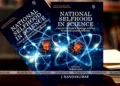
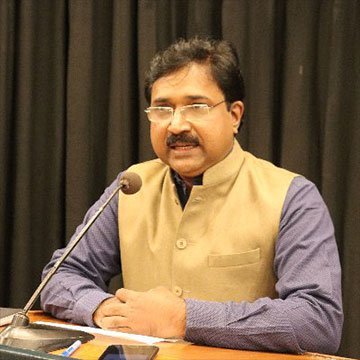
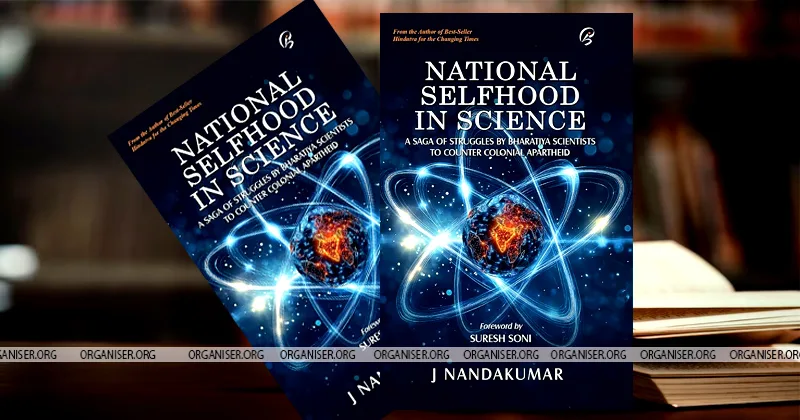
The Jaipur Literature Festival, while unveiling National Selfhood in Science: A Saga of Struggles by Bharatiya Scientists to Counter Colonial Apartheid by Shri J. Nandakumar, the national convener of Prajna Pravah, Shri Makarand Paranjape reminded the audience that even under the brute force of British suppression, Bharatiya scientists transformed science into a medium of national self-expression.
Nandakumarji’s book shows how the nationalisic zeal passionately roused by Bharatiya scientists tapered off during the last 70 years starting from Nehru’s era.
Science, though a quest for truth, has often been weaponised—not only to inflict physical destruction, but to colonise minds for generations and facilitate plunder. The British mastered this art, deploying every stratagem to stifle Bharatiyas engaged in scientific pursuit. Convinced that Europeans embodied the pinnacle of civilisation, George Nathaniel Curzon, the eleventh Viceroy of Bharat, ensured that no Bharatiya was elevated to leading positions in institutions of repute. His disdain was laid bare in his infamous declaration: “Because among all 300 million people of the subcontinent, there was not a single man capable of the job.”
Yet, just as Hemingway’s old man in The Old Man and the Sea proved that one can be destroyed but not defeated, Bharatiya scientists carved their niche by turning science into a banner of resilience. Their vision aligned with pioneers such as P. C. Ray, author of A History of Hindu Chemistry, and Bibhutibhushan Datta and Awadhesh Narayan Singh, who penned History of Hindu Mathematics. For them, science was not merely an intellectual pursuit but a Dharmic calling—a means of self-expression and service to Rashtra. They sought to reveal to the world the ennobling dimension of science and the deeper meaning of Rashtratva (too often mistranslated as “nationhood”). In the Vedic view, the purpose of Rashtra is not merely political organisation but the guidance of humanity toward the higher goal of moksha.
This civilisational perspective stood in stark contrast to the post-Independence narrative shaped by Jawaharlal Nehru and his Communist allies. They propagated the colonial notion that Bharat was a “nation in the making”—a multi-cultural, multi-ethnic, and multi-racial construct, allegedly birthed by the British. Hindu Dharma, they argued, was the root of the nation’s problems, and anything associated with it had to be relegated to the margins. Nehru’s policies, whether in foreign affairs or economics, repeatedly faltered. His much-vaunted Second Five Year Plan, intended to transform Bharat into an industrial giant, instead pushed the country to the brink of famine. On the geopolitical front, Bharat suffered a humiliating defeat at the hands of Communist China—ironically the very regime Nehru had championed globally, despite warnings from Sardar Patel and others. Strangely, each failure only strengthened the demand to persist with Nehruvian policies, while their apologists shifted blame onto Hindu Dharma. The phrase “Hindu Rate of Growth” remains a telling example of this distortion.
When Nehru’s daughter, Indira Gandhi, assumed power, the apparatus he had nurtured consolidated further. Positions in academia and institutions were bartered to loyal comrades, cementing ideological control. Jawaharlal Nehru University emerged as a citadel for these allies, who tirelessly promoted Nehru’s image while weaving “poisoned stories” about Hindu Dharma and Bharat. Nehru was elevated as the hero for all seasons, while the civilisational ethos of Bharat was systematically undermined.
After seven decades of intellectual morass and stagnation, Bharat now stands at a turning point. A more confident nation seeks to re-examine its place among the comity of nations, determined to shed the colonised mindset.
The foreword by senior Pracharak Shri Suresh Soni challenged the illusion that experimentation was a purely Western invention, recalling Acharya P. C. Ray’s contrast between the trivial debates of the Royal Society and the rigour of Bharatiya texts like Rasendra Cintāmani and Rasaprakāśa Sudhākara, where scholars insisted on personally verified experiments as the basis of true knowledge. This spirit of inquiry extended beyond chemistry into musicology, as Bharata’s Nātyaśāstra narrates how observation of natural sounds led to the invention of instruments, exemplifying Bharat’s epistemic cycle of observation, reflection, and innovation. Such traditions affirm that reason and experimentation flourished in Bharat long before the West, and rediscovering them today is vital to shed colonial illusions, cultivate self-reliance, and restore Bharat’s rightful place as a contributor to global knowledge.