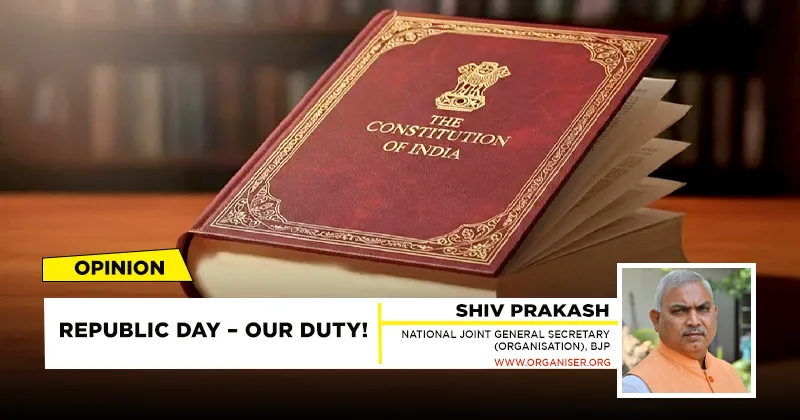
On 26 January, India is celebrating the 76th year of its Republic with great joy and enthusiasm. On 26 January 1950, India implemented its Constitution. This 75-year journey of India has been full of challenges, yet it is the story of a successful democracy. The Constitution of India has made a significant contribution to this success. The Constituent Assembly dedicated this Constitution to the nation on 26 November 1949. At that time, we reiterated our resolve that we are committed to providing social, economic, and political justice through a democratic system.
While following our respective faiths and beliefs, we shall preserve national unity and integrity through fraternity. Referring to the special features of our Constitution, African leader Nelson Mandela said that “India’s Constitution has become an inspiration for South Africa and several other emerging democracies, because it has taught respect in diversity.” On this occasion of Republic Day celebrations, “We, the People of India” must remain alert to future challenges, overcome them, and fulfill the Prime Minister’s resolve of a Developed India.
Prime Minister Shri Narendra Modi, in his call for the Panch Pran, has urged the people of India to free themselves from every form of slavery. Through a planned approach, some foreign scholars generated a sense of inferiority in Indian society toward our systems, history, great personalities, and culture. As a result, our society became afflicted with a sense of self-inferiority. There is confusion across the nation regarding questions such as what the foundation of our nation is and which values we should move forward on. India is the only country in the world that has two names—Bharat and India.
This situation itself has become the cause of many disputes in India. In his speech in the Constituent Assembly, Dr. S. Radhakrishnan said, “Nationality depends on the way of life that we have been following since time immemorial. This way of life is the personal property of this country.” Mahatma Vidura said that “In a state of confusion, the king, the people, and the entire nation perish.” On the occasion of Republic Day, let us remember the glory of India and take a pledge for the awakening of society on the basis of our cultural values, free from confusion.
In his address from the Red Fort on 15 August, Prime Minister Narendra Modi expressed concern over the changing demographic patterns in the country. We have already witnessed the partition of India due to population imbalance. Through a planned manner and by many means, efforts are being made once again to reshape India’s population on religious lines. The declining Hindu population and its consequences can be experienced daily through events occurring in Pakistan and Bangladesh. Egypt, Turkey, Iran, Lebanon, and Kosovo also stand as witnesses to their ancient cultures being destroyed due to demographic changes. The renowned sociologist Auguste Comte, based on these experiences, stated that “Demography is Destiny.” We, the people of India, by recognising these imminent dangers, should assist in the “Detect, Delete, Deport” of foreign infiltrators and become participants in saving democracy.
Due to India’s rising power in the world, many foreign powers, foreign-inspired individuals, and institutions appear disturbed. Because of this disturbance, they are continuously attempting to defame constitutionally recognised institutions and systems. Making allegations against the Indian Election Commission and EVMs, which are globally admired by many countries, creating confusion in society using CAA as a basis, accusing the government of changing the Constitution and removing reservations, and incidents taking place in the name of farmers’ movements—these are all living proofs of such efforts. It is also alleged that similar forces played a role in changing elected governments through movements initiated in Sri Lanka, Bangladesh, and Nepal. In India, too, under the name of Gen Z, they nurture such dreams.
On 26 November 1949, Baba Saheb Dr. Bhimrao Ambedkar, in his final speech to the Constituent Assembly, called this the “Grammar of Anarchy.” He said that these so-called mass movements were attempts to use propaganda as a weapon against the democratic system. In India, many foreign-funded non-governmental organisations (NGOs) are active behind this anarchy. For those who have witnessed the support of global dominance through internal conflicts and economic imperialism in many countries, the answer lies in making India developed and secure on the basis of indigenous strength and self-reliance.
Many scholars inspired by Western and communist ideologies view India not as a nation but as a group of many nations. Granting ideological legitimacy to divisions such as North–South, Aryan–Dravidian, tribal–urban, Dalit–Hindu has been the consistent effort of such groups. People who promote so-called equality through urban Naxalism and armed insurgency have always dreamt of India’s division. India has always been one nation; its culture is one. In diversity (Unity in Diversity), we have experienced unity. From sea to the Himalayas, we are one. Due to the lack of realisation of this truth, selfish and power-hungry political leadership, driven by limited understanding, indulges in divisive statements. The initiative Ek Bharat – Shreshtha Bharat, launched by Prime Minister Narendra Modi, enables the people of India to experience this sense of unity. Kashi–Tamil Sangamam is a living example of this. We, the people of India, must make a successful effort to make crores of Indians realise this truth.
The Government of India has resolved to free the country from Naxalism by 31 March 2026. Since 2014, more than 2,000 Naxals have been eliminated, and more than 7,000 Naxals have surrendered and expressed faith in the Constitution. All Indians must support development and rehabilitation in Naxal-affected areas and assist in Prime Minister Narendra Modi’s resolve of a Naxal-free India.
Extremist forces everywhere are conspiring under the guise of victimhood in the name of protecting their identity. Opposition to Makar Sankranti in Bangladesh, demands for a separate land in Texas in the United States, and conspiracies of religious conversion and love jihad are being witnessed everywhere, including India. By coming out on the streets in large numbers in the name of opposing incidents, attempts are being made to create fear in society. Challenging law and order and the judicial system is increasingly becoming the very nature of certain groups. This is a matter of concern for all nation-minded citizens.
In a democratic system, freedom from dynastic politics for the participation of the common citizen and integrity in the implementation of economic policies should become part of our conduct and decisions. The success of governments should be measured by development and social prosperity, not evaluated on the basis of caste and region. This will create an internal social environment filled with mutual harmony and fraternity. On this occasion of Republic Day, by adhering to constitutional values and remaining alert to challenges, let us perform our duties—this is the duty of all of us, the people of India.