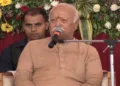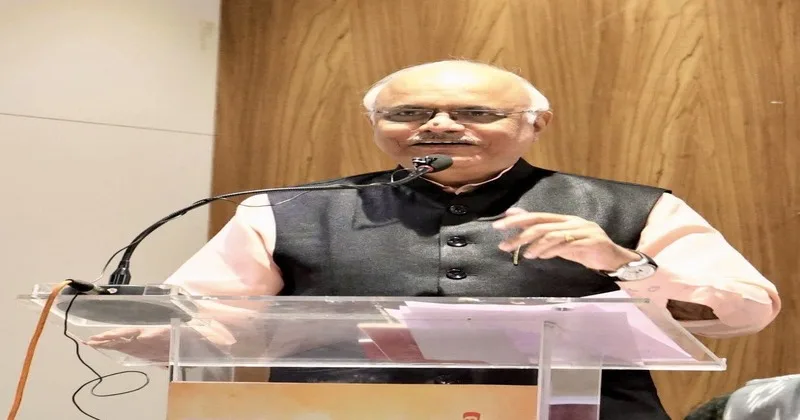
VIJAYWADA: Dr Vinay P.Sahasrabuddhe, on January 24, said that Integral Humanism, propagated by Deendayal Upadhyaya, remains the enduring ideological foundation of the Bharatiya Janata Party and continues to guide its approach to governance and culture, even 65 years after its articulation.
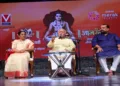
Addressing the second day of the seminar, revisiting 65 years of Integral Humanism in Vijayawada, Dr Sahasrabuddhe said that while India has nearly three hundred political parties, the BJP stands apart because it is rooted in an ideology that carries the “fragrance of the soil of this land — hamari desi mitti ki sugandh”.
He said this ideological journey did not begin recently, but with the foundation of the Bharatiya Jans Sangh in 1951, and that for the last seventy-five years, this philosophical foundation has remained consistent. That philosophy, he said, is Integral Humanism.
Dr Sahasrabuddhe stated that his address would focus mainly on the governance and cultural dimensions of Integral Humanism. Explaining the core principles of the philosophy, he said Integral Humanism rests on certain cardinal values, with Swadeshi being among the most important.
He said Swadeshi should not be confined to economics alone, but must also include Swabhasha (language), Swabhusha (attire), Swadharma (civilisational duty), and an indigenous way of thinking. “Identity matters. A name matters. Language matters. Culture matters,” he said.
He observed that India is India because it is essentially Bharat, and that identity is not accidental. He said individuals are born into a society, a language, and a cultural ecosystem, and that the way people speak, dress, eat, and inherit values shapes their identity. Denying this reality, he said, amounts to denying the truth of civilisational existence.
Explaining the concept of Dharma in Integral Humanism, Dr Sahasrabuddhe said it is not about rituals or modes of worship, but about duty—duty towards society, the nation, and civilisation. He said fulfilling this duty requires a clear understanding of India’s history and heritage.
Recalling his association with the Indian Council for Cultural Relations, Dr Sahasrabuddhe referred to an international conference jointly organised with Tehran University on Maharshi Panini. He said Panini’s contribution was not limited to Sanskrit grammar, but also influenced the grammatical structure of Persian.
He recalled an informal discussion with a professor from Tehran University who told him that Vedanta and the Upanishads are taught there, and then asked him in which Indian university Iranian knowledge was taught. Dr. Sahasrabuddhe said that at that point in time, he had no answer.
He said the situation has since changed following the introduction of the National Education Policy 2020 under Prime Minister Narendra Modi, which formally recognises the Indian Knowledge Systems. He said universities across the country are now reclaiming and integrating this intellectual heritage.
Dr Sahasrabuddhe underlined that culture is central to the idea of India and said that removing culture would render the nation hollow. Referring to the redevelopment of the Kashi Vishwanath Corridor and the Mahakal Lok, he said these initiatives represent civilisational restoration, not merely infrastructure development.
He said Integral Humanism also finds deep reflection in governance, as the philosophy integrates the individual, society, nature, and spirituality. He said it balances Dharma, Artha, Kama, and Moksha, thereby ensuring material progress alongside spiritual elevation.
According to Dr Sahasrabuddhe, this integration is visible in governance under the Modi government through initiatives such as Mudra for financial inclusion, empowerment of marginalised communities, constitutional support for economically weaker sections, expansion of educational institutions in the North-East, and focused development of remote regions.
He noted that this approach had earlier been initiated during the tenure of Atal Bihari Vajpayee, particularly with the creation of the Ministry for Development of the North Eastern Region.
Referring to women’s representation, Dr Sahasrabuddhe said that 2026 marks 100 years since Dr. Mutthu Lakshmi Reddy became the first woman to enter a legislative body in India, in 1926. He said it was significant that during this period, the Modi government ensured constitutional provision for 33 per cent reservation for women in legislatures, reflecting governance rooted in inclusion and dignity.
He further said Integral Humanism views society as a living body, where the suffering of one limb affects the entire system. He stressed that development must prioritise the most deprived sections of society, treating them as the most deserving.
On environmental consciousness, Dr Sahasrabuddhe said sustainability is embedded in Indian culture, reflected in traditional prayers expressing gratitude to Mother Nature. He contrasted Bharatiya thought, which emphasises confluence with Prakruti, with ideologies that advocate conquest over nature.
Referring to International Yoga Day, now observed by more than 165 countries, he said it represents India’s contribution of traditional knowledge to the world and exemplifies Swadeshi that is rooted, confident, and universal.
Concluding his address, Dr. Sahasrabuddhe recalled a story of two birds sitting on the same tree—one receiving sweet fruits and the other bitter ones—to underline the importance of collective responsibility. He said those who are comparatively privileged have a duty towards sections that continue to live in deprivation and neglect, adding that only through such responsibility can the vision of Ek Bharat, Sureshit Bharat be realised.