India grew despite policy errors due to civilisational strengths
July 14, 2026
  • Read Ecopy
  • Circulation
  • Advertise
  • Careers
  • About Us
  • Contact Us
Android AppiPhone AppArattai
Organiser
  • ‌
  • Bharat
    • Assam
    • Bihar
    • Chhattisgarh
    • Jharkhand
    • Maharashtra
    • View All States
  • World
    • Asia
    • Europe
    • North America
    • South America
    • Africa
    • Australia
  • Editorial
  • International
  • Opinion
  • RSS @ 100
  • More
    • Op Sindoor
    • Analysis
    • Sports
    • Defence
    • Politics
    • Business
    • Economy
    • Culture
    • Special Report
    • Sci & Tech
    • Entertainment
    • G20
    • Azadi Ka Amrit Mahotsav
    • Vocal4Local
    • Web Stories
    • Education
    • Employment
    • Books
    • Interviews
    • Travel
    • Law
    • Health
    • Obituary
  • Subscribe
    • Subscribe Print Edition
    • Subscribe Ecopy
    • Read Ecopy
  • ‌
  • Bharat
    • Assam
    • Bihar
    • Chhattisgarh
    • Jharkhand
    • Maharashtra
    • View All States
  • World
    • Asia
    • Europe
    • North America
    • South America
    • Africa
    • Australia
  • Editorial
  • International
  • Opinion
  • RSS @ 100
  • More
    • Op Sindoor
    • Analysis
    • Sports
    • Defence
    • Politics
    • Business
    • Economy
    • Culture
    • Special Report
    • Sci & Tech
    • Entertainment
    • G20
    • Azadi Ka Amrit Mahotsav
    • Vocal4Local
    • Web Stories
    • Education
    • Employment
    • Books
    • Interviews
    • Travel
    • Law
    • Health
    • Obituary
  • Subscribe
    • Subscribe Print Edition
    • Subscribe Ecopy
    • Read Ecopy
Organiser
  • Home
  • Bharat
  • World
  • Operation Sindoor
  • Editorial
  • Analysis
  • Opinion
  • Culture
  • Defence
  • International Edition
  • RSS @ 100
  • Magazine
  • Read Ecopy
Home Bharat

India grew despite policy errors due to civilisational strengths: Prof. Kanakasabhapati

Economist and BJP Tamil Nadu Vice President Kanakasabhapati traced India’s economic resilience to its family-based, community-driven systems while addressing a seminar in Vijayawada on January 24, 2025, marking 60 years of Integral Humanism

Kunti SurenderKunti Surender
Jan 24, 2026, 04:20 pm IST
in Bharat, Telangana
Follow on Google News
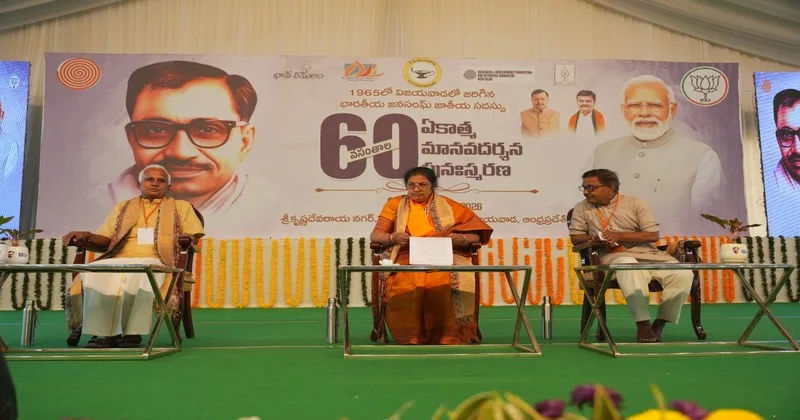
Dignitaries on the stage at the seminar in Vijayawada marking 60 years of Integral Humanism

Dignitaries on the stage at the seminar in Vijayawada marking 60 years of Integral Humanism

FacebookTwitterWhatsAppTelegramEmail

VIJAYWADA: Kanakasabhapati, noted economist and BJP Tamil Nadu Vice President, delivered an extensive address at Vijayawada on January 24, 2025, during the commemorative seminar marking 60 years of Integral Humanism, organised by BJP Andhra Pradesh.

In his speech, Kanakasabhapati traced India’s economic journey from the 1950s onwards and emphasised that despite policy mistakes, ideological misadventures, and unsuitable economic models adopted over the decades, India has continued to grow. He underlined that this growth was not accidental but rooted in India’s unique civilisational, cultural, and social foundations.

He noted that during the growth phase between the 1950s and the 1990s, India frequently compared itself with Europe and America. Later, when socialism spread globally, India’s establishment adopted globalisation in a manner unsuitable to the country. As a result, development outcomes fell short of expectations. However, he stressed that India still progressed despite these wrong approaches and policy errors committed over the last 50-plus years.

Kanakasabhapati explained that India’s resilience stems from its fundamentally different economic and business systems. Unlike Western models, India’s economy is built on family structures, community networks, social capital, high savings, entrepreneurship, and an intergenerational outlook. These strengths, he said, arise from India’s civilisational and cultural background.

Also Read: Historic Vijayawada meet marks 60 years of ‘integral humanism’; BJP leaders recall Jana Sangh legacy

Drawing from over three decades of field studies across the country, he observed that even in the 21st century, India’s economic and business systems do not function according to textbook theories. Instead, they are shaped by family, community, and cultural values. He pointed out that India has historically maintained high savings rates, including immediately after Independence, when the savings rate stood at 9.1 per cent despite widespread poverty. He contrasted this with present-day Western economies, where such savings rates are unimaginable.

He emphasised that saving has always been considered a moral value in Indian society, where spending beyond one’s means was seen as a sin. Over the past 15 years, India’s savings have averaged more than 30 per cent of GDP, among the highest in the world. According to him, families save not only for themselves but also for future generations, and this intergenerational commitment has driven India’s economic progress for generations.

Kanakasabhapati highlighted the central role of families—especially mothers, sisters, grandmothers, and wives—in India’s economic ecosystem. He stated that Indian entrepreneurs consistently acknowledge the contribution of women in enabling businesses to start, survive, and grow. Citing examples from the hospitality and textile industry in Tamil Nadu, he explained how married sisters often provided seed capital, a contribution rarely acknowledged in conventional economic textbooks.

Through a series of detailed case studies—from Tiruppur’s textile exporters and Surat’s diamond and textile industries to Sivakasi’s fireworks and printing clusters—he demonstrated how ordinary individuals from rural and agricultural backgrounds built globally competitive industries without elite education or corporate backing. These successes, he said, were powered by indigenous business sense, community trust, decentralised finance, and cultural solidarity.

He further noted that India’s economic systems have historically been decentralised, a principle echoed in Integral Humanism. Referring to post-2014 governance reforms, he cited the abolition of the Planning Commission and the establishment of NITI Aayog as recognition that no single foreign model can be transplanted into India. He pointed out that NITI Aayog’s official mandate calls for a Bharatiya approach to development rooted in Indian realities.

Kanakasabhapati also referred to recent developmental outcomes, including infrastructure expansion, sanitation coverage, and poverty reduction, describing them as unprecedented in independent India. He stressed that these achievements reaffirm the relevance of decentralised, culture-based development models.

Quoting American economist and former US Ambassador to India John Kenneth Galbraith, he recalled the observation that India’s progress is attributable to the “energy and genius of the Indian people.”
He argued that India must decolonise its mindset and recognise its own indigenous economic wisdom rather than blindly follow Western ideologies, which have failed even in their countries of origin.

Concluding his address, Kanakasabhapati asserted that only decentralised and culturally rooted economic systems can ensure sustainable prosperity. He urged policymakers, intellectuals, and citizens to recognise India’s native economic strengths and strengthen them further in the spirit of Integral Humanism.

Topics: NITI AayogDeendayal UpadhyayaKanakasabhapati60 years of Integral Humanism
ShareTweetSendShareSend
✮ Subscribe Organiser YouTube Channel. ✮
✮ Join Organiser's WhatsApp channel for Nationalist views beyond the news. ✮
Previous News

Bullet train for the South? Metro man Sreedharan unveils Kerala’s high-speed future with center’s blessing

Next News

Arunachal Pradesh govt orders demolition of illegal Mosques in Ziro amid ST Bachao Andolon

Related News

India’s first made-in-India C-295 aircraft marks a shift from state control to nation-building through public-private partnership

From Nationalisation to Nation Building: The difference between socialism and integral humanism

Delegates at the Niti Aayog meeting

NITI Aayog’s Northeast Development Model: How Modi Govt is transforming landscape of India’s ‘Ashtalakshmi’ States

From Borrowers to Builders: Indian women are rewriting the rules of credit

Divya Bharat: NITI Aayog New Anthology Unlocks India Year-Round Tourism Soul

C. P. Radhakrishnan , Vice President; Dr. Pradeep Bharadwaj, Prajna Pravah Karnataka South Coordinator; Pujya Jagadguru Sri Shivarathri Deshikendra Mahaswamiji Thaawarchand Gehlot, Karnataka Governor; Prof. Sharanappa Halase, VC of KSOU

Karnataka: VP Radhakrishnan inaugurates ‘Ekatma Manava Darshan’ Conference, calls for applying Integral Humanism

A representative image

What is Swavalambini scheme? How centre’s women entrepreneurship programme will turn students into job creators

Load More

Latest News

Shri Nandkishore Goenka ji

Renowned social worker Nandkishore Goenka passes away; RSS pays tribute to his lifelong commitment to Goseva

The organisers of the 'Melbourne Meets Modi' community have issued a strongly worded open letter to Rahul Gandhi

Don’t insult Indian-Australians: Melbourne Meets Modi organisers demand apology from Rahul Gandhi over paid crowd claim

Tiruvananthapuram Mayor Adv. V.V. Rajesh administers oath to BJP councillor R. Sugatan at Viyyoor Central jail, Thrissur

Keralam: Tiruvananthapuram BJP Councillor R Sugatan retakes oath in Viyyoor Central Jail after Kerala HC intervention

Bhojshala Case: Supreme Court Declines Muslim Plea, No Namaz Allowed on Premises

Bhojshala: SC refuses to stay Madhya Pradesh HC order; No namaz allowed within premises, Bars structural changes by ASI

Tamil Nadu: Supreme Court stays Madras HC order directing state govt to ensure no cow slaughter

Pahalgam Terror Attack: NIA Court Issues Non-Bailable Warrant Against LeT Chief Hafiz Saeed

Pahalgam Terror attack: NIA court issues non-bailable warrant against LeT chief Hafiz Saeed, who resides in Pakistan

Akhil Bharatiya Karyakarini Sadasya Bhaiyyaji Joshi addressing the gathering

Pride of being a Hindu represents a life based on peace, truth and justice: Bhaiyyaji Joshi

India’s Minerva Academy wins Helsinki Cup in Finland

India’s Minerva Academy scripts history, beats defending champions HJK to win Helsinki Cup in Finland

Hindu leader Sagar Beg (Left), Pakistan-based gangster Shahzad Bhatti (Right)

Maharashtra: Pakistan based terror gangster syndicate publicly marks Hindu leader Sagar Beg for assassination

Indian Women Cricket Team beat England in test match at Lords

India scripts history at Lord’s, crushes England by 270 runs in first Women’s Test

Load More
  • Privacy
  • Terms
  • Cookie Policy
  • Refund and Cancellation
  • Delivery and Shipping

© Bharat Prakashan (Delhi) Limited.
Tech-enabled by Ananthapuri Technologies

  • Home
  • Search Organiser
  • Bharat
    • Assam
    • Bihar
    • Chhattisgarh
    • Jharkhand
    • Maharashtra
    • View All States
  • World
    • Asia
    • Africa
    • North America
    • South America
    • Europe
    • Australia
  • Editorial
  • Operation Sindoor
  • Opinion
  • Analysis
  • Defence
  • Culture
  • Sports
  • Business
  • RSS @ 100
  • Entertainment
  • More ..
    • Sci & Tech
    • Vocal4Local
    • Special Report
    • Education
    • Employment
    • Books
    • Interviews
    • Travel
    • Health
    • Politics
    • Law
    • Economy
    • Obituary
  • Subscribe Magazine
  • Read Ecopy
  • Advertise
  • Circulation
  • Careers
  • About Us
  • Contact Us
  • Policies & Terms
    • Privacy Policy
    • Cookie Policy
    • Refund and Cancellation
    • Terms of Use

© Bharat Prakashan (Delhi) Limited.
Tech-enabled by Ananthapuri Technologies