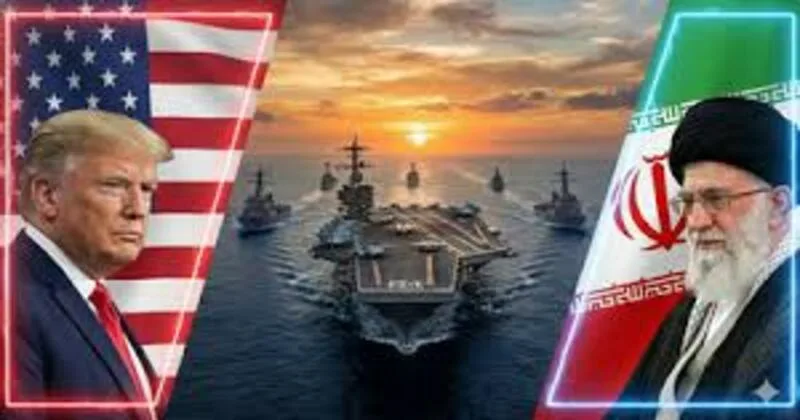
Washington: In a dramatic escalation of tensions in West Asia, reports from major international media and US officials indicate that the United States is preparing to take military action against Iran following the Islamic Republic’s brutal suppression of widespread popular protests. President Donald Trump has announced that a large US naval “armada,” including the aircraft carrier USS Abraham Lincoln and several guided-missile destroyers, is heading toward Iran via the Indian Ocean and the Persian Gulf region.
The movement of US forces reflects Trump’s increasingly hawkish posture, even as he publicly warns that he would prefer to avoid a protracted conflict. Alongside the aircraft carrier group, the US has deployed additional air defense systems throughout the Middle East, and F-15E Strike Eagle fighter jets have been pictured landing at military bases within the US Central Command area of operations, a clear signal of readiness for potential combat operations.
International reporting suggests this buildup is being justified in Washington as a retaliation for Tehran’s lethal crackdown on nationwide protests that began on December 28. Protesters initially took to the streets in Tehran’s Grand Bazaar against soaring inflation and economic hardship, but the movement rapidly morphed into a broad anti-government uprising. According to Iranian state media, 3,117 people have been killed in the unrest, including civilians and security personnel. However, independent activist groups operating inside Iran estimate the death toll has already exceeded 5,000, with many thousands more detained, a figure some international observers believe could be much higher as communications remain tightly controlled inside Iran.
Critics have condemned the Iranian clerical leadership for a ferocious crackdown involving live fire on demonstrators and a near-total blackout of internet services to suppress information. Human rights advocates describe the government’s actions as a severe violation of fundamental freedoms.
https://twitter.com/i/status/2014703998474060129
In Washington, Trump appears determined to leverage the crisis not only for military pressure but also for regime change, suggesting that Iran’s Supreme Leader could be removed and power transferred to opposition figures outside the current theocratic structure. If a US strike occurs, analysts warn it would threaten the Strait of Hormuz, risking severe disruption to global energy markets and pulling regional allies into a wider conflict. Iran has responded with stark warnings that any US attack would be treated as an all-out war, and Tehran has signaled it could retaliate directly against US partners in the region, particularly Israel, risking a multi–front war in an already volatile Middle East.
This unfolding situation marks a perilous crossroads that a US military posture sharpened by political calculation on one side, and an embattled Iranian regime clinging to power through force on the other, with ordinary civilians and other peaceful countries like India, caught in the devastating crossfire.