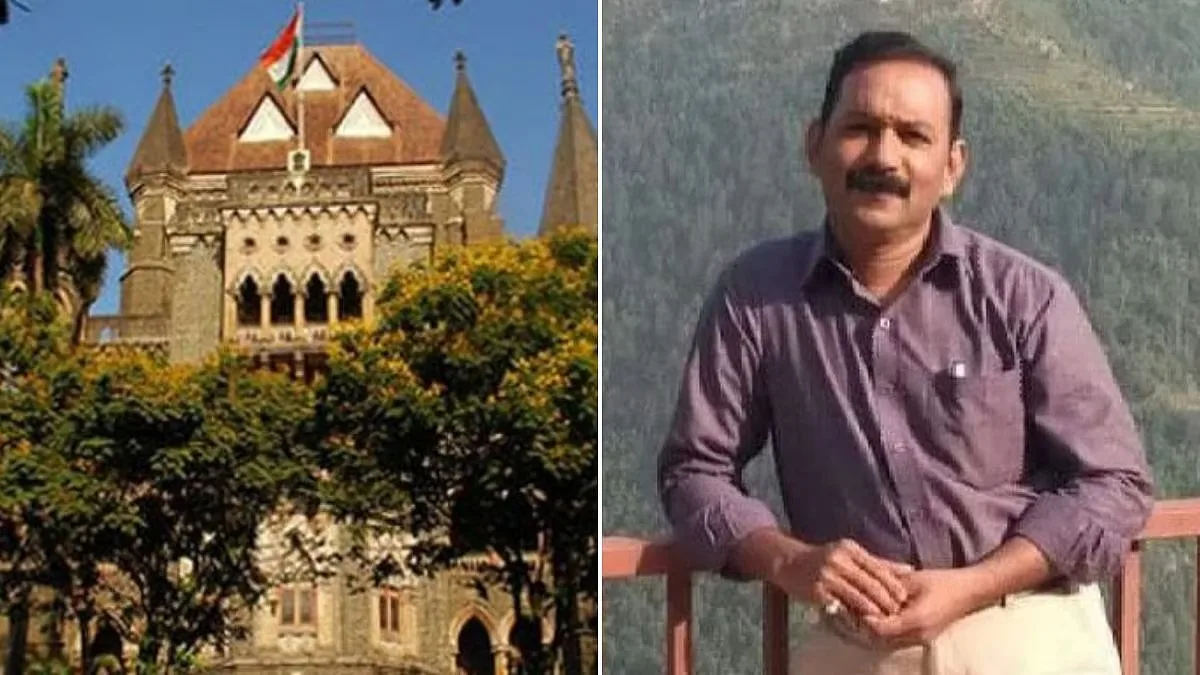
The Bombay High Court on January 20 denied bail to Yusuf Khan, one of the accused in the murder of Amravati-based chemist Umesh Kolhe, observing that the crime was intended to instil fear among the general public and could not be reduced to a personal dispute or a spontaneous act of violence. Kolhe was brutally killed in June 2022 after he shared a WhatsApp message expressing support for former BJP spokesperson Nupur Sharma, whose remarks during a television debate had triggered nationwide unrest.
A division bench of Justice A.S. Gadkari and Justice Shyam C. Chandak held that the material placed on record by the National Investigation Agency established, at least at the prima facie stage, that the offence went far beyond an ordinary murder. The court said the planning, motive and execution of the killing pointed to a coordinated conspiracy with a larger objective of creating fear and silencing dissenting voices, thereby justifying the continued incarceration of the accused under the UAPA.
Rejecting Khan’s plea for bail, the bench underlined that the case involved “more than a mere criminal conspiracy”. The judges noted that the alleged acts struck at the foundations of social order and collective conscience, and that the law required courts to adopt a cautious approach while dealing with bail pleas in terror-related offences.
Umesh Kolhe, a veterinary medical shop owner in Amravati, Maharashtra, was murdered on the night of June 21, 2022, while returning home after closing his shop. The killing took place amid heightened communal tension following protests and violence sparked by Nupur Sharma’s remarks, which she had made in response to derogatory comments about Hindu deities during a televised debate.
According to the prosecution, Kolhe had shared a photograph of Sharma along with a message supporting her on a WhatsApp group on June 14, 2022. While several others who had posted similar content were allegedly pressured into apologising or retracting their statements, Kolhe was singled out. The High Court noted that he was not merely asked to apologise but was instead chosen as a target, a factor that assumed significance in determining the intent behind the crime.
The prosecution maintained that the murder was the culmination of an escalating reaction to Kolhe’s social media activity in an already volatile atmosphere, rather than a sudden or isolated act.
Yusuf Khan, a veterinary doctor by profession, was known to Kolhe and regularly purchased medicines from his shop. Both were members of a WhatsApp group called “Black Freedom”, which included veterinary chemists and medical representatives. Khan was the only Muslim member of that group.
Khan’s defence argued that his actions were motivated by a business dispute and that his intention was limited to persuading others to boycott Kolhe’s shop. The High Court, however, found this explanation unconvincing. It observed that the manner in which Khan acted was inconsistent with a mere commercial disagreement.
The court noted that instead of limiting his message to Kolhe’s customers, Khan circulated the WhatsApp post widely across multiple groups and to individuals who had no business dealings with the deceased. This, the bench held, demonstrated that the objective was not economic pressure but deliberate provocation and exposure, aimed at triggering anger and retaliation.
The judges also took into account Khan’s educational and professional background, observing that as a literate and qualified individual, he was fully aware of the fragile social conditions prevailing at the time. Despite this, he chose to circulate an inflammatory message rather than attempt to defuse the situation.
A crucial element of the court’s reasoning related to the WhatsApp message circulated by Khan. The bench noted that before taking a screenshot of Kolhe’s post, Khan altered the second last digit of Kolhe’s mobile number in his contact list and re-saved it. This step ensured that Kolhe’s identity and contact details were exposed to a wider audience.
Khan then added a message in Hindi urging recipients to show Kolhe the consequences of “betraying those who gave him business” and to circulate the message as widely as possible. The message stated: “Isko batana hai ke jin logon ke bharose kamai ki, unse hi dushmani ka anjaam kya hota hai. Is message ko zyada se zyada group aur logon ko send kare.”
The High Court observed that the wording was carefully crafted to provoke anger and immediate action. It rejected the argument that the language merely suggested a boycott, noting that references to mass circulation and groups pointed towards an intent to incite retaliation rather than commercial pressure.
The court also relied on phone records and meeting details to infer Khan’s role in the conspiracy. It noted that Khan exchanged at least 25 phone calls with Accused No. 5 before and after Kolhe’s murder. These calls, when read alongside witness statements and location data, were treated as strong circumstantial evidence of his involvement.
The prosecution argued that Accused No. 5 acted as a conduit between Khan and the other conspirators. While Khan may not have been present at every meeting, the bench observed that direct participation at each stage is not necessary to establish conspiracy.
The court also noted that Khan’s mobile location placed him near Roshan Hall on June 9, 2022, where a meeting was held to discuss filing an FIR over Sharma’s remarks. This, combined with subsequent communications and meetings among co-accused, reinforced the inference that Khan was involved from the early stages.
The judges remarked that Khan appeared to have deliberately distanced himself from the execution phase after igniting the anger through his message, remaining “quietly active behind the curtain” while the conspiracy unfolded.
The High Court reconstructed the conspiracy through a sequence of events. According to the prosecution, Khan’s instigating message marked the starting point. He subsequently met Accused No. 5, who then met other accused at Gausiya Hall, where Kolhe’s social media post was discussed.
On June 19, 2022, a meeting involving several accused led to a decision that Kolhe should be killed as punishment for allegedly dishonouring their faith. The manner of the killing, targeting the neck with a sharp weapon, was also discussed. An initial attempt on June 20 failed as Kolhe’s shop was closed. The following night, after a recce, Kolhe was intercepted and stabbed to death.
The court emphasised that conspiracy is often proved through conduct and circumstances rather than direct evidence. In Khan’s case, it held that the cumulative material was sufficient to establish a prima facie meeting of minds.
One of the most significant observations in the order was the court’s characterisation of the accused group as a terrorist gang. The bench held that the murder was intended to send a message of fear to society at large, warning people against expressing certain views.
The court observed that such an objective squarely attracted Sections 16, 18 and 20 of the UAPA. It reiterated that at the bail stage, the court is only required to assess whether the accusations are prima facie true, not whether they will ultimately result in conviction.
Khan’s counsel also argued that his incarceration of over three and a half years amounted to a violation of Article 21 of the Constitution. While acknowledging that prolonged detention can justify bail in certain cases, the court held that this principle cannot be mechanically applied in terror-related offences supported by strong prima facie evidence.
The bench concluded that releasing Khan at this stage would run contrary to the statutory mandate under the UAPA and the larger interest of public safety.