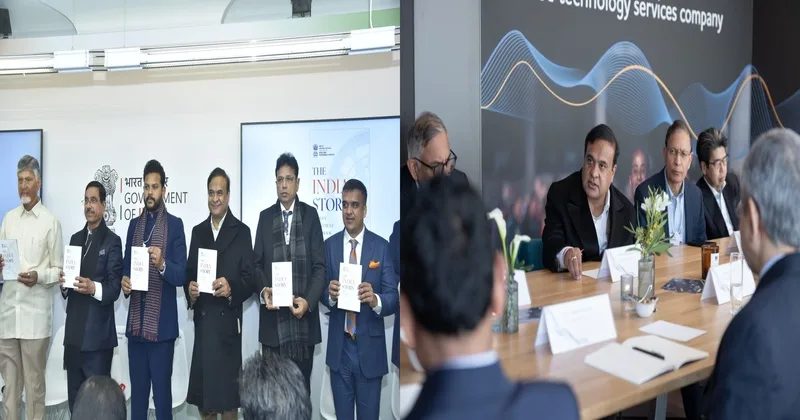
GUWAHATI: In a historic first for Northeastern India, Assam Chief Minister Himanta Biswa Sarma is actively participating in the World Economic Forum (WEF) Annual Meeting 2026 in Davos, Switzerland, scheduled from January 19 to 23. This landmark event underscores Assam’s emergence on the global stage, as the state joins elite company with India’s leading economies like Maharashtra, Gujarat, Karnataka, and Andhra Pradesh, which have long been regulars at such high-profile conclaves.
CM Sarma’s presence in Davos is no overnight achievement. It stems from a decade of deliberate, planned development, bolstered by focused attention from the Union government, sweeping infrastructure improvements, robust good governance, and—most crucially—lasting peace across the region.
From Insurgency Buffer to Stability Stronghold
Just a decade ago, when the Congress party and the United Progressive Alliance (UPA) were ousted from power in Delhi and subsequently in most Northeastern states, Assam and its neighbors were often relegated to the status of a “buffer zone” plagued by insurgency and violence. Militant activities disrupted daily life, deterred investments, and stifled growth. However, with the change in central leadership, a strategic shift occurred. The Union government prioritised the Northeast through targeted security operations, peace accords, and development packages.
By 2020, these efforts had yielded lasting peace, transforming the region from a conflict hotspot into a zone of opportunity. The last five years have witnessed unprecedented fast-paced infrastructure development—think expansive highways, modern airports, and digital connectivity—and the seeds of industrialization taking root. This groundwork has now propelled Assam to the WEF, where the Central government has extended a rare opportunity for the state to represent India alongside its more developed counterparts.
In the past, India’s economically advanced states typically shouldered the responsibility of showcasing the nation at this premier business summit. This year marks a significant departure, with Assam stepping up for the first time, signaling the Centre’s confidence in the state’s trajectory.
A Platform for Global Pitching and Partnerships
The WEF conference draws prominent world leaders from several countries, offering delegates like Sarma an ideal platform to articulate their visions and woo renowned global investors. Expectations are sky-high following the triumphant Advantage Assam 2.0 Investment and Infrastructure Summit, which already catalyzed commitments worth billions. Analysts predict CM Sarma’s WEF engagements will further amplify investment inflows and unlock Assam’s economic prospects.
During the sessions, Chief Minister Sarma has presented a compelling array of development initiatives centered on inclusive growth and the digital revolution. India’s rapid economic ascent has captured worldwide attention, and Assam—emerging as one of the nation’s fastest-paced and most promising states—has garnered both national and international spotlight. The state has registered notable advances in key sectors, from manufacturing to technology, positioning it as a vital cog in India’s growth story.
CM Sarma’s packed itinerary includes participation in more than 17 high-stakes meetings, where he is set to sign several memoranda of understanding (MoUs). His discussions span forward-looking themes such as securing a future-ready workforce for the next industrial era, elevating travel and tourism, and advancing health and healthcare innovations. He has also showcased Assam’s industrial progress, lucrative investment opportunities, and inspiring key success stories that exemplify India’s broader economic transformation.
Spotlight on Semiconductors and Strategic Partnerships
A standout moment was CM Sarma’s collaboration with Union Minister Ashwini Vaishnaw in a pivotal meeting with key leaders of the global semiconductor industry. “In our quest to expand Assam’s semiconductor ecosystem and secure upstream as well as downstream supply chain, I, along with Hon’ble Minister Ashwini Vaishnaw Ji had an excellent meeting with key leaders of the global semiconductor industry,” Sarma shared on social media. Joined by executives from Synopsys, Qualcomm, Analog Devices, Thermo Fisher, Honeywell, and Henkel, the dialogue highlighted mutual enthusiasm. Each of these companies is pioneering cutting-edge work and has shown keen interest in partnering with Assam to build a resilient supply chain.
In another key interaction, CM Sarma met Gary Cohn, Vice Chairman of IBM, to explore expansive investment opportunities in the state. This comes amid surging global interest from leading companies, particularly in Assam’s burgeoning IT sector.
Skilling the Youth for an AI-Driven Future
CM Sarma elaborated on Day 2 of the WEF: “Happy to share that a team would be coming down to Guwahati to evaluate opportunities in skilling, AI adoption and other initiatives. On Day 2 of WEF, I had the privilege to share how Assam is preparing its workforce for an increasingly automated and AI-enabled environment.” Leveraging the state’s young demography, Assam is “rewriting the training playbook.” Institutions like the Assam Skill Development University are embedding industry-friendly curricula and programs at their core. The state boasts excellent use cases, including one of the most digitally advanced manufacturing sites globally, underscoring its readiness for the Fourth Industrial Revolution.
High-Profile Panels and Broader Engagements
CM Sarma’s influence extended to engaging dialogues with global leaders. He posted on his X handle: “For this engaging dialogue, I was joined by an extremely distinguished panel, which included: Governor @GovStitt of the State of Oklahoma; Governor @GovWhitmer of the State of Michigan; @benjaminhaddad the Minister Delegate for Europe for France; and Kiva Allgood, Managing Director of @wef.” These interactions focused on investment opportunities, blending Assam’s story with international perspectives.
Addressing the media, CM Sarma stressed interconnected growth: “The Growth of Assam and Northeast are interlinked. Any development in Assam benefits the whole of Northeast.” He is aggressively pitching high-potential sectors like semiconductors, tourism, renewable energy, and others. On the summit’s last day, Assam anticipates signing important MoUs with several investors, potentially sealing deals that could reshape its economy.
The WEF’s Global Mandate and Assam’s Stakes
Founded in 1971, the WEF operates as a non-profit organization and is recognized as one of the most influential business conferences worldwide. Its mission is to fortify global economic growth through dialogues on geopolitics, education and technology, financial policy, and investment. Alongside India, nearly fifty countries are taking part, fostering collaborations that transcend borders.
For Assam, this participation promises to open new paths for investment, launch ambitious projects like semiconductor initiatives, and create employment opportunities for the younger generation. The ripple effects will benefit the state across multiple fronts—economic, social, and strategic—cementing the Northeast’s role in India’s Act East Policy. As CM Sarma put it, under Prime Minister Narendra Modi’s guidance, “Assam is the key pillar of India’s Act East Policy and… we have emerged as the country’s fastest growing State.”
This WEF outing not only validates Assam’s progress but also sets a precedent for other Northeastern states, heralding an era of inclusive national development.