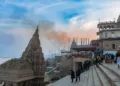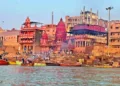
KASHI: Manikarnika Ghat in Varanasi is not only a riverside view along the Ganga, but it is also one of Hindu civilisation’s most sacred cremation grounds, carrying layers of belief, ritual practice and textual tradition accumulated over centuries. Any misrepresentation linked to this site resonates far beyond routine political contestation. Last week, one saw such a controversy unfold when misleading claims about a Mandir structure near the Kashi Vishwanath Corridor began circulating on social media. Administrative action and a wider debate on misinformation around Hindu religious sites is not happening for the first time.
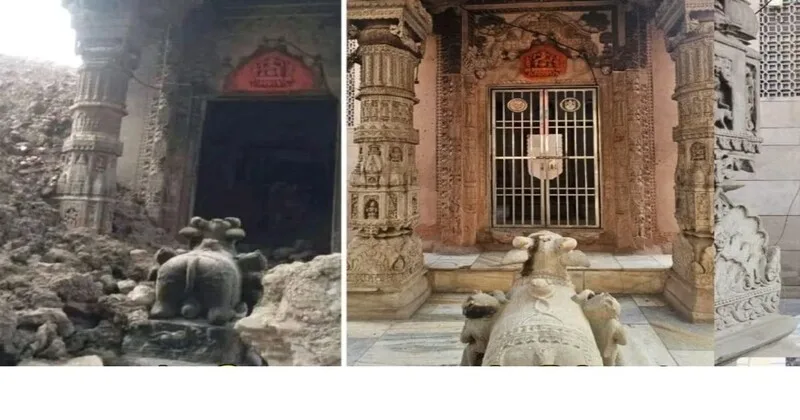
At the centre of the episode was the Kumbh Mahadev Mandir, an old shrine located within the Kashi Vishwanath Corridor area. Viral videos and posts claimed that this Mandir was situated at Manikarnika Ghat, implying that redevelopment work had altered or removed religious structures linked to the ghat. Official clarification and historical records have established that the Kumbh Mahadev Mandir is geographically and historically distinct from Manikarnika Ghat. The two sites serve different ritual purposes and have separate identities within Kashi’s sacred landscape.
According to police statements, the circulation of such content created confusion among devotees and risked disturbing public order in a city where religious sensitivities are deeply entrenched. Acting on its own cognisance, the Uttar Pradesh Police registered a case against unknown persons for spreading misleading information. Notices were later sent to eight people, including two Members of Parliament from the AAP party, Sanjay Singh and Congress leader Pappu Yadav, to record their statements at the Chowk police station in Varanasi. The police argued that any attempt to show that Kumbh Mahadev Mandir was part of Manikarnika Ghat would distort historical facts and mislead society.
The scenario has taken a political turn. Social media posts from some opposition politicians further fuelled public perception of the destruction of idols and the removal of Mandir structures in the name of redevelopment. The state government disputed this perception, saying that these were mere misconceptions arising from misidentified images.
UP Chief Minister Shri Yogi Adityanath had commented on the issue, stating, “Action will be taken against those who indulge in spreading lies regarding the Manikarnika Ghat and Kashi Vishwanath Corridor.” He also added that freedom of speech doesn’t give anyone the right to share misinformation, especially in religious places that can trigger someone’s feelings.
कांग्रेस द्वारा AI जनरेटेड वीडियो बनाकर मंदिर को तोड़ने का दुष्प्रचार फैलाया जा रहा है,
जबकि हर व्यक्ति जानता है कि मणिकर्णिका में जो मंदिर हैं, वे वहां पर वैसे ही मौजूद हैं… pic.twitter.com/DhUwMbJC1l
— Yogi Adityanath (@myogiadityanath) January 17, 2026
The opposition leaders, including the UP-Congress president Ajay Rai, have dared the government to prove its allegation by displaying the idols and artefacts to negate the charges of destruction.
https:/twitter.com/INCIndia/status/2012066115116245143?s=20
Regarding the Manikarnika controversy, Ajay Rai has also targeted RSS Sarsanghchalak Mohan Bhagwat, in an effort to expand the political discourse from administrative realities into the realm of ideas. Ajay Rai tried to translate the battle of misinformation into an ideological conflict in which administrative realities are less significant than the ruling ideas in the ecosystem of governance.
#WATCH | Lucknow, UP: On RSS Chief Mohan Bhagwat’s statement, President UP Congress, Ajay Rai says, "… If Mohan Bhagwat truly has such deep attachment to the Hindus, I request him to go to Manikarnika Ghat and apologise for the vandalism of the idol of Mata Ahilyabai Holkar,… pic.twitter.com/r8dGDKG3uS
— ANI (@ANI) January 17, 2026
Other political personalities from Congress, such as Pappu Yadav, also issued statements questioning the events as described by the government. The police actions were primarily centred on the factual issue involved here, namely the mistaken association between Kumbh Mahadev Mandir and Manikarnika Ghat.
बनारस के मणिकर्णिका घाट पर यह विध्वंस
महमूद गजनवी के असली अनुयायी मोदी ने कियाबनारस का इतिहास गौरव वहां के प्राचीन मंदिरों पर
बुलडोजर बाबर नहीं मोदी चला रहे हैंहर हर महादेव को बदल घर घर मोदी का नारा देने
वाला हिंदू सभ्यता का सबसे बड़ा दुश्मन है
अंधभक्तों आंख खोलो, सच देखो! pic.twitter.com/KHjLFHUJZ3— Rajesh Ranjan Pappu Yadav (@pappuyadavjapl) January 16, 2026
This incident may have political implications, but it also signifies the underlying problem with the digital age. Such short videos, cut-out images, and strategic quotes tend to function independently, with no linkages to place or time, spreading misinformation much more quickly than factual explanations. This becomes more dangerous when such misleading information is related to Hindu religious spots, since there are millions of people emotionally attached to them. This particular incident led people to believe, through repeating misinformation, that the Mandir situated inside this renewed zone had been connected with one of the holiest burning ghats of Hinduism.
The development of the Kashi Vishwanath Corridor itself has already been reported in official releases and architecture drawings. This is because it is apparent that the development was targeted at enhancing accessibility, regaining visibility for heritage buildings, and facilitating movement for devotees, rather than diminishing religious symbols. When misinformation is posted in cyberspace, it is difficult for correct information to reach similar levels of reach.
But this round of misinformation reminds us that to preserve our cultural and religious traditions, we must guard against harm not just to our tangible heritage but also to our narratives. Setting the record straight is not to stifle dissent or dissenting opinions, but to ensure that we discuss what is true. For places like Varanasi, where religion, history and reality are so intimately intertwined, this scenario must not arise again.
As seen in the instance of Manikarnika, the moment holy sites are used for viral politics, the truth tends to be the first casualty. Bringing truth back requires vigilance on the part of the administration and much more care for the truth in the public domain. Otherwise, talk of India’s religious legacy can never be rooted in truth and harmony.