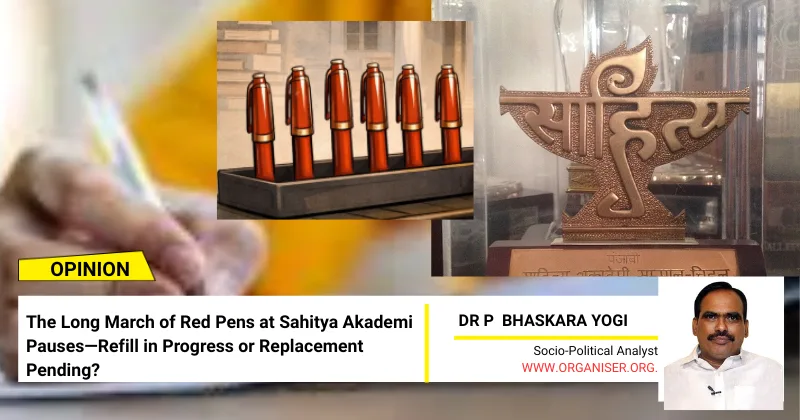
There is a Telugu proverb: “When the cat is blind, the mouse combs her whiskers.” The Central Sahitya Akademi today fits that image almost too perfectly. Recently, the Union government quietly put the annual literary awards on hold, citing the need for a review of processes and compliance with a new Memorandum of Understanding. Officially, it is described as a routine administrative pause. Unofficially, it reads like the first admission that the cat may finally be realising it has been blind all along.
For decades, an indulgent, hands-off approach from the Ministry at the Centre ensured that the institution meant to guard literary standards perfected the art of mischief instead. Oversight vanished, entitlement took charge, and the mouse not only combed the whiskers but began issuing certificates of grooming. The temporary freeze on awards, therefore, comes not as a bolt from the blue, but as a delayed acknowledgement of an ecosystem that has grown far too comfortable with itself.
For nearly seventy years, the Sahitya Akademi has lived by another familiar maxim: “Leaves for one’s own people, plates for others.” It has functioned like a one-eyed Shukracharya, dispensing wisdom selectively and justice sparingly. Even today, despite a decade of a nationalist government at the Centre, appointments to the Akademi continue to produce shockwaves in the literary world. The review now promised through a new MoU merely underlines what writers have long known: the faces may change, the procedures may be renamed, but the ideological bloodstream has remained stubbornly intact. Wherever one looks, the same old dens of red foxes appear to have been well prepared for any audit.
This stagnation appears even more ironic when set against the Akademi’s lofty origins. Conceived in 1944 through a proposal of the Royal Asiatic Society of Bengal, the idea was noble to the core: unify Indian languages, guide diverse literary traditions, and give equal dignity to Visual Arts, Performing Arts, and Literature. By 15 December 1952, the decision to establish the Central Sahitya Akademi had taken shape, and by 12 March 1954, it was inaugurated in New Delhi with ceremony and solemn promises.
The founding gallery itself reads like a roll call of modern India’s intellectual elite—Dr Sarvepalli Radhakrishnan, Maulana Abul Kalam Azad, C. Rajagopalachari, K. M. Munshi, Zakir Husain, Umashankar Joshi, Mahadevi Varma, D. V. Gundappa, among others, with Jawaharlal Nehru presiding.
Curiously, the elders of that time proposed that the appointment of the Chairman should be made not by the government but by an autonomous institution. Subsequently, along with a few other bodies, the Sahitya Akademi was reconstituted under the Societies Registration Act, 1860, and Nehru was placed in the President’s chair. It was here that the real knot was tied.
Nehru even declared that he was chairing the Akademi not as Prime Minister but as a poet and writer. The stated aims were clear: recognise creativity, nurture writers, encourage criticism, and serve literature rather than ideology.
Somewhere between those ideals and the present pause on awards, the knot was firmly tied. The decision to keep the Akademi formally “autonomous” slowly transformed autonomy into immunity. Presidents changed over the decades, committees reshuffled, guidelines rewritten, and now MoUs are being revisited—but the ideological muscle memory did not weaken.
After Nehru, the presidential chair continued its predictable journey, passing through Dr Sarvepalli Radhakrishnan, Zakir Husain, K. R. Srinivasa Iyengar, Umashankar Joshi, Virendrakumar Bhattacharya, U.R Ananthamurthy, Ramakanta Rath, Gopichand Narang, Sunil Gangopadhyay, Vishwanath Prasad Tiwari, Chandrashekhara Kambara, and Dr Madhav Kaushik, suggesting that while decades changed, the circle rarely did.
Notably, the Akademi has never had a woman President. Even when Mahasweta Devi contested in 2003, she lost—ironically, to a fellow traveller from the same left-liberal universe.
On paper, the Akademi still looks impressive. Seminars, conferences, fellowships, and awards the Sahitya Akademi Award, Bhasha Samman, Translation Award, Children’s Literature Award, Yuva Puraskar, along with journals such as Indian Literature and Samakaleen Bharatiya Sahitya, a vast multilingual library, and a calendar packed with national and international events. The only missing footnote, until recently, was an asterisk saying: subject to review. This quite footnote started speaking volumes.
Which brings us back to the uncomfortable question on how did such a distinguished body contract this chronic “red disease”? How did an institution meant to unify languages become a laboratory for Marxist monoculture?
The answer lies in how the Akademi has increasingly behaved like inherited property. Much like those who loudly swear that “India is my ancestral wealth”, the Akademi’s gatekeepers have long thumped tables and declared, “This is my domain.” General Councils and Executive Councils filled up with familiar names, awards circulated within closed ideological loops, and reputations were manufactured in-house. While the pause signals an intent to review the system, but history warn that the well-oiled machinery is unlikely to be disrupted for long.
Contrast this with the lives of poets who shaped Indian literature without safety nets, MoUs, or five-star cushions. Telugu poet Dhurjati could say, while being in the court of Krishnadevaraya, “Serving wicked kings is akin to hell.” Those who speak of another poet Pothana say that, being a cultivator, he declared he would not sell his pen and would not eat the “bread of subservience”. Garimella Satyanarayana Pandit, who thundered “We do not want White rule”, is said to have begged in the streets of Pandy Bazaar. It is impossible to recount the hardships faced by writers like Ravuri Bharadwaja. Many great poets died without even the fortune of seeing their works printed. An ocean of literature was lost quietly, without committees to “review” its absence.
Today’s Akademi elite, however, will not move without flights or air-conditioned coaches. Pens rest while boarding passes flutter. Five-star suits replace worn-out shawls. Working lunches are beneath notice; simple meals do not meet the dignity threshold. Even as the government speaks of compliance and transparency, the culture of comfort remains untouched. Budgets running into crores ensure that red ideological conviction is always well fed.
This patronage culture does more than reward mediocrity; it actively shapes the literature that is encouraged. Poems fashionable in their disdain for tradition, faith, and national memory are hailed as bold interventions, while dissent from this orthodoxy is dismissed as irrelevance.
For some time, certain people become members; they give awards to those they like within the circle. When they leave, they seat their favourites on the chair, like placing a handkerchief on a bus seat. One can receive awards, and later even “return” them. Of late, unless one returns an award, one is not counted at all. After 2012, this practice became even more pronounced through the Telugu Advisory Board. “Katyayani Vidmahe”, who received an award in 2013, still speaks in support of urban Naxalism. She belongs to the “return-the-award” batch. Those who once suppressed the lower castes now speak about Bhima Koregaon.
In the Telugu section, all of them have directors Vasireddy Naveen and Rachapalem Chandrasekhar Reddy. Fathers of free verse and grandfathers of haiku sing their praises. Those who truly yearn for literature do not receive these awards.
A so-called great scholar who wrote a novel insulting Draupadi received the Padma Bhushan, but what is wrong if Telugu people like Olga, Pingali Chaitanya, K. Siva Reddy, Papineni Sivasankar, Devipriya, Vallabhaneni, Velcheru Narayana Rao, or Nikhileshwar receive honours? An extreme Marxist poet like K. Siva Reddy will happily accept the “Kabir Samman” given by a government in Madhya Pradesh, while daily attacking the “nationalist” government for allegedly curbing freedom.
They write poetry about Punjab farmers as though they themselves cultivated fields in Hyderabad. They pour tears into verse over CAA and Kashmir. Astonishing! This is the frenzy of red poetry.
Awards and jury appointments are not crimes. But seventy years of ideological monopoly certainly is. Are there truly no nationalist poets, no rooted scholars, no thinkers outside the Left-liberal echo chamber? Or are they simply inconvenient when committees sit down to tick compliance boxes? When thousands of crores are spent every five years, not on discovering neglected voices but on preserving comfort and conformity, resentment becomes inevitable.
Perhaps the most revealing irony surfaced when a line attributed to Gurajada—“A nation is not soil; it is people”—was recently elevated as wisdom. Torn from context, it sits comfortably with the same literary ecosystem now awaiting procedural clearance to resume business as usual. History remembers that people once walked to the gallows chanting Vande Mataram, kissing the noose for the motherland. That contrast, too, requires no committee to review it.
India is the birthplace of many languages. No one can say when Panini lived. The Maheshwara Sutras born here are the wombs of all alphabets. From Kashmir to Kanyakumari, from Hatta to Cuttack, with 1,618 languages, 6,400 castes, 29 major festivals, and countless other celebrations and traditions, the Central Sahitya Akademi should have been a platform for a great yajna proclaiming unity in diversity. Instead, patronage bias, ideological hatred, and a Marxist mindset rule supreme.
If nationalist organisations do not wake up from their deep slumber immediately, and if the pause is lifted without real change, the skill of these red pens could wreak havoc on the nation within minutes, turning institutions like the Central Sahitya Akademi into a ballistic missile office.
What they write becomes scripture.
What they draw becomes the line.
What they give becomes the award.
What they pause becomes “process review”.
One may finally ask: is this a betrayal of language, or of literature itself? Are these merely institutional failures, or the silent tears of poets whose words never reached print? While manuscripts perish in floods, fires, and forgotten cupboards, the Akademi flits across cities, waiting for the green signal to resume.
A German anecdote tells of a poet who, when offered a statue funded by the state, replied that two dollars a day would suffice—he would come and stand there himself. Poverty, humility, dignity. Our Sahitya Akademi, by contrast, prefers statues of itself, cast in five-star comfort, briefly paused for inspection.
Until the blind cat truly learns to see, the mouse will continue to comb her whiskers—MoU or no MoU, review or no review—with confidence, comfort, and awards ready to roll again.