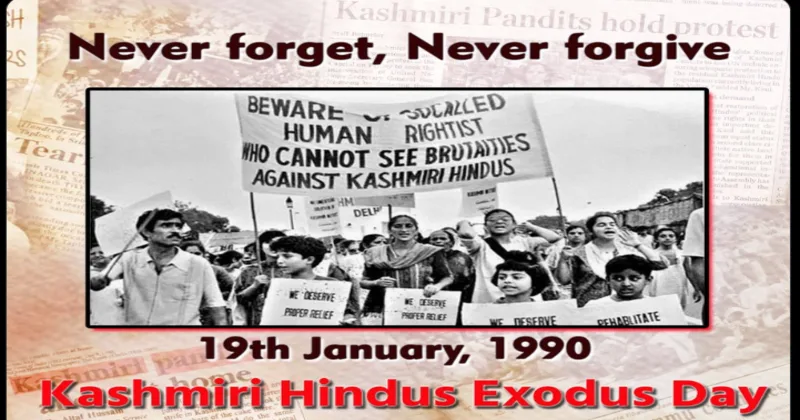
The night of 19 January 1990 marks a civilizational rupture in the post-Independence history of India, one whose consequences continue to shape the constitutional, moral, and political landscape of the Republic. On that night, the indigenous Kashmiri Pandit community, a religious and cultural minority with an unbroken presence in the Kashmir Valley for centuries, was subjected to an atmosphere of orchestrated terror that culminated in its near-total expulsion from its ancestral homeland. This was not a spontaneous breakdown of law and order, nor an incidental by-product of militancy. It was a targeted, identity-based displacement carried out through intimidation, selective killings, threats broadcast from public religious platforms, and the conspicuous withdrawal of the State from its most elementary constitutional duties.
The events of that night were preceded by a sustained campaign of fear. Prominent Kashmiri Pandit intellectuals, judges, lawyers, teachers, journalists, and public servants were assassinated with impunity. These killings were not random; they were messages, designed to signal that constitutional loyalty, secular public service, and minority identity were no longer compatible with survival in the Valley. By January 1990, slogans openly calling for expulsion and religious cleansing echoed across Srinagar and other towns. Law-enforcement institutions collapsed, intelligence warnings went unheeded, and the civil administration abdicated its responsibility to protect citizens equally. What followed was a mass flight, undertaken overnight, without preparation, documentation, or institutional support.
Within months, between three and four lakh Kashmiri Pandits had been displaced. Entire localities were emptied, homes abandoned, temples desecrated, libraries destroyed, and properties encroached upon or illegally transferred. Families arrived in Jammu, Delhi, and other parts of India with little more than the clothes they were wearing. Many lived for years in overcrowded refugee camps under extreme climatic conditions, inadequate sanitation, and persistent uncertainty. Children grew up without ever seeing their ancestral homes, while elders died in exile, severed from the land that had defined their identity, language, and cultural memory.
This displacement cannot be understood merely as a humanitarian crisis; it represents a profound constitutional failure. The Constitution of India guarantees equality before the law, freedom of religion, and the right to life with dignity. Indian constitutional jurisprudence has consistently held that the right to life under Article 21 extends beyond physical survival to include livelihood, cultural continuity, and social security. The forced displacement of an entire community, without protection, remedy, or restitution, constitutes a collective violation of these guarantees. The State’s obligation is not limited to refraining from harm; it includes a positive duty to protect citizens from non-state actors. That duty was breached, not momentarily, but systematically.
International legal standards reinforce this conclusion. The United Nations Guiding Principles on Internal Displacement, reflecting customary international law, affirm that internally displaced persons retain all rights of citizenship, that displacement must be prevented where possible, and that those displaced are entitled to safe, voluntary, and dignified return, along with restitution of property or adequate compensation. Despite these widely accepted norms, India has no comprehensive national framework governing internal displacement. There has been no truth commission, no independent judicial inquiry with a mandate to fix responsibility, and no coherent mechanism for property recovery. Policy responses have remained fragmented, ad hoc, and largely welfare-oriented rather than rights-based.
Over the decades, relief packages, employment schemes, and housing assistance have been extended, but these measures, while necessary, do not exhaust the State’s constitutional obligations. Rehabilitation without justice risks converting a grave constitutional wrong into a matter of administrative convenience. There has been no systematic prosecution of those responsible for targeted killings and intimidation, no institutional acknowledgement of failure, and no credible process of accountability. In the absence of truth and justice, relief becomes a substitute for restitution, and memory is reduced to ritual.
The question of return has often been invoked rhetorically, yet return cannot be symbolic or tokenistic. Meaningful reintegration requires enforceable security guarantees, restoration of property rights, community-based resettlement rather than isolated enclaves, and sustained judicial oversight. Comparative experiences from other post-conflict societies demonstrate that return without justice entrenches fear and perpetuates displacement in another form. For the Kashmiri Pandits, return is not merely about geography; it is about reclaiming dignity, citizenship, and the assurance that the Constitution applies equally, regardless of identity.
Remembering 19 January 1990 is not an exercise in grievance-keeping. It is an act of constitutional fidelity. A democracy that claims pluralism as a foundational value cannot afford selective memory. Identity-based displacement, whether religious, ethnic, or cultural, strikes at the core of constitutional morality. Silence, denial, or procedural minimisation does not preserve social harmony; it corrodes trust in the legal order.
More than three decades later, the displacement of the Kashmiri Pandits remains unresolved, not because solutions are unavailable, but because political and institutional resolve has been insufficient. Until truth is formally acknowledged, justice is credibly pursued, dignity is fully restored, and return is secured as a right rather than a concession, January 19, 1990, will continue to stand as an open wound in India’s constitutional conscience. It is not merely a tragedy of the past; it is an ongoing test of the Republic’s commitment to its own foundational promises.