Kashmir on January 19, 1990: Unfinished constitutional wound
June 30, 2026
  • Read Ecopy
  • Circulation
  • Advertise
  • Careers
  • About Us
  • Contact Us
Android AppiPhone AppArattai
Organiser
  • ‌
  • Bharat
    • Assam
    • Bihar
    • Chhattisgarh
    • Jharkhand
    • Maharashtra
    • View All States
  • World
    • Asia
    • Europe
    • North America
    • South America
    • Africa
    • Australia
  • Editorial
  • International
  • Opinion
  • RSS @ 100
  • More
    • Op Sindoor
    • Analysis
    • Sports
    • Defence
    • Politics
    • Business
    • Economy
    • Culture
    • Special Report
    • Sci & Tech
    • Entertainment
    • G20
    • Azadi Ka Amrit Mahotsav
    • Vocal4Local
    • Web Stories
    • Education
    • Employment
    • Books
    • Interviews
    • Travel
    • Law
    • Health
    • Obituary
  • Subscribe
    • Subscribe Print Edition
    • Subscribe Ecopy
    • Read Ecopy
  • ‌
  • Bharat
    • Assam
    • Bihar
    • Chhattisgarh
    • Jharkhand
    • Maharashtra
    • View All States
  • World
    • Asia
    • Europe
    • North America
    • South America
    • Africa
    • Australia
  • Editorial
  • International
  • Opinion
  • RSS @ 100
  • More
    • Op Sindoor
    • Analysis
    • Sports
    • Defence
    • Politics
    • Business
    • Economy
    • Culture
    • Special Report
    • Sci & Tech
    • Entertainment
    • G20
    • Azadi Ka Amrit Mahotsav
    • Vocal4Local
    • Web Stories
    • Education
    • Employment
    • Books
    • Interviews
    • Travel
    • Law
    • Health
    • Obituary
  • Subscribe
    • Subscribe Print Edition
    • Subscribe Ecopy
    • Read Ecopy
Organiser
  • Home
  • Bharat
  • World
  • Operation Sindoor
  • Editorial
  • Analysis
  • Opinion
  • Culture
  • Defence
  • International Edition
  • RSS @ 100
  • Magazine
  • Read Ecopy
Home Bharat

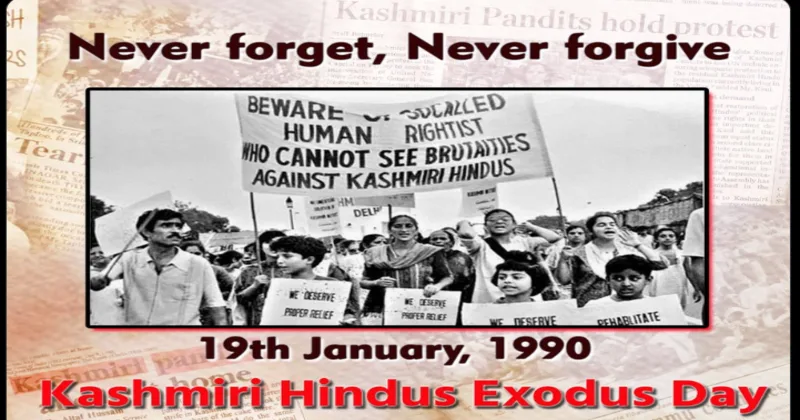
Kashmir on the night of January 19, 1990: An unfinished constitutional wound in India’s conscience

More than three decades after one of the darkest chapters in post-Independence India, January 19, 1990, continues to haunt the nation’s constitutional and moral conscience. On the Hindu Exodus Day, let us remember the way Kashmir Valley witnessed a systematic campaign of fear that led to the near-total displacement of the indigenous Kashmiri Pandit community — a centuries-old cultural and religious minority of the region

Advocate Rajesh GognaAdvocate Rajesh Gogna
Jan 19, 2026, 04:10 pm IST
in Bharat, Opinion, Jammu and Kashmir
Follow on Google News
Exodus of Kashmiri Hindus

Exodus of Kashmiri Hindus

FacebookTwitterWhatsAppTelegramEmail

The night of 19 January 1990 marks a civilizational rupture in the post-Independence history of India, one whose consequences continue to shape the constitutional, moral, and political landscape of the Republic. On that night, the indigenous Kashmiri Pandit community, a religious and cultural minority with an unbroken presence in the Kashmir Valley for centuries, was subjected to an atmosphere of orchestrated terror that culminated in its near-total expulsion from its ancestral homeland. This was not a spontaneous breakdown of law and order, nor an incidental by-product of militancy. It was a targeted, identity-based displacement carried out through intimidation, selective killings, threats broadcast from public religious platforms, and the conspicuous withdrawal of the State from its most elementary constitutional duties.

The events of that night were preceded by a sustained campaign of fear. Prominent Kashmiri Pandit intellectuals, judges, lawyers, teachers, journalists, and public servants were assassinated with impunity. These killings were not random; they were messages, designed to signal that constitutional loyalty, secular public service, and minority identity were no longer compatible with survival in the Valley. By January 1990, slogans openly calling for expulsion and religious cleansing echoed across Srinagar and other towns. Law-enforcement institutions collapsed, intelligence warnings went unheeded, and the civil administration abdicated its responsibility to protect citizens equally. What followed was a mass flight, undertaken overnight, without preparation, documentation, or institutional support.

Also Read: Looks like an airport, not a railway station: Banaras city railway station and its new avatar goes viral

Within months, between three and four lakh Kashmiri Pandits had been displaced. Entire localities were emptied, homes abandoned, temples desecrated, libraries destroyed, and properties encroached upon or illegally transferred. Families arrived in Jammu, Delhi, and other parts of India with little more than the clothes they were wearing. Many lived for years in overcrowded refugee camps under extreme climatic conditions, inadequate sanitation, and persistent uncertainty. Children grew up without ever seeing their ancestral homes, while elders died in exile, severed from the land that had defined their identity, language, and cultural memory.

This displacement cannot be understood merely as a humanitarian crisis; it represents a profound constitutional failure. The Constitution of India guarantees equality before the law, freedom of religion, and the right to life with dignity. Indian constitutional jurisprudence has consistently held that the right to life under Article 21 extends beyond physical survival to include livelihood, cultural continuity, and social security. The forced displacement of an entire community, without protection, remedy, or restitution, constitutes a collective violation of these guarantees. The State’s obligation is not limited to refraining from harm; it includes a positive duty to protect citizens from non-state actors. That duty was breached, not momentarily, but systematically.

International legal standards reinforce this conclusion. The United Nations Guiding Principles on Internal Displacement, reflecting customary international law, affirm that internally displaced persons retain all rights of citizenship, that displacement must be prevented where possible, and that those displaced are entitled to safe, voluntary, and dignified return, along with restitution of property or adequate compensation. Despite these widely accepted norms, India has no comprehensive national framework governing internal displacement. There has been no truth commission, no independent judicial inquiry with a mandate to fix responsibility, and no coherent mechanism for property recovery. Policy responses have remained fragmented, ad hoc, and largely welfare-oriented rather than rights-based.

Over the decades, relief packages, employment schemes, and housing assistance have been extended, but these measures, while necessary, do not exhaust the State’s constitutional obligations. Rehabilitation without justice risks converting a grave constitutional wrong into a matter of administrative convenience. There has been no systematic prosecution of those responsible for targeted killings and intimidation, no institutional acknowledgement of failure, and no credible process of accountability. In the absence of truth and justice, relief becomes a substitute for restitution, and memory is reduced to ritual.

The question of return has often been invoked rhetorically, yet return cannot be symbolic or tokenistic. Meaningful reintegration requires enforceable security guarantees, restoration of property rights, community-based resettlement rather than isolated enclaves, and sustained judicial oversight. Comparative experiences from other post-conflict societies demonstrate that return without justice entrenches fear and perpetuates displacement in another form. For the Kashmiri Pandits, return is not merely about geography; it is about reclaiming dignity, citizenship, and the assurance that the Constitution applies equally, regardless of identity.

Remembering 19 January 1990 is not an exercise in grievance-keeping. It is an act of constitutional fidelity. A democracy that claims pluralism as a foundational value cannot afford selective memory. Identity-based displacement, whether religious, ethnic, or cultural, strikes at the core of constitutional morality. Silence, denial, or procedural minimisation does not preserve social harmony; it corrodes trust in the legal order.

More than three decades later, the displacement of the Kashmiri Pandits remains unresolved, not because solutions are unavailable, but because political and institutional resolve has been insufficient. Until truth is formally acknowledged, justice is credibly pursued, dignity is fully restored, and return is secured as a right rather than a concession, January 19, 1990, will continue to stand as an open wound in India’s constitutional conscience. It is not merely a tragedy of the past; it is an ongoing test of the Republic’s commitment to its own foundational promises.

Topics: Kashmiri PanditsExodus of Kashmiri PanditsAssassination of Kashmiri PanditsUnited Nations Guiding Principles on Internal DisplacementHindu Exodus Day
Advocate Rajesh Gogna
Secretary General, Human Rights Defense International [Read more]
ShareTweetSendShareSend
✮ Subscribe Organiser YouTube Channel. ✮
✮ Join Organiser's WhatsApp channel for Nationalist views beyond the news. ✮
Previous News

Haryana: Several schools in Ambala receive bomb threats, authorities on high alert

Next News

Pakistan: Top Lashkar-e-Taiba commander Abdul Gaffar dies under mysterious circumstances

Related News

Hiralal Chatta

Remembering Hiralal Chatta on his death anniversary: The tenacious leader of the Kashmiri Hindus

Kashmiri Pandits at Kheer Bhawani Temple(File Photo)

J&K: Exiled Kashmiri Pandits throng temples amid enhanced security; Crowd peaks on Jyestha Ashtami at Kheer Bhawani

A representative image

J&K: Threat posters in Kashmir trigger fear, Kashmiri pandits seek urgent security measures

PM Narendra Modi

‘Herath Poshte!’ PM Modi celebrates Kashmiri Pandit heritage on Maha Shivratri

January 1990: Darkest chapter in the lives of Kashmiri Pandits

From threats to Erasure: What happened to Kashmiri Pandits

Representative image

Holocaust Day: ‘Homeland or demographic balance’ will only lead to resettlement of pandits in Kashmir

Load More

Latest News

Pakistan escalates airstrikes on Afghan territory

UN debunks Pakistan’s fake narrative & terror operation claim in Afghanistan: 29 civilians killed & not militants

The 1975 Emergency remains one of India's darkest chapters, marked by censorship, mass arrests, and widespread political repression

Emergency 1975: Harrowing stories of torture, mass arrests & resistance during India’s darkest democratic crisis

India has launched the Green Hydrogen Certification Portal to boost transparency and advance its clean energy mission

Green Hydrogen Certification Portal Launched: How India is building a transparent & self-reliant clean energy ecosystem

Prime Minister Narendra Modi and Seychelles President Patrick Herminie

PM Modi Gifts to Seychelles Leaders: Brass tortise, Kanchivaram silk, Todo embroidery reflect India’s artistic heritage

Uttar Pradesh Chief Minister Yogi Adityanath

How Uttar Pradesh Transformed Its Police Force: From one cyber thana to a statewide model of smart policing

US Ambassador to India Sergio Gor(File Photo)

Sergio Gor hints India-US trade deal; Dismisses Indo-Pacific renaming row, Hails India’s global rise & strong ties

Bengaluru court has summoned Priyank Kharge and Mohammed Nalapad in an RSS defamation case

RSS Defamation Case in Karnataka: Bengaluru court issues summons to Priyank Kharge, Mohammed Nalapad

Uttar Pradesh Chief Minister Yogi Adityanath

“Those who lathi-charged ‘people for chanting Jai Shri Ram now speak of ‘Ram Bhakti’: CM Yogi attacks SP, Congress

Army Field Hospital Deployed in Earthquake-hit Venezuela

Operation Amistad: India intensifies relief efforts in quake-hit Venezuela; Army hospital deployed as death toll spikes

A representative image

Exam paper controversies in India: 15 Anti-Hindu questions that triggered nationwide backlash between 2019 and 2026

Load More
  • Privacy
  • Terms
  • Cookie Policy
  • Refund and Cancellation
  • Delivery and Shipping

© Bharat Prakashan (Delhi) Limited.
Tech-enabled by Ananthapuri Technologies

  • Home
  • Search Organiser
  • Bharat
    • Assam
    • Bihar
    • Chhattisgarh
    • Jharkhand
    • Maharashtra
    • View All States
  • World
    • Asia
    • Africa
    • North America
    • South America
    • Europe
    • Australia
  • Editorial
  • Operation Sindoor
  • Opinion
  • Analysis
  • Defence
  • Culture
  • Sports
  • Business
  • RSS @ 100
  • Entertainment
  • More ..
    • Sci & Tech
    • Vocal4Local
    • Special Report
    • Education
    • Employment
    • Books
    • Interviews
    • Travel
    • Health
    • Politics
    • Law
    • Economy
    • Obituary
  • Subscribe Magazine
  • Read Ecopy
  • Advertise
  • Circulation
  • Careers
  • About Us
  • Contact Us
  • Policies & Terms
    • Privacy Policy
    • Cookie Policy
    • Refund and Cancellation
    • Terms of Use

© Bharat Prakashan (Delhi) Limited.
Tech-enabled by Ananthapuri Technologies