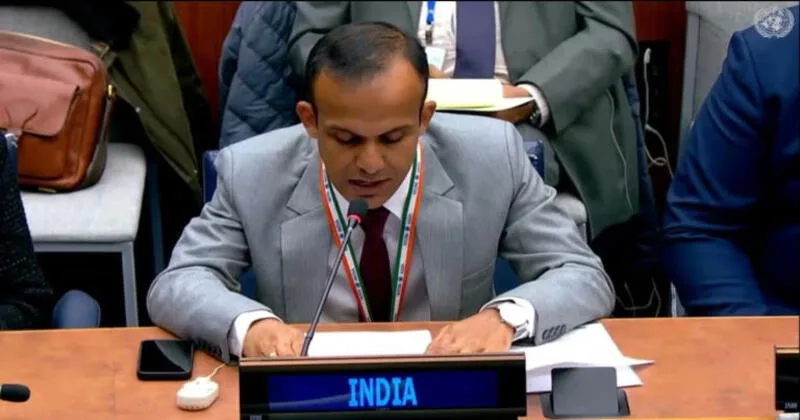
India called out Pakistan for misusing UN platforms to drive its “divisive agenda” after Islamabad’s envoy raised the issue of Jammu and Kashmir in the General Assembly. It is Pakistan’s established habit of time and again making some ill-founded statements at various world forums in its attempts to villify India. However, on this occasion, as has happened in the past, India’s response to Pakistan’s lies was measured, to the point and truthful.
A strong rebuttal was issued to Pakistan’s lies by Counsellor in the Permanent Mission of India to the UN Eldos Mathew Punnoose. In response to Pakistan’s unfounded claims, he said on January, 15, Thursday that the right to self-determination must not be abused to encourage secession in pluralistic and democratic states.
“At a time when member states have to rise beyond their narrow considerations, Pakistan continues to misuse all platforms and processes in the UN to drive their divisive agenda”, Punnoose said, demolishing Pakistan’s arguments. It is pertinent to mention here that for the past several decades, Pakistan has been responsible for large scale terrorism that plagued J&K in the past.
Spreading terrorism
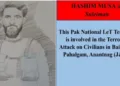
Its promotion of terrorist proxies and the resulting Pahalgam attack by a group called The Resistance Front (TRF) had led to Operation Sindoor in May 2025. During this kinetic action, India had specifically targeted at least nine terrorist group assets like buildings using precise ammunition. These attacks were meant to
Later, Pakistan has tried to escalate by trying to harm some military assets in India and this had led to a fiery retaliation which included the use of Russian S-400 missile systems and the superbly efficient Brahmos missiles.
“This forum is no exception either and Pakistan made an unwarranted reference to the Union Territory of Jammu and Kashmir, an integral and inalienable part of India”, Punnoose said, while delivering the national statement at the UN General Assembly Plenary on ‘Report of the Secretary-General on the work of the Organisation’.
“The right to self-determination is a fundamental principle enshrined in the UN Charter. However, this right must not be abused to encourage secession in pluralistic and democratic states. Though habituated, Pakistan would do well if they do not resort to baseless allegations and falsehoods and portray a picture that is completely detached from reality”, he said.
Permanent falsehoods
It bears mention here that time and again, Pakistani delegates try to promote this falsehood that people in J&K have been denied the right of self-determination. It has been India’s consistent stand that these people have all the rights guaranteed to all Indian citizens living anywhere in the country. Like all other citizens, the people of J&K participate in periodic elections.
Not only for the Union Territory (UT) of J&K, people also participate in elections held for electing representatives of Parliament of India, both the Lok Sabha and the Rajya Sabha. Like people of other states of the Indian Union, the people also participate in three-tier panchayat elections.
The strong retort by India came after Permanent Representative of Pakistan to the UN Ambassador Asim Iftikhar Ahmad made a reference to Jammu and Kashmir in his remarks in the General Assembly. One wonders whether there is something wrong in the name Asim itself as one has seen in case of failed, sorry Field Marshall Asim Munir.
Endless propaganda
It needs to be pointed out here that the word Asim (or Aasim, Assim) has Arabic origin which means protector, guardian or defender. Pakistan as a state takes this meaning literally to consider itself a guardian and protector of all terrorists working against India. Whether Hafiz Saeed of Lashkar e Taiba (LeT) of Maulana Masood Azhar.
Aseem, on the other hand, is of Sanskrit origin which means unlimited, boundless, infinite or limitless. Pakistan takes this word seriously and posts people like Asim Ahmad to UN as they are capable of telling infinite or limitless lies at every forum.
Incidentally, Pakistan repeatedly raises the issue of Jammu and Kashmir at the United Nations and its various platforms but fails to get any traction from the wider international community on the matter. It had also raised the issue a couple of times at Organisation of Islamic Countries (OIC) forum framing it falsely as an issue of violation of human rights. However, it had failed in all such attempts.
At the UN, Punnoose, in his remarks, also stressed that the Global South has its unique set of developmental challenges that cut across development financing and climate justice and financing, among other areas.
Global South
Punnoose, in his remarks, also stressed that the Global South has its unique set of developmental challenges that cut across development financing and climate justice and financing, among other areas.
“India has consistently endeavoured to bring these to the forefront across all UN platforms. Concerted and focused follow up action is required on this front. Moving forward, there is a need to translate the sentiments of the Global South to concrete and tangible steps,” he said.
As the UN membership takes stock of the past, it is important to reflect upon the current context and the way ahead for the largest multilateral organisation, the United Nations. “United Nations is going through a crucial phase, as it faces various critical challenges. World citizenry expects the UN to deliver on each of the three pillars – peace and security, development and human rights,” he said.
India emphasised that UN’s inability to purposefully intervene on its critical functions leads to questions related to efficacy, legitimacy and credibility. “This is quite pronounced in case of maintenance of international peace and security. As conflicts rage across different parts of the globe, the world hopes the UN to deliver, to put an end to human suffering and misery”, Punnoose reiterated.