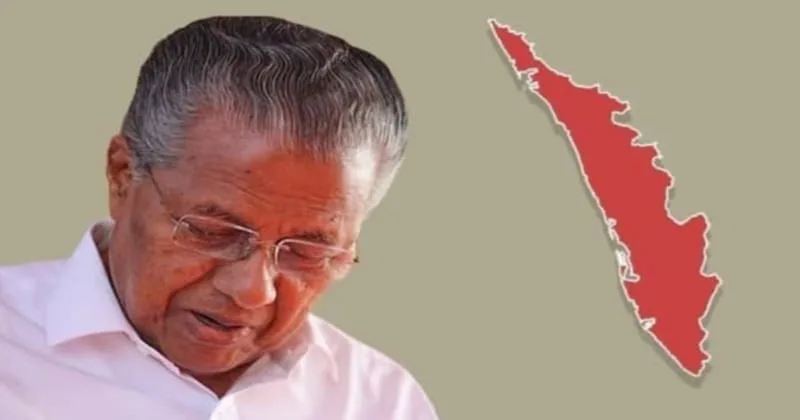
Thiruvananthapuram: Kerala has emerged as the state with the highest inflation in the country for the twelfth consecutive month, reinforcing growing concerns over the rising cost of living and the state’s economic management. While retail inflation at the national level rose modestly to 1.33 per cent in December, up from 0.71 per cent in November, Kerala recorded a staggering 9.49 per cent, sharply higher than its 8.27 per cent inflation rate in the previous month. The gap between Kerala and the rest of the country is striking. Karnataka, which stands second in the inflation ranking, reported a retail inflation rate of just 2.99 per cent. Other large states recorded even lower figures, underscoring how isolated Kerala’s inflation problem has become.
The Reserve Bank of India has consistently stated that maintaining inflation at around 4 per cent is desirable for the Indian economy. Even inflation levels up to 6 per cent are considered manageable and non-threatening to economic stability. However, Kerala has exceeded this upper tolerance limit for several months, with inflation continuing to surge rather than stabilise. Since January 2025, Kerala has remained the highest inflation state in India, a distinction that has now become entrenched. Retail inflation measures the year-on-year increase in the prices of goods and services consumed by households, particularly essential items such as food, fuel, clothing, healthcare, and transport. In comparison to Kerala’s figures, Andhra Pradesh, which ranks third nationally, recorded inflation of only 2.71 per cent, followed by Tamil Nadu at 2.67 per cent and Jammu and Kashmir at 2.26 per cent. At the other end of the spectrum, several states are experiencing negative inflation, indicating either price stability or deflation. Bihar (-1.37 per cent), Assam (-1.25 per cent), Haryana (-0.10 per cent), Madhya Pradesh (-0.25 per cent), Odisha (-0.99 per cent), and Uttar Pradesh (-0.66 per cent) have all reported significantly lower or negative inflation rates, highlighting the exceptional nature of Kerala’s price rise.
NABARD funds lapse as state blames centre for financial strain
Amid rising inflation, a parallel crisis is unfolding in the state’s development financing. While the Kerala government continues to allege that the central government is cutting funds, official records reveal that Rs 685 crore out of Rs 900 crore allocated by the National Bank for Agriculture and Rural Development (NABARD) has not been utilised by state departments.
The Chief General Manager of NABARD has formally written to the state Finance Department, warning that unless the unutilised amount is drawn immediately, the funds will lapse. Following this, Additional Chief Secretary (Finance) K.R. Jyothilal instructed heads of departments to urgently complete procedural steps to claim the funds. However, officials now concede that due to delays and stalled schemes, only a small portion of the remaining Rs 685 crore is likely to be received in the coming days.
NABARD had sanctioned these funds for a wide range of critical development projects. These include the formation of a Rapid Response Unit under the Forest Department, infrastructure development works, distribution of solar-powered irrigation pumps under the Agriculture Department, irrigation and canal renovation projects, restoration of paddy fields and ponds, multiple initiatives under the Social Justice Department, establishment of smart agricultural houses in 12 districts, and projects aimed at preventing human-wildlife conflict.
Additional allocations were made for the construction of bridges, the establishment of agricultural storage godowns, and waste management projects under the Local Self-Government Department. All these projects were required to be completed and billed by December 21.
However, despite the generous allocation, departments managed to submit bills worth only Rs 215 crore. Some departments failed to initiate projects altogether. After repeated reminders went unanswered, NABARD finally issued a formal warning letter. The explanation offered by departments was that the rush related to local body elections prevented timely execution and billing.
BJP targets state government over fiscal mismanagement
The opposition Bharatiya Janata Party (BJP) has seized upon both the inflation figures and the NABARD fund lapse to mount a sharp political attack on the state government. BJP state president Rajiv Chandrasekhar accused the ruling dispensation of incompetence and misleading the public by blaming the Centre for its own failures. Addressing a press conference, Chandrasekhar said that the central government “is not a cooperative bank that releases money whenever it is demanded without accountability.” He pointed out that during the UPA regime, when the CPM supported the Centre, Kerala received only Rs 72,000 crore, and no mass protests were organised then. In contrast, under the NDA government led by Narendra Modi, Kerala has received Rs 3.2 lakh crore, yet protests have intensified.
According to Chandrasekhar, the issue is not about protesting against the Centre but about presenting accurate data and governing efficiently. He said the Chief Minister must convince the people with facts rather than rhetoric. The BJP leader was responding to Chief Minister Pinarayi Vijayan’s satyagraha, which alleged denial of funds and loan sanctions by the Centre.
Chandrasekhar laid out a grim picture of the state’s finances over the past decade. When the Pinarayi Vijayan government came to power ten years ago, Kerala’s public debt stood at Rs 1.4 lakh crore. Today, it has risen to Rs 5 lakh crore. Including central assistance, the state has received around Rs 7 lakh crore, and when its own revenue is added, total resources exceed Rs 10 lakh crore.
Despite this, Chandrasekhar claimed that Kerala now leads the country in unemployment, estimated at 30 per cent, and inflation. He cited social indicators to argue that governance has failed: 52 lakh people lack access to drinking water, 5.5 lakh families do not have houses, and 45,000 people still live in huts, even after repeated government assurances and permissions.
He further noted that while the state’s debt has tripled, the Gross State Domestic Product (GSDP) has increased only twofold. Alarmingly, 92 per cent of government expenditure goes towards revenue spending and interest payments, leaving just 8 per cent for capital expenditure and development. “If debt continues to rise at this pace, who will repay it? The burden will fall on future generations,” he warned.
Recalling a statement made by Pinarayi Vijayan in 2015, when he told the then Congress Chief Minister, “If it is easy, you should resign”, Chandrasekhar said those words now apply to Vijayan himself. He accused the Chief Minister of spreading falsehoods to hide administrative failures and divert public attention. “The BJP will demolish this palace of lies with facts,” he asserted.